Close
Two rolls72 framesOne Story

Women’s Euro 2025 Finals

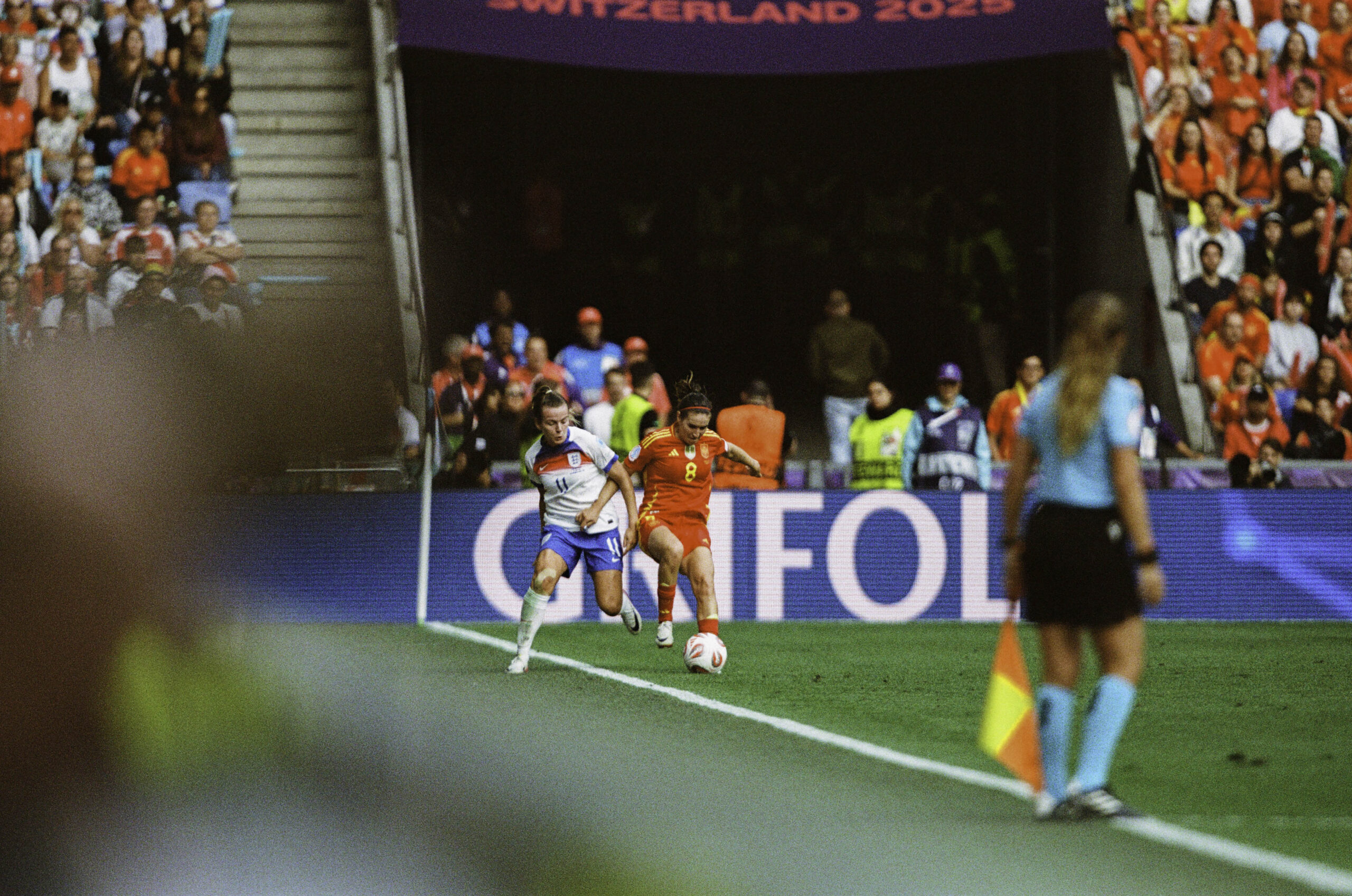
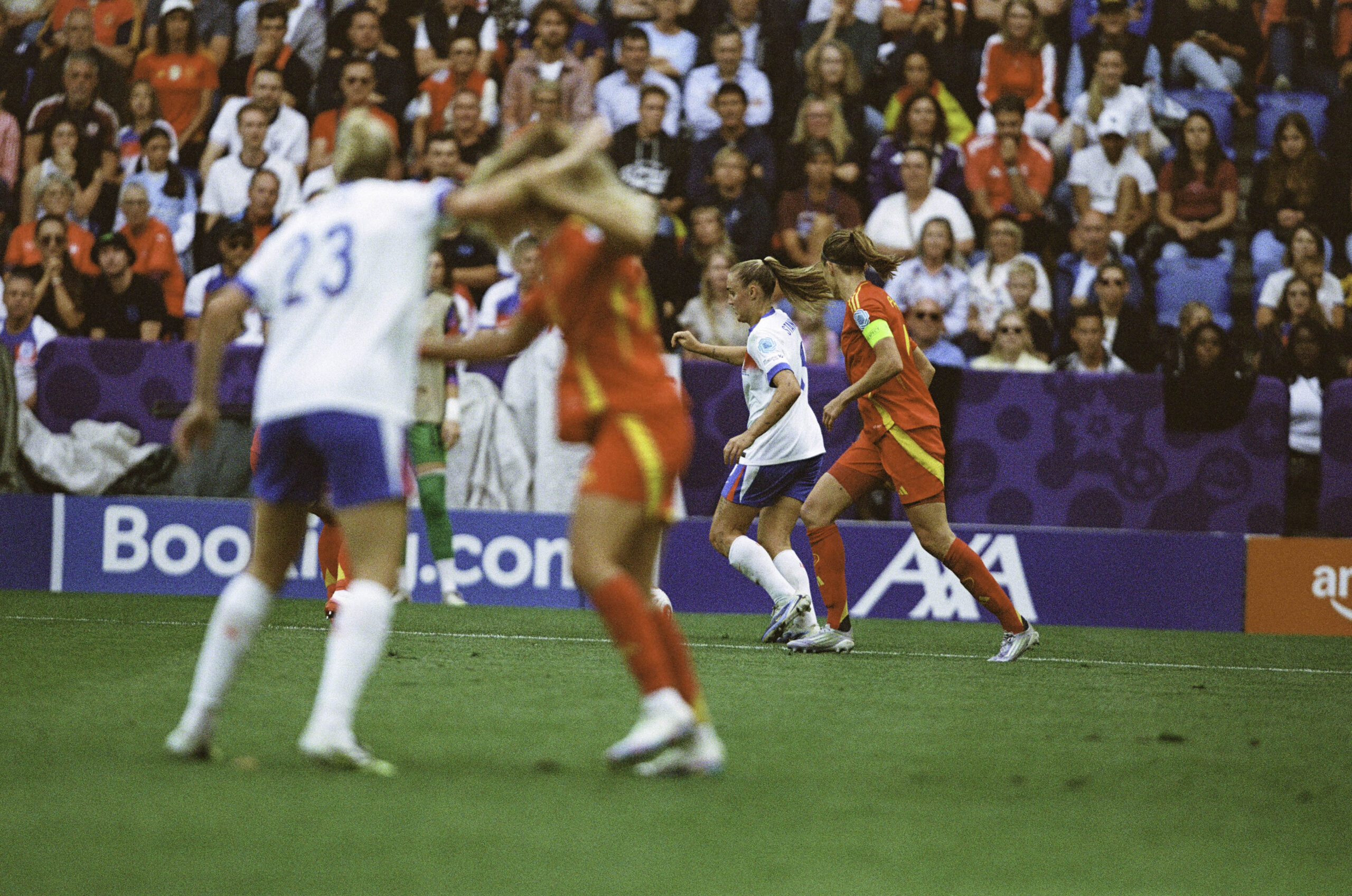
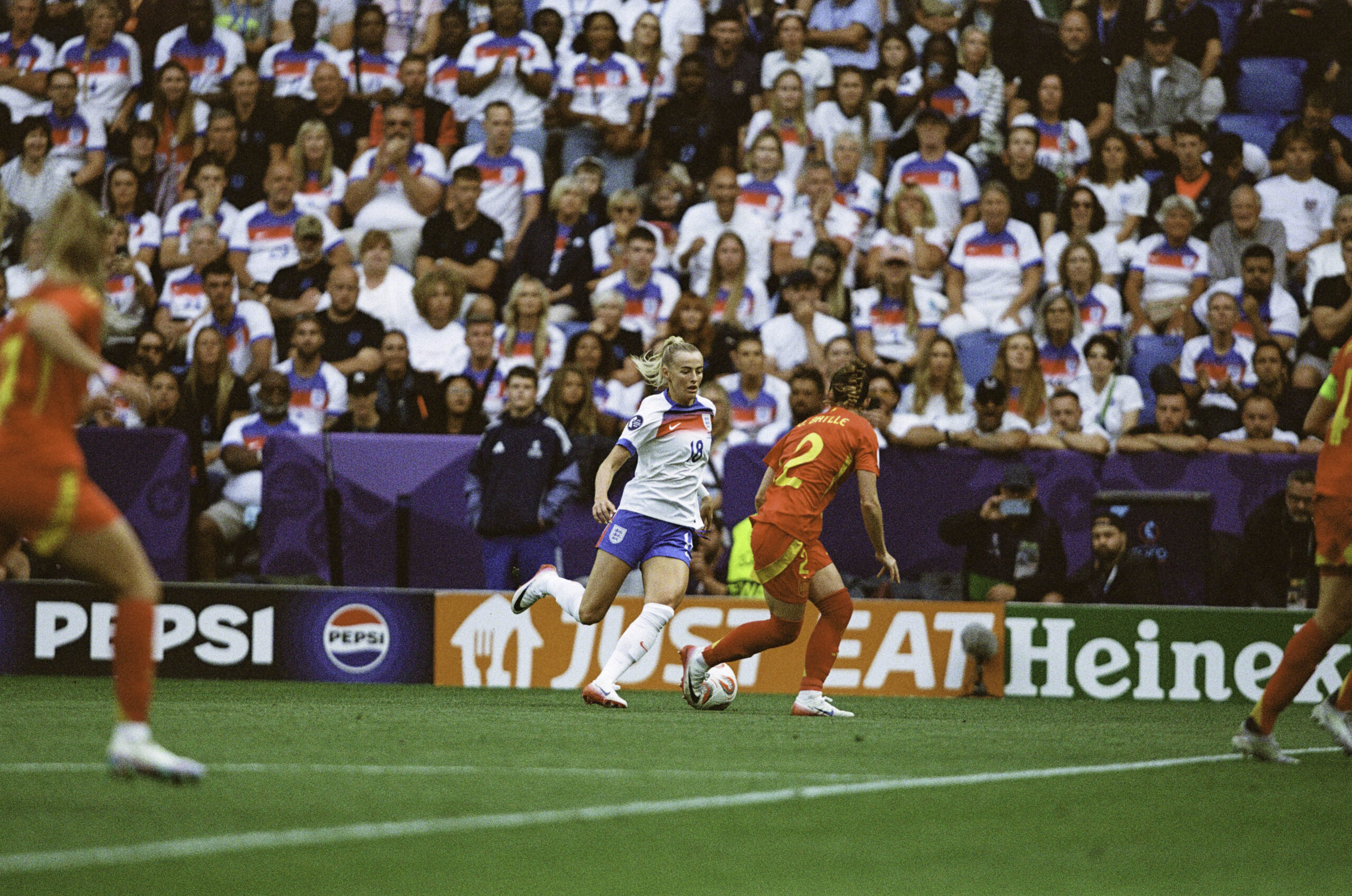
Final night, two rolls, seventy‑two chances – nothing more. I traded speed for intention, letting limitation steer the lens. What follows isn’t polished; it’s honest. Every frame, a fragment of the women’s game, wired straight from film grain to you. Scroll down the page, feel the stadium breathe.

Intro

Storm Breaks, Story Rolls Forward

I shot fourteen matches at the Woman’ Euro 2025 and now I have one goal: tell a month‑long tournament in the finals with just seventy‑two frames.
Most days I lean on a mirrorless monster that spits forty RAWs a second. You shoot, chimp, crop, caption, send – while agency heavyweights send their data straight via LAN to remote editors who retouch from air‑conditioned bunkers. Blink and their images are live; mine are still buffering on stadium Wi‑Fi.

So, I decided to play a different game.

Two rolls of Kodak Portra 800, meter‑cheated to 1250, pushed to 1600 ISO in the tank. Scanned on a Noritsu HS‑1800 to pull every whisper out of the shadows. Nothing here is trimmed or disqualified: soft focus stays, crooked horizons stay, messy framing stays. The constraint is the point.

The pictures carry the weight, but they’re only half the language. Each earns dedicated paragraphs of words – context, texture, the off‑mic chatter you can’t see.

Sunday, 1:45 p.m. Basel time. I’m four hours early for the final, perched on the tailgate of my Land Rover while a summer storm cleans the air outside. First roll clicks into a thirty‑five‑year‑old Canon EOS‑1, paired with a slightly younger 35‑350 mm workhorse. For sharper bursts I’ll swap on the 400 mm f/2.8, but most of the story will ride that dim zoom—f/3.5 wide open, f/5.6 when it tightens.

Rain quits. The parking‑lot asphalt steams in the sudden sun. The strap bites my neck – good. Means the camera’s loaded, and excuses are over.

Pre

Chaos Fuels The Oiled Machine
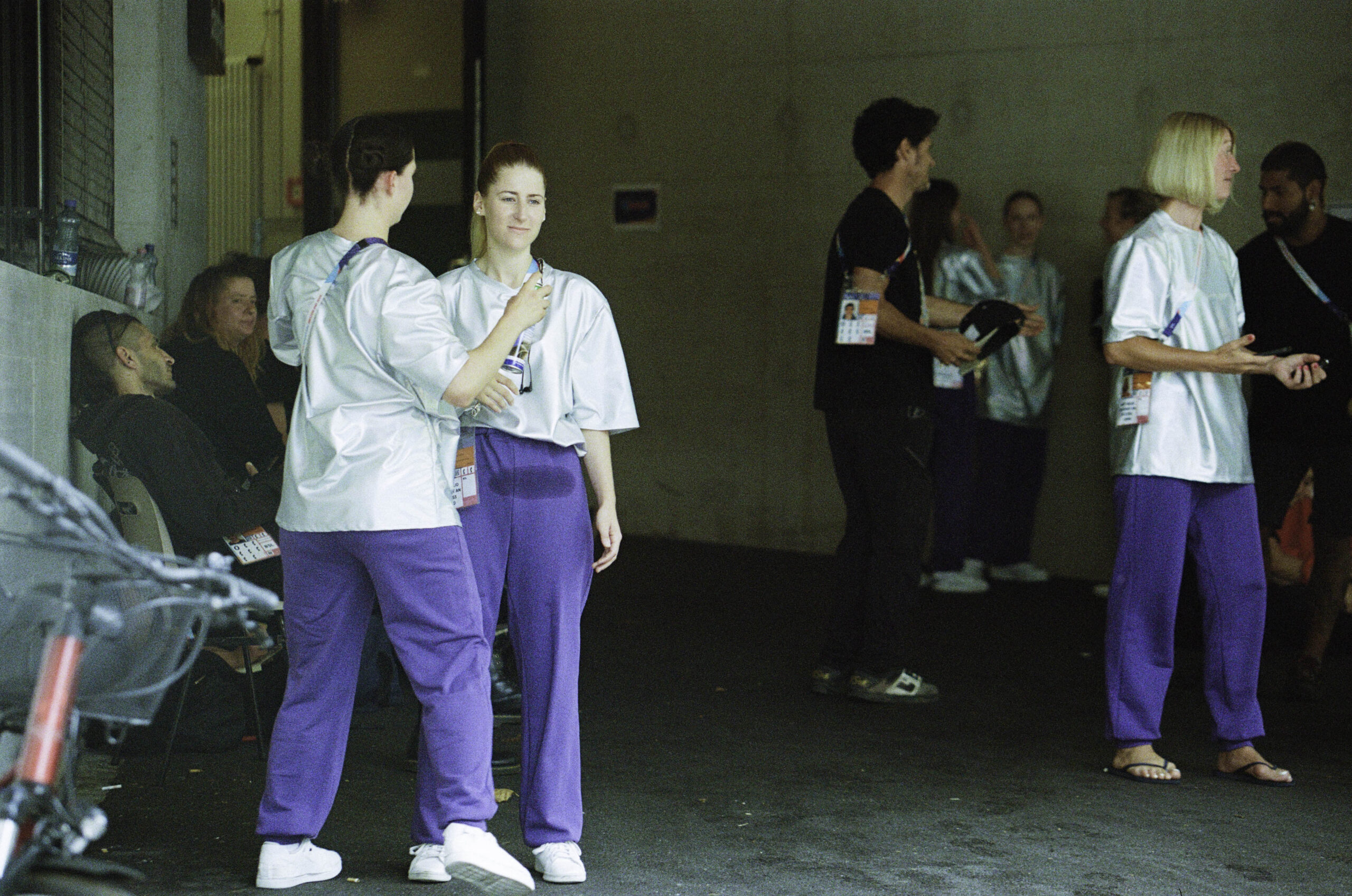
The walk from the parking garage to accreditation funnels past the volunteer hub – a concrete throat where anyone without a VIP badge pauses, re-stows gear, and pretends not to stare. I swing through fast, ISO already climbing, trying to look invisible. One reflex-shot: two silver-shirted dancers, purple sweats pooling at their sneakers, fussing with each other’s ponytails like sisters before prom. Far right, a blond colleague discusses with someone out of the frame; deeper in, two guys practice a juggling routine with their caps and balls.

It’s a brief, humming corridor – more back alley than backstage – but this is where the show starts. Volunteers corral cables, steer VIPs, rest, eat, coordinate. If they vanished, kickoff wouldn’t, and the sell-out crowd would never know why.

Truth: I missed the clean frame. Composition leans left, depth’s a little muddy. On digital I’d chimp, reshoot, maybe crouch lower, maybe wait for symmetry. Film says: you get what you get, move on. The stumble is baked into the record. And maybe that’s fair: volunteers rarely earn perfect focus either, yet the match cannot begin without them.

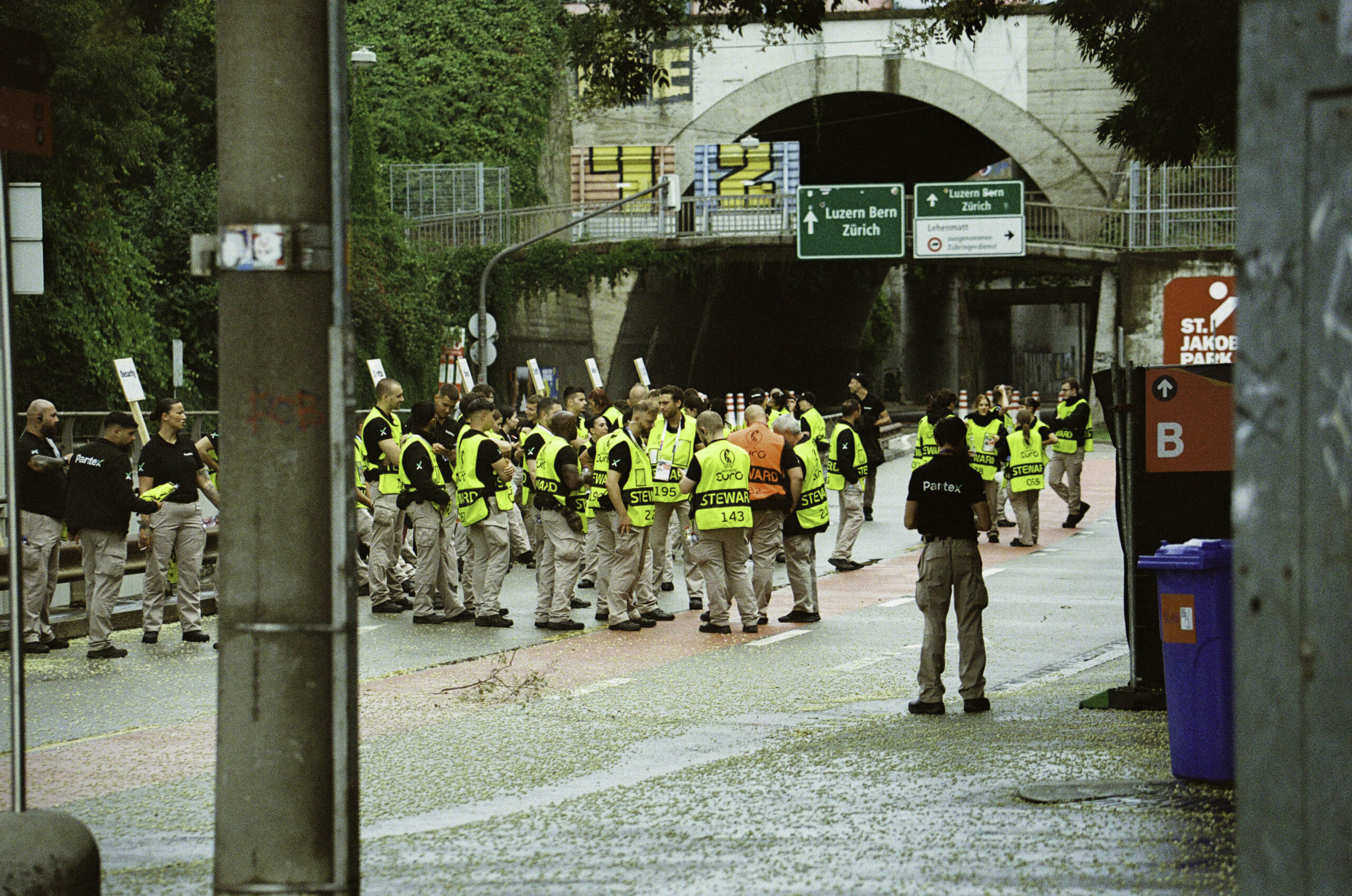
The thunderstorm left confetti: shredded blossoms, a snapped twig, a film of rainwater that turns the road slick and green. In the middle of it, a platoon of stewards clusters beneath highway signs pointing to nowhere because every lane is sealed. Neon yellow vests, barcode IDs, radios clipped where a backbone should be. They joke, fidget, lean on each other’s shoulders like regular people. In a few minutes they’ll harden, backs to the pitch, eyes scanning the crowd for flares, beer showers, the stray heart attack. We’ll never know if they steal a glance when the first goal rattles the net.

Ahead, the street dives into a dark underpass. That’s where the fans will surge through, chanting, phones glowing. For now, it’s a damp echo chamber, filling slowly with nerves. The game hasn’t started; the rules already have.

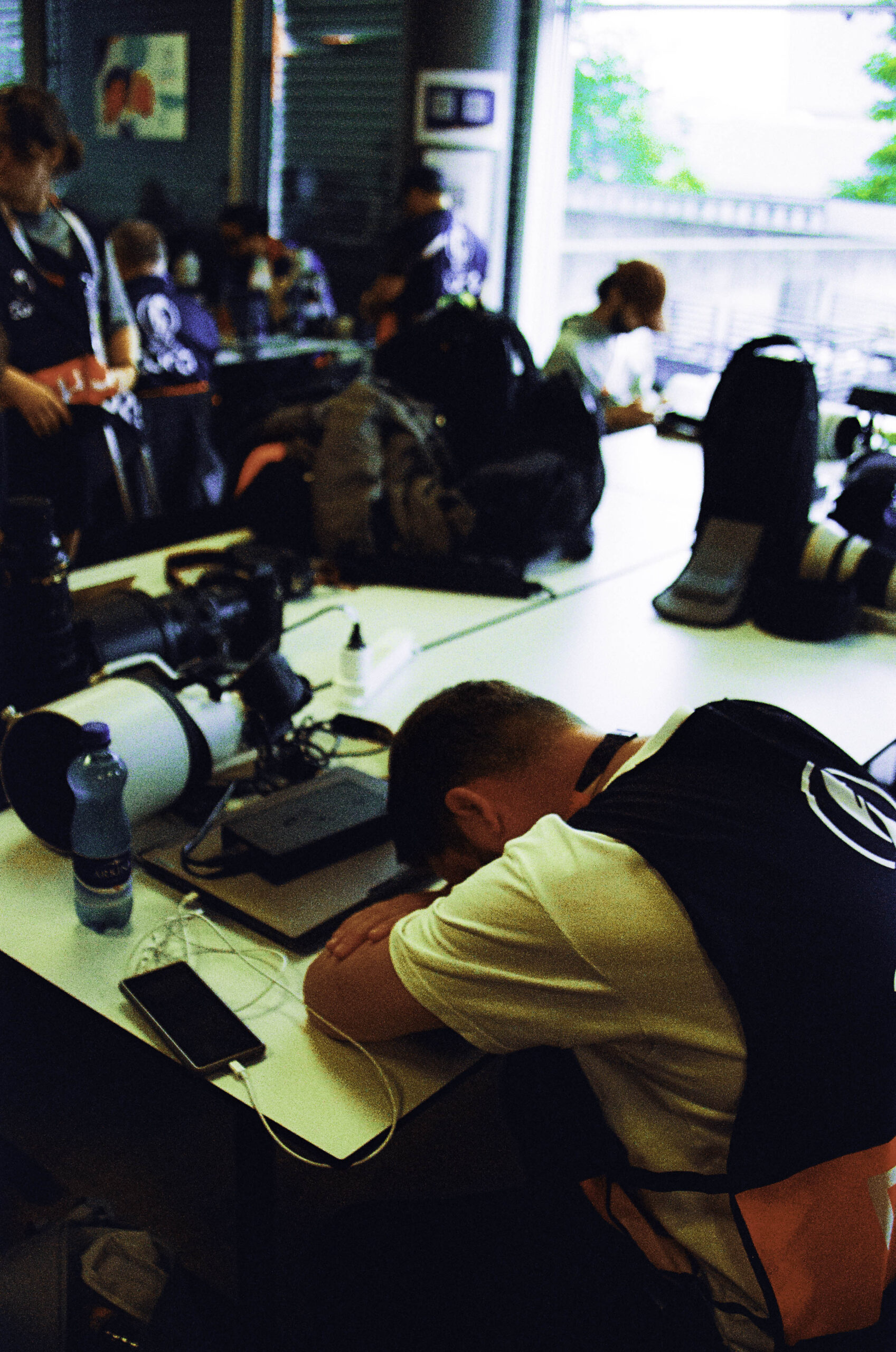
The media room smells like body heat and today’s catering trays. 14:30 o’clock – a colleague folds onto his forearms, face pressed to the laminate. A 400 mm cannon rests in front of him, phone leeching power from a brick the size of a paperback. Four minute micro nap: screen dark, brain darker, wake on the next Slack ping.

Tournament math: twelve night matches, bed by two thirty if traffic behaves, four thirty if it snarls. Some nights I skip sheets entirely, reclining the car seat outside a 24 hour gas station and dreaming in JPEG thumbnails. Permanent jet lag sets in; noon feels like 3 o’clock Caffeine becomes both ally and tax collector.

Then the whistle blows – adrenaline detonates, shutter counts rocket north. The crash waits until the press feed clears and the last confetti is swept into black bags. Until then we sleep where we can: behind LED boards, on concrete steps, or face down on a laptop still exporting.

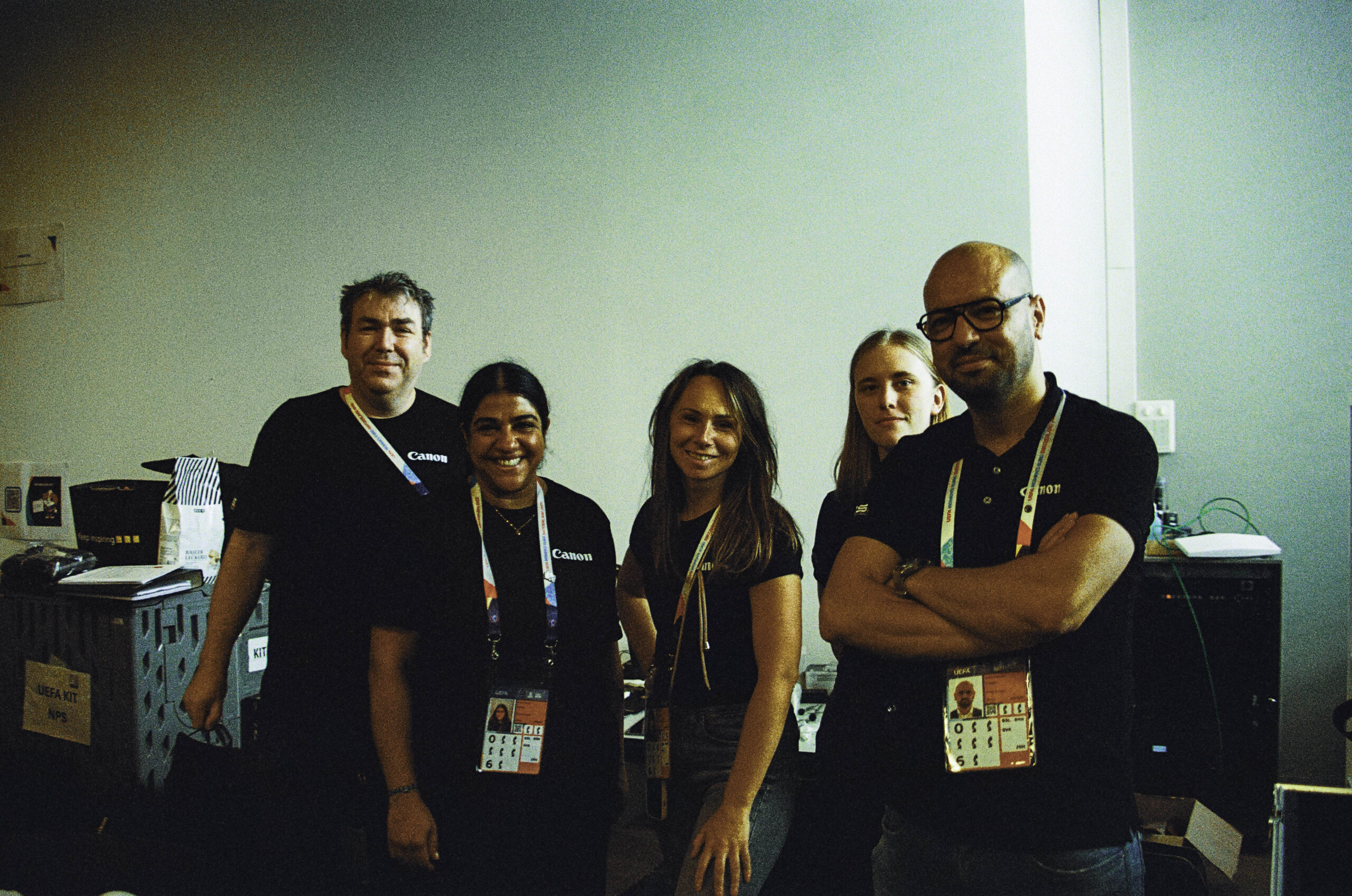
The Canon Professional Services crew huddles for a photo, backs to a wall of labeled kit crates and tiny workbenches. They look loose, but their shift started before the stewards’ first briefing and won’t end until the last photographer hits Send. CPS is the pit crew we don’t deserve: wiping stadium grit off sensors, recalibrating skittish autofocus modules, swapping cracked lens collars – cracking one‑liners while the queue thickens behind you.

Their loan desk is photographer heaven. Need a spotless flagship R1 because your ten‑year‑old backup just coughed up an error? A fresh body appears. Fancy the new 100‑300 mm f/2.8 – price of a family car? No paperwork; your accreditation QR-code is enough. One late group‑stage night I lumbered back to the field with roughly 22 000 CHF in borrowed glass slung across my chest, gratis and drama‑free.

CPS runs on caffeine and adrenaline, first in, last out, polishing lenses while the floodlights cool overhead. If your shutter curtain sticks or your 70‑200 starts grinding, they step in – quietly rescuing half the tournament’s images. Nikon and Sony field equally devoted teams, sure, but after thirty Canon years these faces feel like family: the unseen co‑authors of every frame you’re about to scroll past. And yes – every one of my own bodies and lenses left their table cleaner than it arrived.

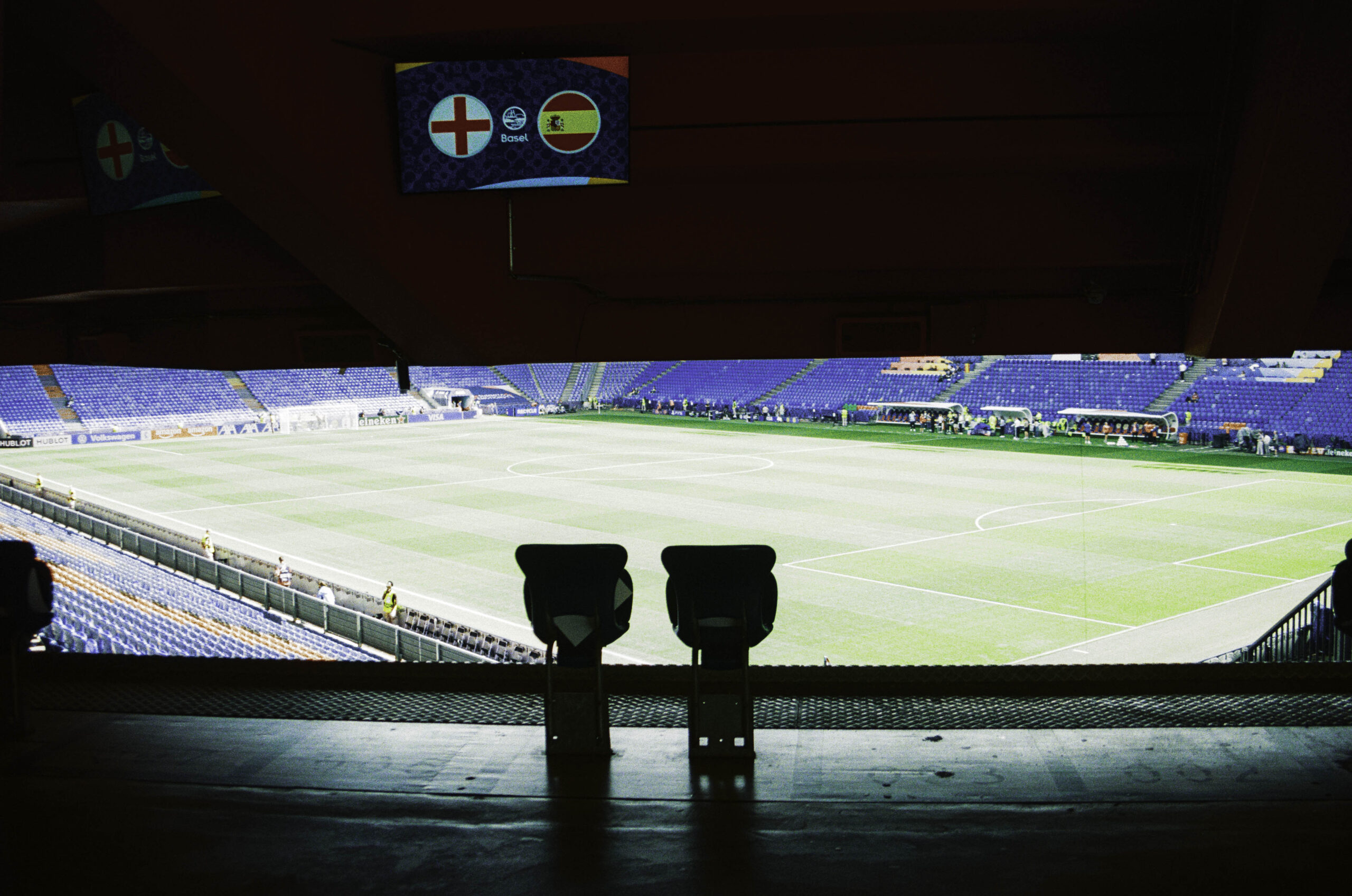
Two seats sit high above touch  line level, lit by striping sunlight that hasn’t yet noticed the coming sell out. They look like VIP chairs – extra legroom, unobstructed sightline, a private TV overhead showing the simple clash: England vs. Spain. But the nameplates read differently: Companion. These spots are reserved for the friends, partners, or parents who guide wheelchair users through the maze of ramps and elevators, hold ponchos when rain ambushes, and angle cameras so the keeper isn’t blocked by a railing.

They’ll never lift a trophy or see their faces on the jumbotron, but they track every substitution, fetch every halftime beer, and cheer twice as loud because they’re cheering for two. For now, the seats wait in silence, shadows cooling the plastic. In ninety minutes, they’ll carry the quiet heroes who make full stadium access more than a slogan—and who’ll spend ninety minutes watching, explaining, celebrating, never once thinking of themselves as the reason this view exists.

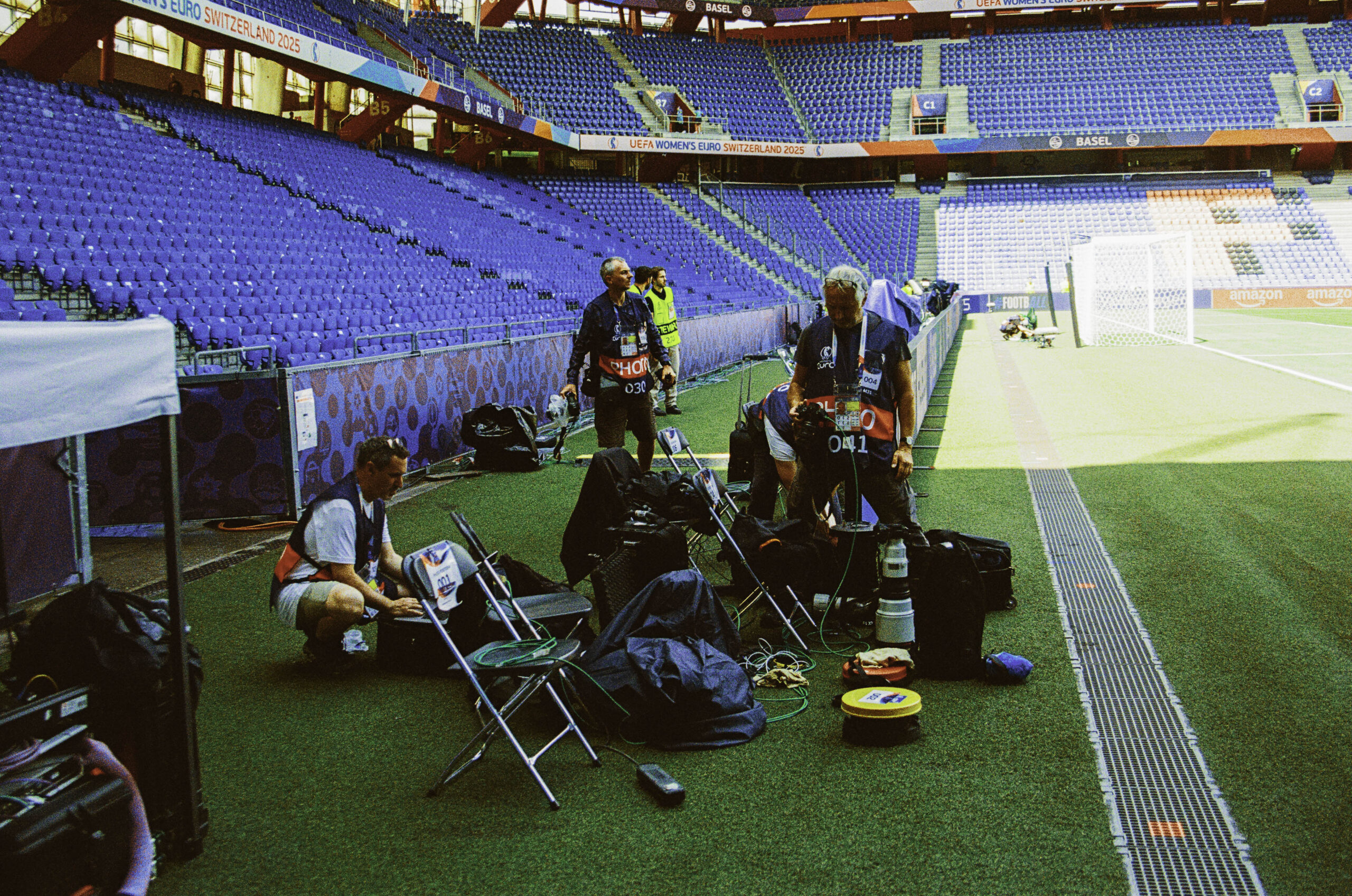
Sixteen hundred hours, two before kick off, and the goal line feels like a pop up repair bay. One snapper crouches over his laptop, Ethernet cable locked into the venue switch, flooding Speedtest with packets – making sure the LAN will cope when every agency server starts vacuuming RAWs. Ten meters away, another photographer kneels in a sun slashed rectangle, anchoring a remote body behind the net: sensor cleaned, cable routed, rain sleeve cinched – ready to face ninety minutes of studs, shins, and ricochets. Tripods stand like sentries, pelican cases gape, long whites hide under black ponchos waiting for the clouds to remember the forecast. The bright yellow discs scattered on the turf aren’t cable reels at all but collapsible stools, flattened so nobody face plants during the sprint to position. Hydration comes in plain water bottles stacked by volunteers just out of frame. Nothing here is pre focused, only pre checked – shutter counts, redundant cards, failsafes against the chaos that will hit the instant the first whistle cuts through the empty seats.

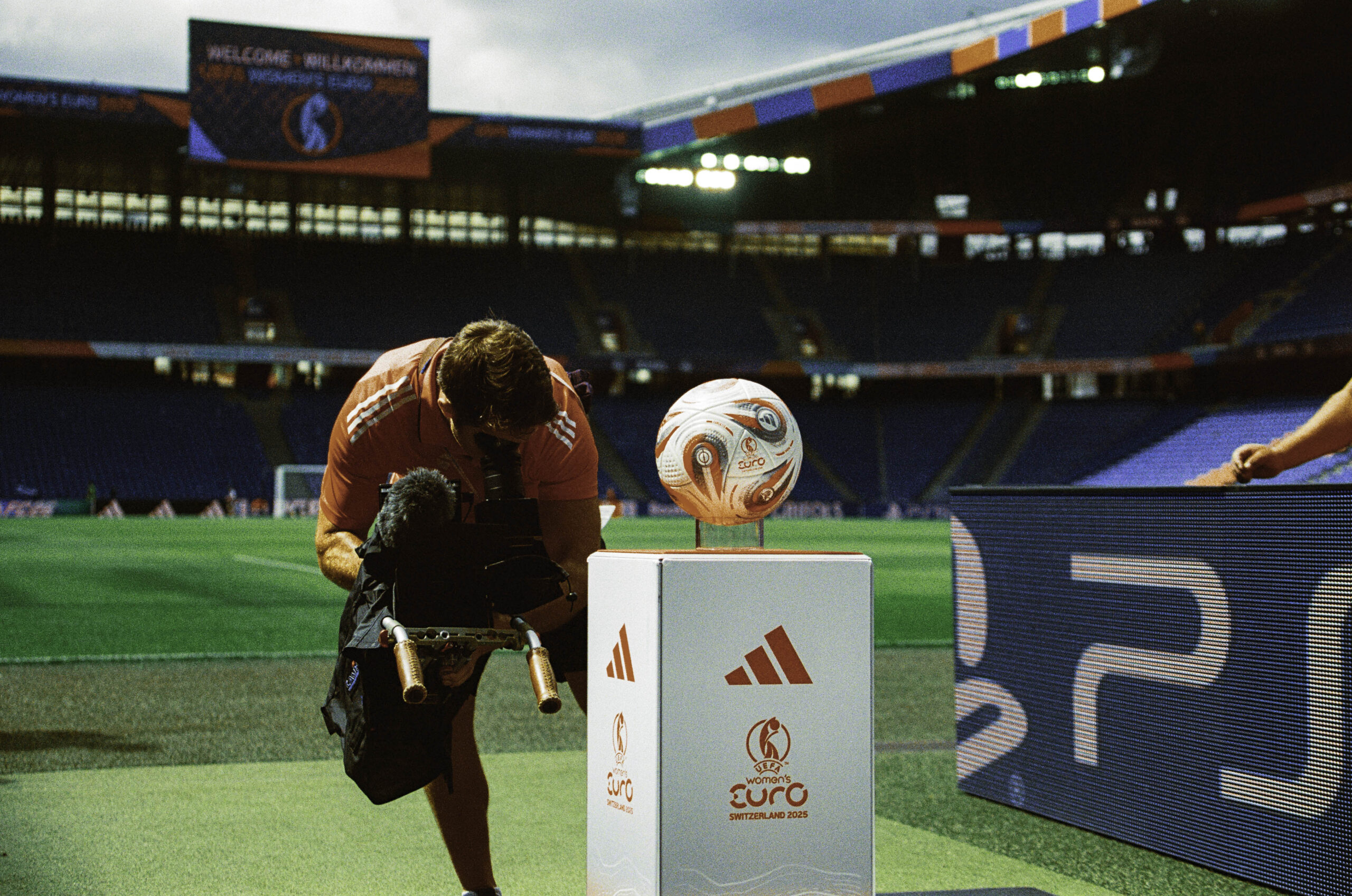
The match ball gets its close-up first. Balanced on an Adidas plinth, it soaks in the late-afternoon sun while a broadcast operator inches a gimbal for the pre-roll hero shot – every millimeter tuned so the sponsorship sleeve lands dead-center on screens from Zürich to Auckland. Inside the paneling hides UEFAs connected-ball tech, an RFID core that will whisper live speed and spin numbers to the VAR truck before the crowd even finishes the goal roar. Just outside the frame lean the cardboard shipping crates that birthed it – plain brown, “Made in China” stamped in courier red. For this moment, though, the orb looks sovereign: stitched, branded, hovering in silence until twenty-two players – and a billion pixels – decide its fate.

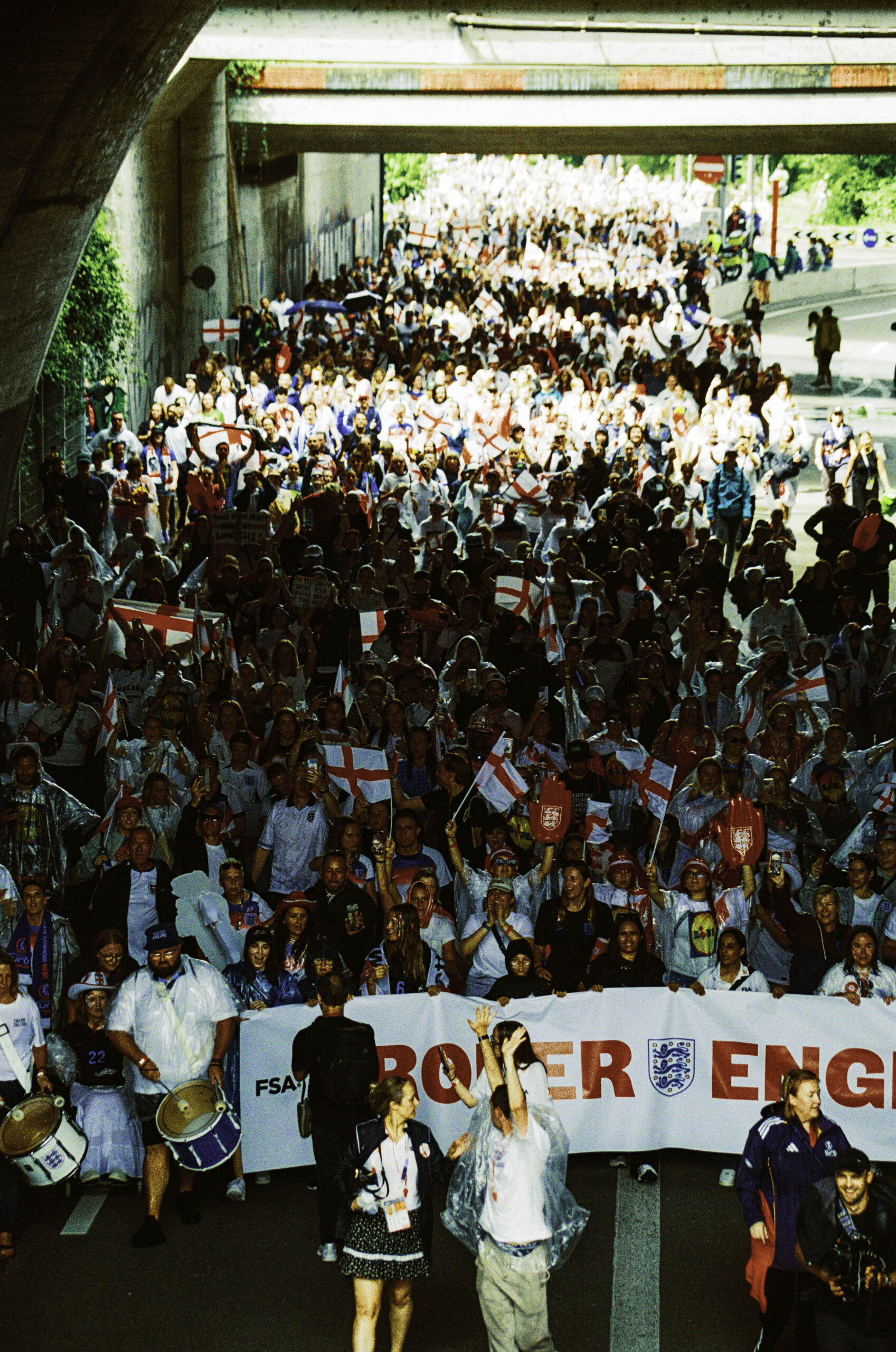
The traffic tunnel is sealed, just for an afternoon, and the four lane ribbon has turned into an English river. White jerseys shimmer with leftover drizzle, St George’s flags bloom like sails, and a wall of sound ricochets between concrete and ivy. Drums lay down a heartbeat that vibrates the road paint; above it the chorus folds itself into the Tequila riff, swapping the hook for “Sa-ri na!” – a pint rich love song to their coach. Front rank unfurls a banner wider than a bus: PROPER ENGLAND. Red letters flex each time the mass surges, then settle like a living lung.

I climb the pedestrian crossing at the tunnel’s mouth for a cleaner sight line, promise myself one frame, but the chant swells and my shutter fires twice before I remember film rationing. The late sun needles through the overpass gap, picking out poncho droplets and the foam heads of paper pint cups. There’s no cordon, no flares – just a travelling pub on good behavior, intent on singing its manager all the way to the goal line. In ten minutes, these voices will split into ticketed blocks, but right now they own the road, and the asphalt feels softer for it.

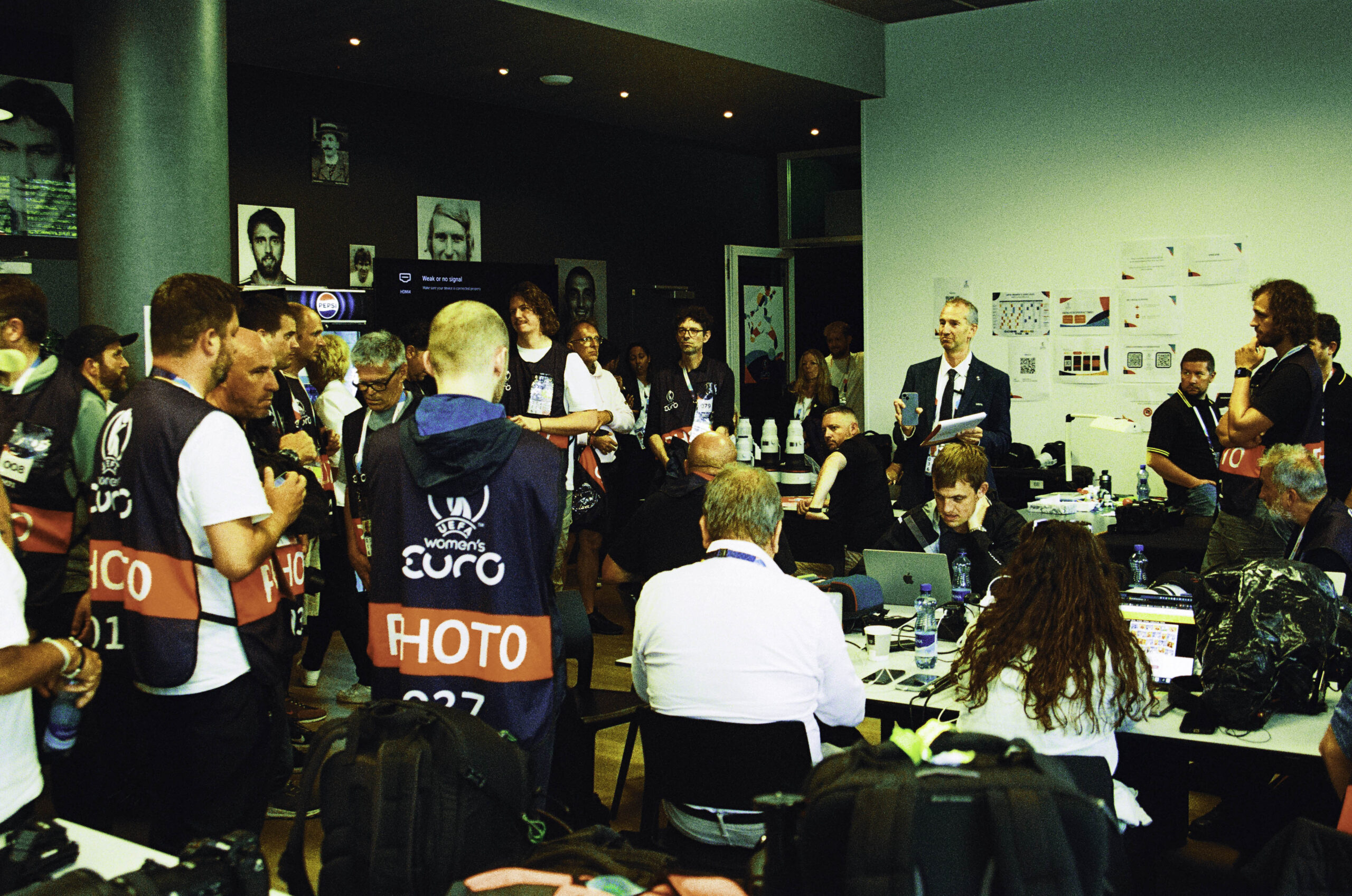
The last stragglers slip inside just as the briefing begins. A UEFA official – navy suit, clipboard tucked tight, phone held aloft like a metronome – cuts the murmur of keyboards: “Final protocols, please.” At the group stage we mostly tuned these talks out, but a final resets the stakes; nobody wants to be the lens that costs a million viewer replay. Stick behind the LED boards, respect the trophy route, keep remotes silent, mind the cable mats – simple rules, suddenly heavy.

Laptops clap shut, 400 mm barrels lean against chair backs, and the room tightens around the official’s voice and the faint tang of instant coffee. Even the hard case agency shooters, who claim they could work blindfolded, nod along. One mistimed stride into a TV sight line and you’re the headline no one wants. Five minutes later the phone drops to his side, clipboard closes, and the tension loosens. Shutters dry click again while everyone runs the same quiet checklist: cards cleared, batteries green, routes mapped. Ninety minutes of football are coming, but first – thirty minutes of choreography, learned just in time.

In

We step inside, lights loom
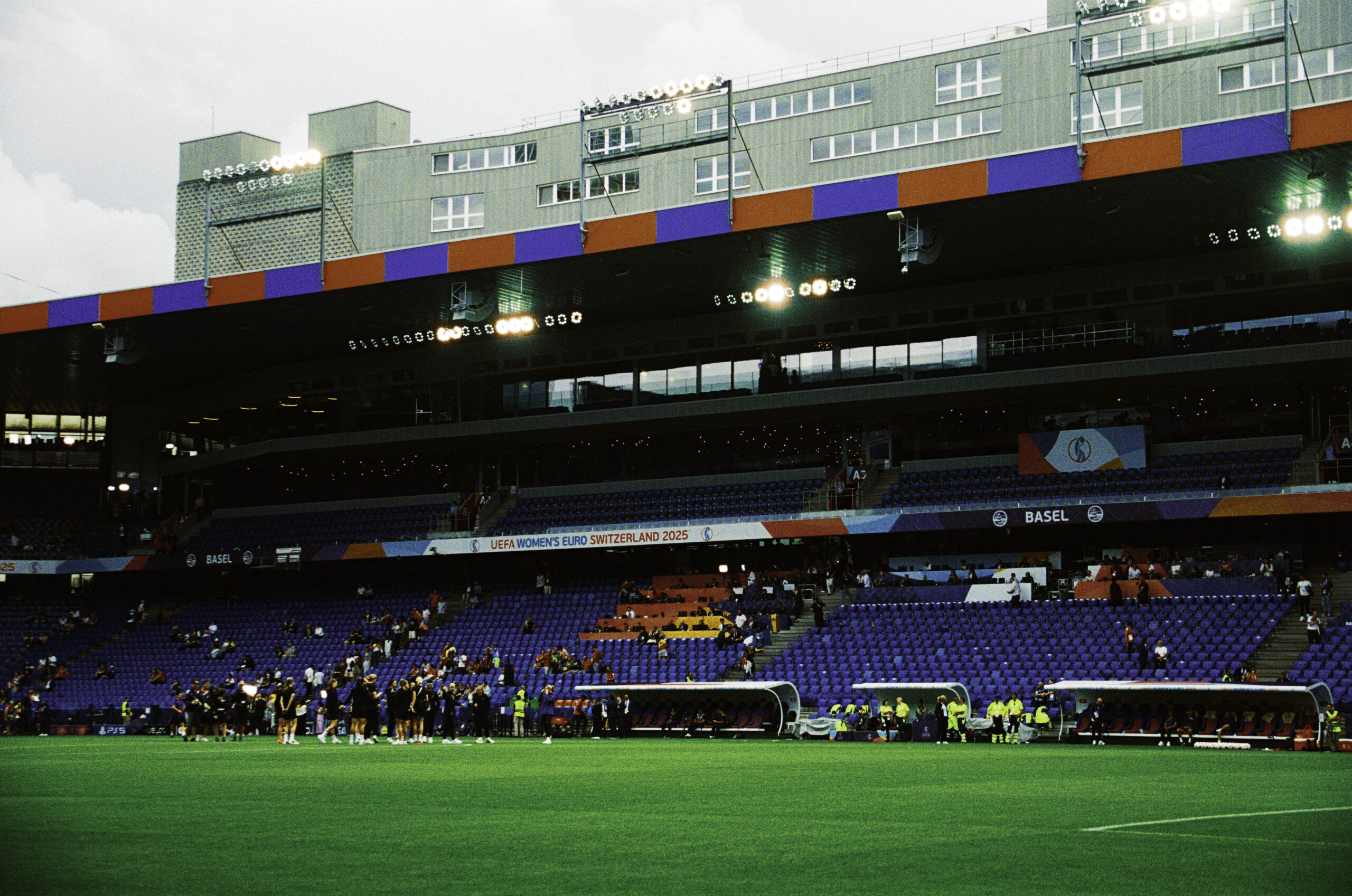
Early arrivals drift to their seats like test pixels on a giant screen, blue rows blinking to life one by one while the England squad wanders the grass in matching travel kits. No shinguards yet – just trainers, hands in pockets, a few earbuds piping private playlists over the stadium PA. One player films a slow panorama on her phone, flips the camera, snaps a grinning selfie with the substitutes’ bench behind her; another checks studs for loose mud that doesn’t exist on this groomed carpet.

The inspection stroll is always a quiet ritual – fifteen minutes to map sight lines, gauge the bounce, swallow the nerves. Coaches linger near halfway, murmuring about shape; substitutes swap weather jokes with stewards; kit staff count water bottles on the benches. Up under the cantilever roof the floodlights hum to full power, bleaching the evening gray to theatre white. The mood, for now, is unhurried: a team stretching its legs in someone else’s living room, knowing the furniture gets moved the second national anthems roll.

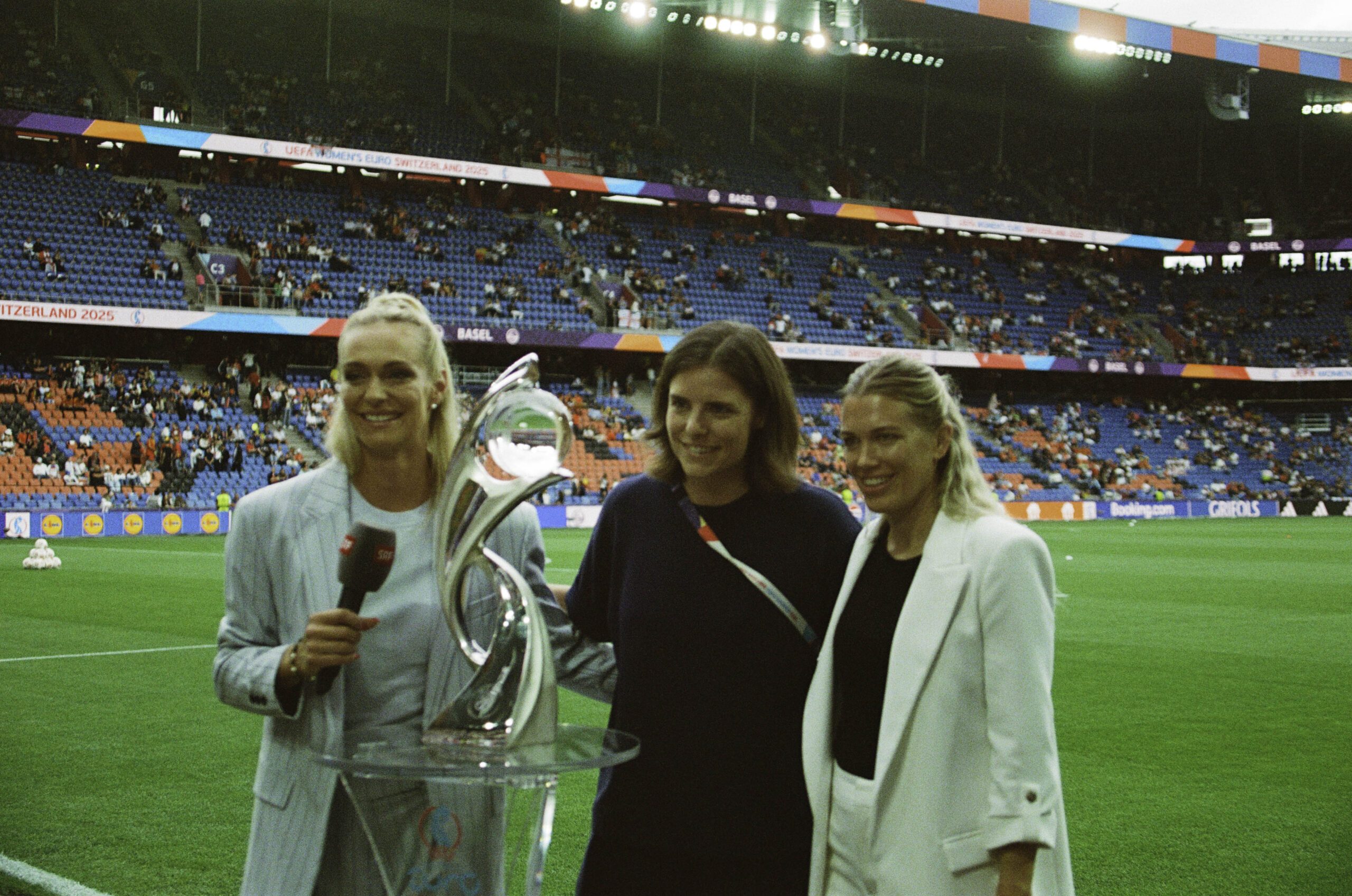
The focus missed and settled somewhere in the stadium instead of the three women in front of me, but the moment still lands: Annette Fetscherin balancing an SRF mic, Seraina Degen leaning in, and former Swiss captain Lara Dickenmann smiling like she never left the pitch. They’ve just wrapped a live hit, the UEFA trophy parked on an acrylic plinth between them, its chrome curves mirroring floodlights that haven’t fully warmed. A quick pose for off air phones – moderators and ex pros briefly tourists at their own show – then they dissolve back into broadcast pace. My frame may be half soft, but the story’s sharp enough: before ninety minutes crown new champions, the silverware belongs to the storytellers.

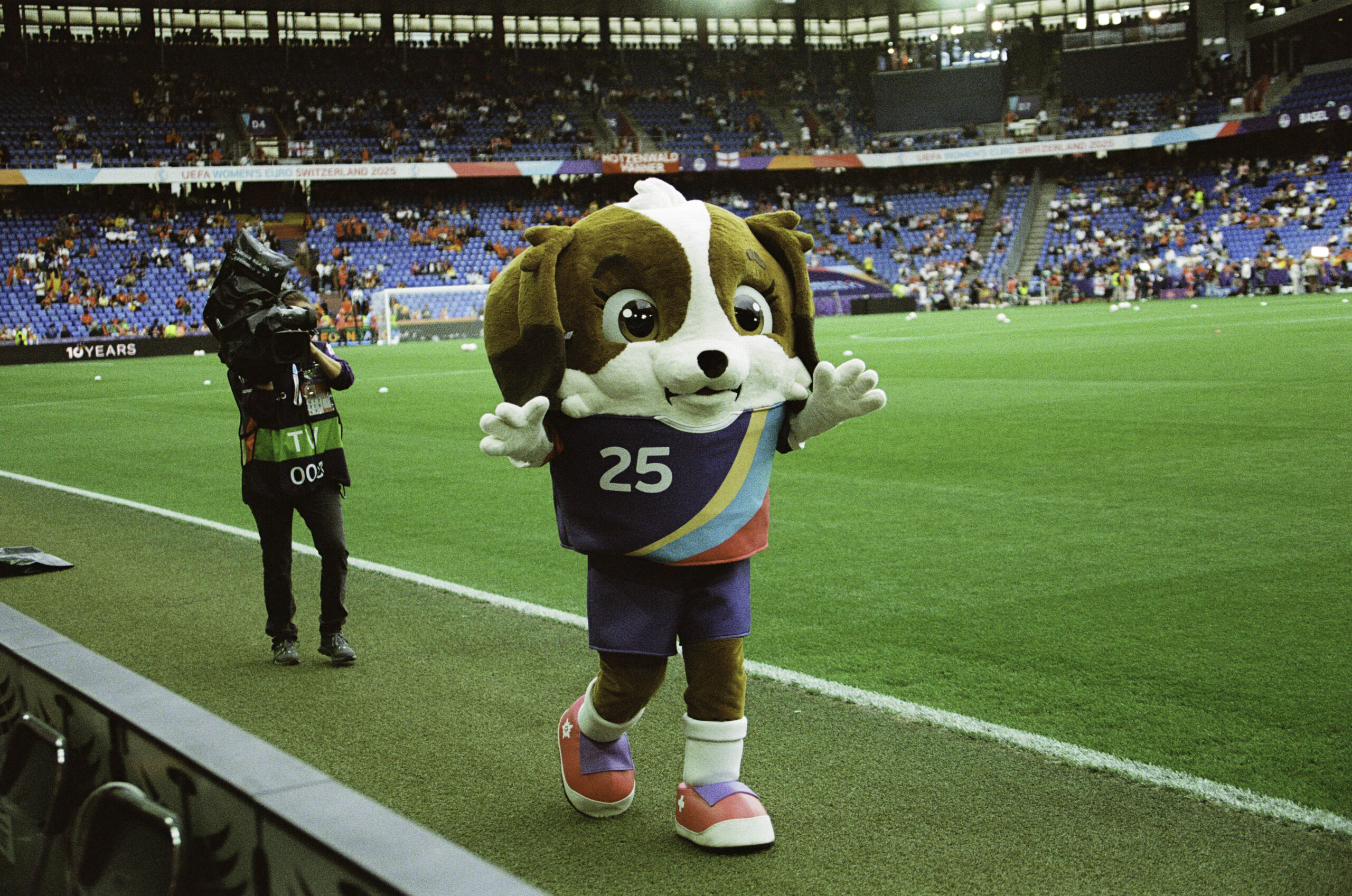
Maddie the St. Bernard pup pads along the sideline – again. Like a stubborn cold sore you can’t quite shake, she appears at every match, and the PA unleashes the same upbeat script we now tune out the way frequent fliers skim safety demos. A volunteer stays glued to her foam elbow because the human inside peers through a slot thinner than a letterbox. That makes the hop skip wave routine more impressive: a whole tournament and not one Maddie face plant.

She spreads her padded paws, crowds oblige with a cheer, and off she lumbers – plush head bobbing, droopy ears flapping – as if the stadium were built solely to give a St. Bernard pup somewhere soft to roam.

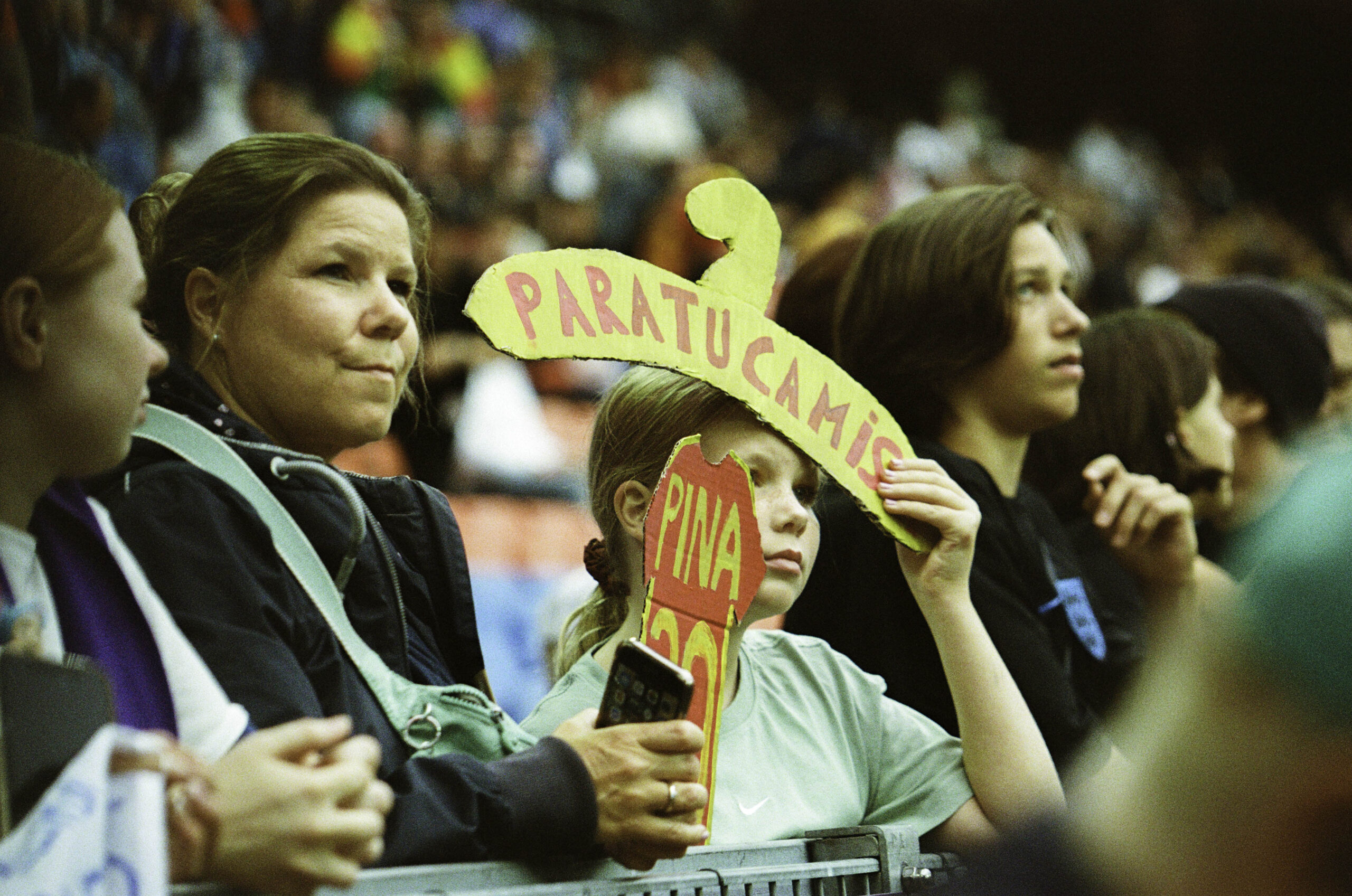
Front row patience: a mother steadies the rail while her daughter balances a jagged, hand cut sign over her head – yellow cardboard shaped like a jersey hanger, red letters reading “PARA TU CAMISA?” Asking, in awkward Spanish, if midfielder Clàudia Pina might spare a shirt after the match. The girl’s eyes track every movement on the far sideline; the phone in Mom’s hand is ready for either outcome, trophy lift or simple wave. Around them the noise climbs, but in this little pocket of the stand time slows to hopeful heartbeats and the smell of fresh sharpie. Whether a jersey makes it over the advertising boards tonight almost doesn’t matter – the sign, the wait, and the shared hush are already their souvenir.

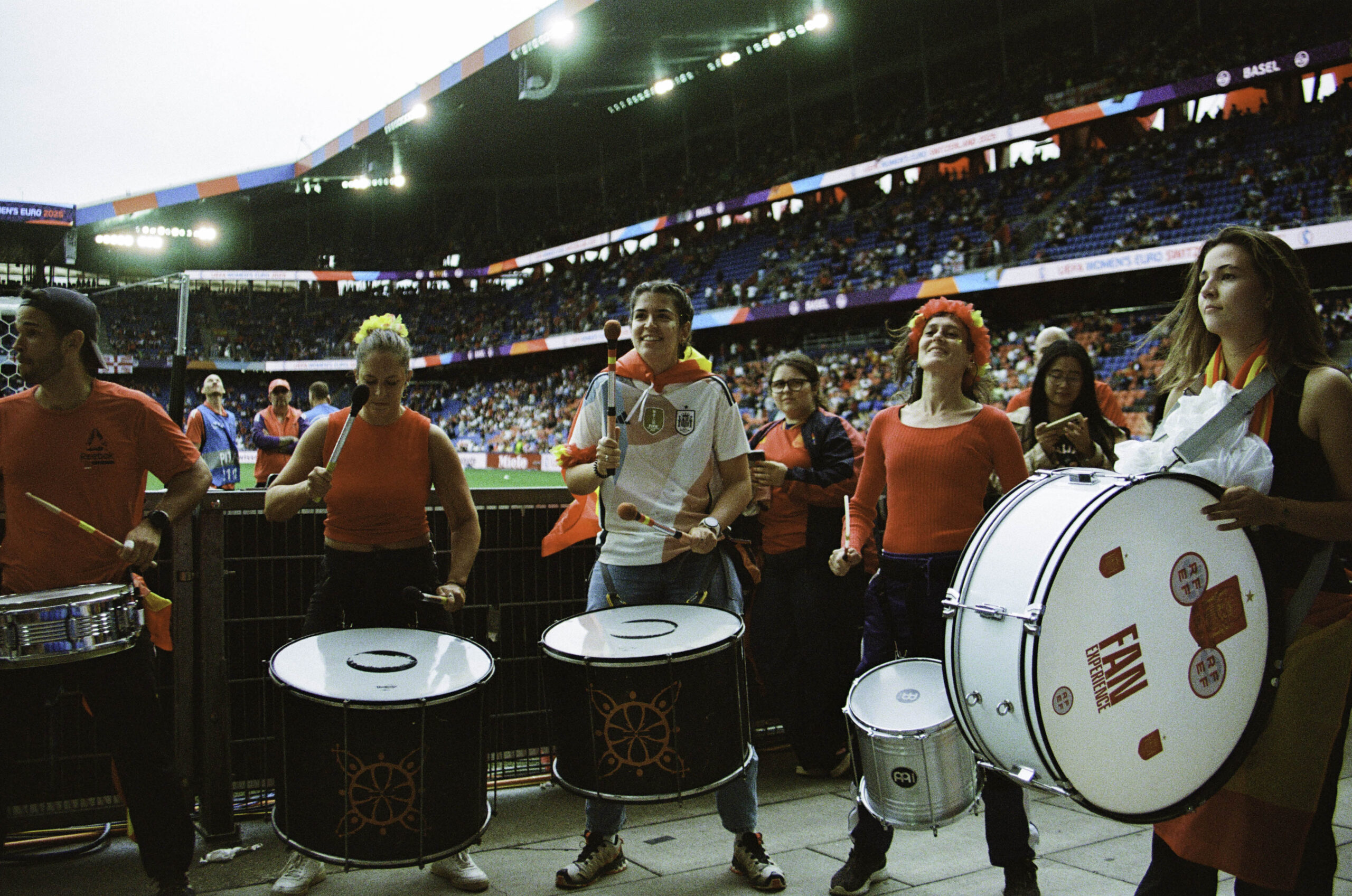
A pocket of La Roja turns the concourse into a street fiesta. Five drummers – two snares, two surdos, one bass big enough to hide behind and some more you don’t see on the left side – hammer out a carnival groove that ricochets off the steel stanchions. The lead wears a Spanish flag as a superhero cape, each down beat landing with a grin wide enough to share. Next to her, a woman in a red flower crown leans back, letting the rhythm drive straight through her ribcage. Phones rise for a bar or two, but most hands switch to clapping; the pulse feels better than pixels.

Across the pitch England’s brass band hasn’t started yet, so for a minute the whole stadium belongs to Madrid, Barcelona, Bilbao, Sevilla – one rolling drumline tightening the air until the players appear and the night’s main soundtrack kicks in.

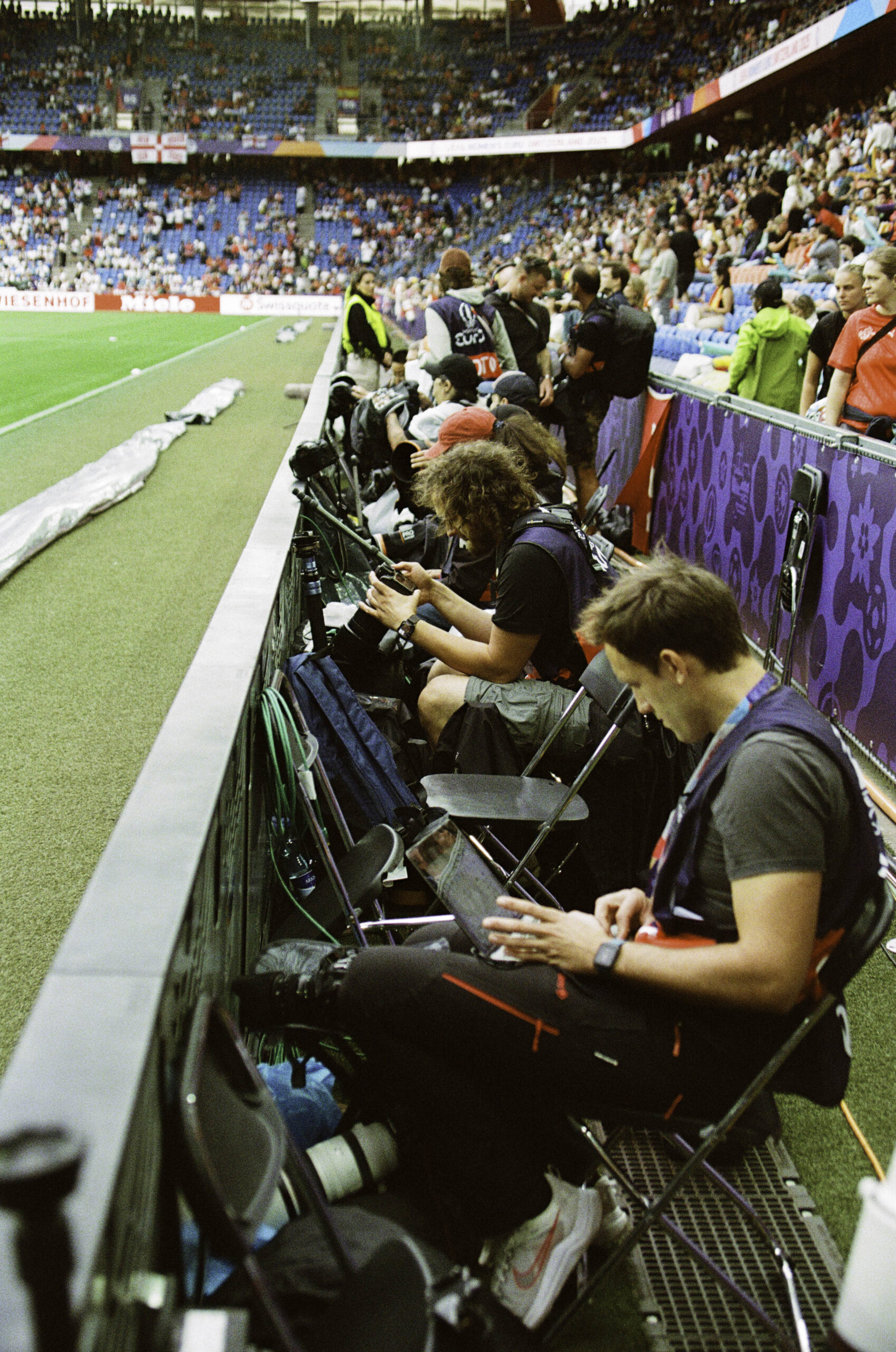
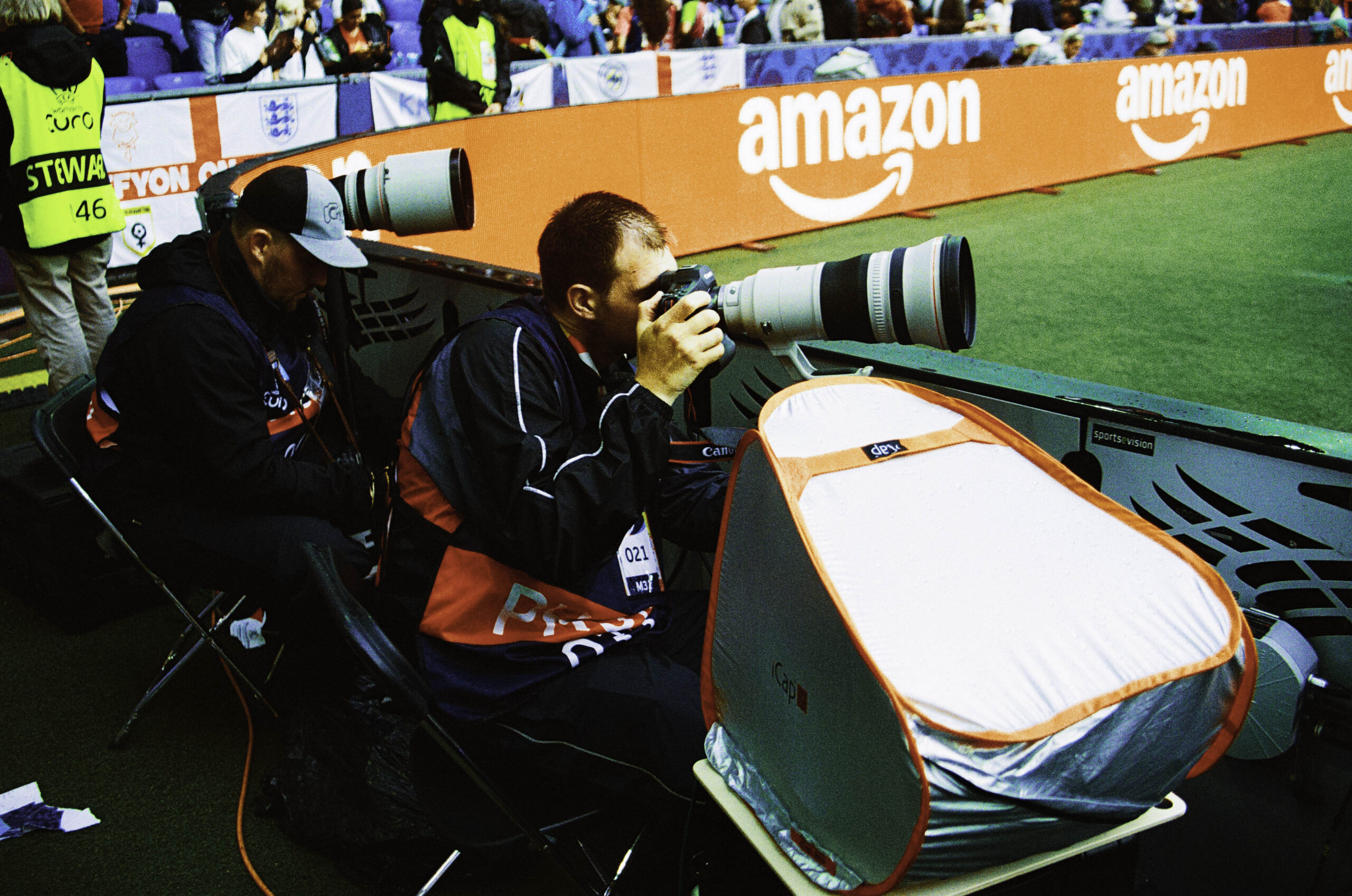
Sideline real estate is tight as a subway at rush hour. Photographers fold into camping stools barely wider than their hips, knees grazing the advertising boards, 400 millimeter cannons stacked underfoot like spare oxygen tanks. Laptops balance on actual laps – no desk, no tray – while card after card gets popped, browsed, color checked, and rated with the flick of a trackpad. Between the legs and chair backs runs a snaking weave of Ethernet, rain sleeved lenses, monopods, and rolled tarps ready for the next cloudburst. One wrong shift of weight and someone’s USB-C tether yanks free; one stray elbow and a six figure lens takes a dive. Yet the assembly line hums: shoot, cull, caption, transmit. Ninety minutes of football, thirty seconds of turnaround, zero room to stretch – welcome to the factory floor of modern sports journalism.

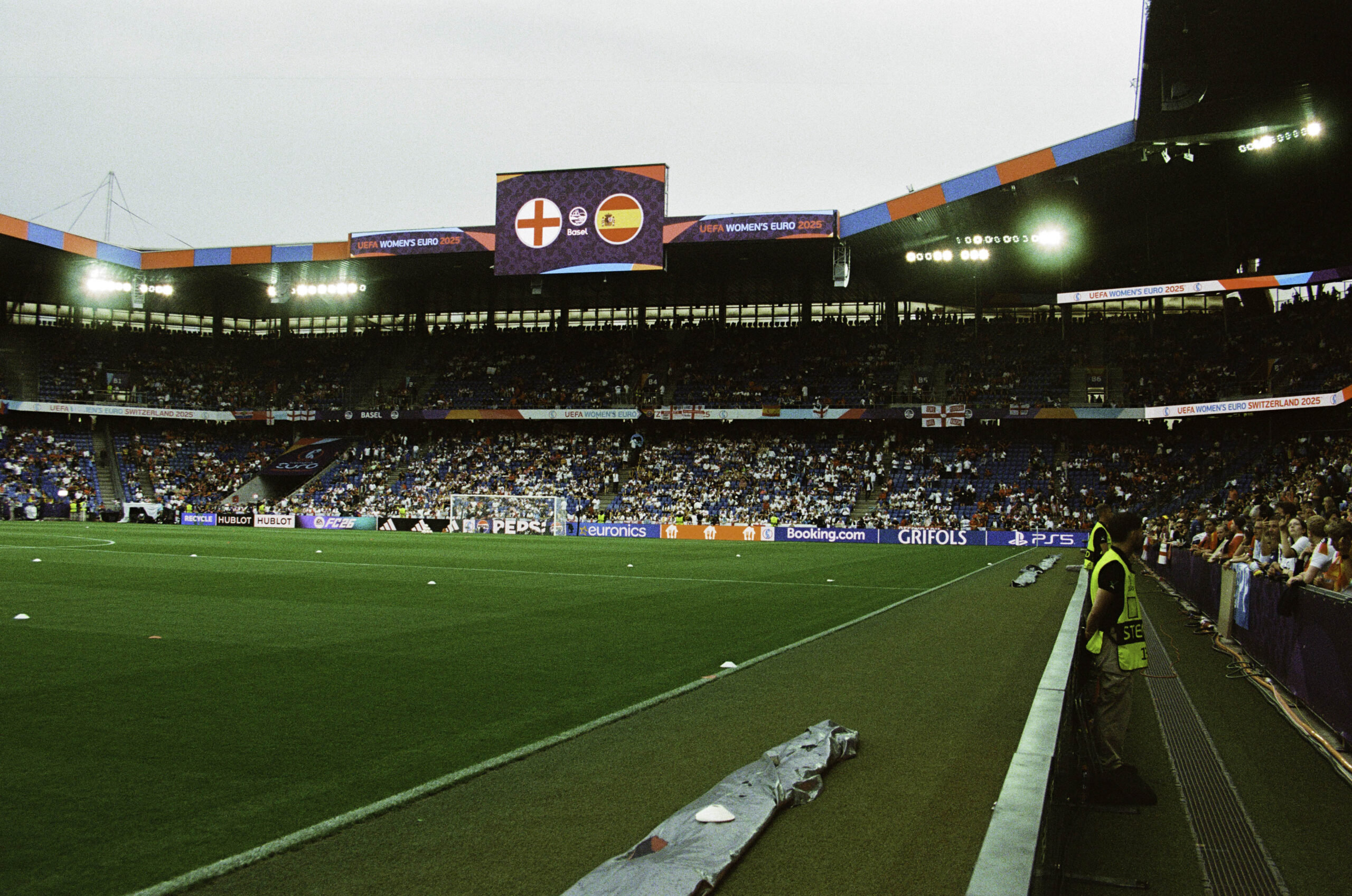
The pitch is dressed for the last rehearsal: neat rows of white cones dot the touchline half, marking sprints that will shake out nervous quads in a few minutes. The main screen blinks the matchup one more time – England left, Spain right – while pockets of empty blue seats shrink with every train that pulls into the stadium’s own railway station Basel St. Jakob. Stewards take their posts, high-vis vests bright against the darkening edge, backs to the grass, faces to the swelling crowd. Their job is to watch the watchers, unmoved by the roar they’ll never see.

Warm-up looms in the thin space between anticipation and action. Soon the cones will scatter, playlists will spike, and the ball will finally roll. For the moment, though, the field is a stage set – perfect, untouched, waiting for the players to write their ninety-minute script.

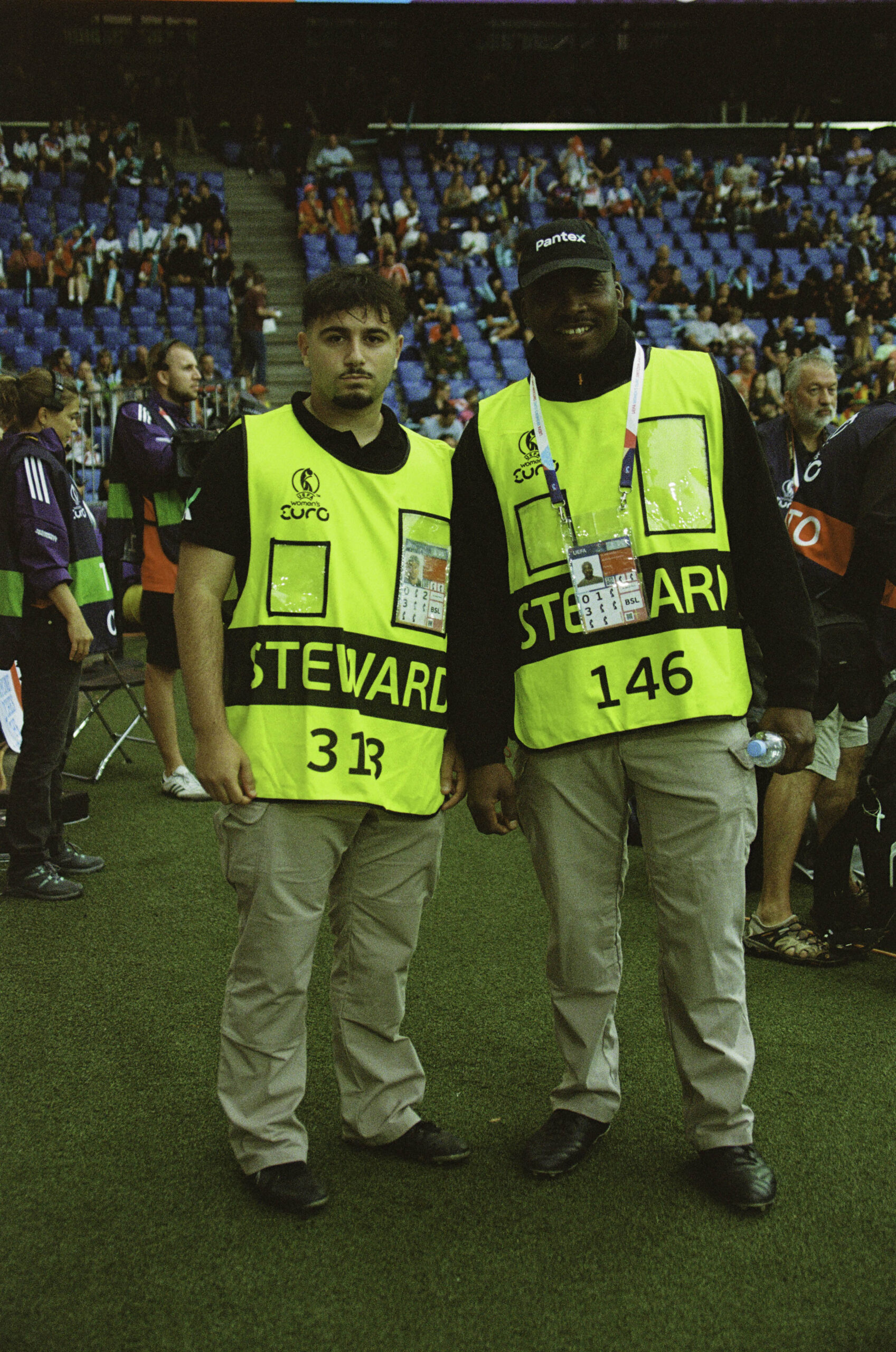
Meet the sprinters. Every steward rings the pitch, a static chain of yellow vests forming the human barrier between the game and everything else, but vests 313 and 146 carry an extra credential: molded studs on their feet. Most marshals are limited to the advertising boards; they can wave a finger, block a shortcut, escort a fan back to the stands, but they never set foot on the grass. These two are different. If someone vaults a railing, chasing a lifetime ban for fifteen seconds of TikTok glory, they’re the ones cleared to cross the white line and sprint the intruder down.

They pose for me with a mix of amusement and quiet purpose. The one on the left is stone-faced, eyes on the camera, while his partner can’t help but grin, water bottle dangling from one hand. The boots give them a subtle air of readiness – the studs gripping the carpet beneath us even as they stand still. Tonight, with the final at stake, they’ll spend ninety minutes scanning the crowd instead of the pitch, muscles loaded like springs.

Most matches pass without incident, but the cleats are a reminder: when you’re the last safety net, hesitation isn’t an option. They slide back into their posts along the goalline, indistinguishable again from the other fluorescent vests, yet everyone in the inner circle knows their role. With luck, they’ll walk out at full-time with the same spotless boots they walked in with. If not, at least the turf won’t slow them down.

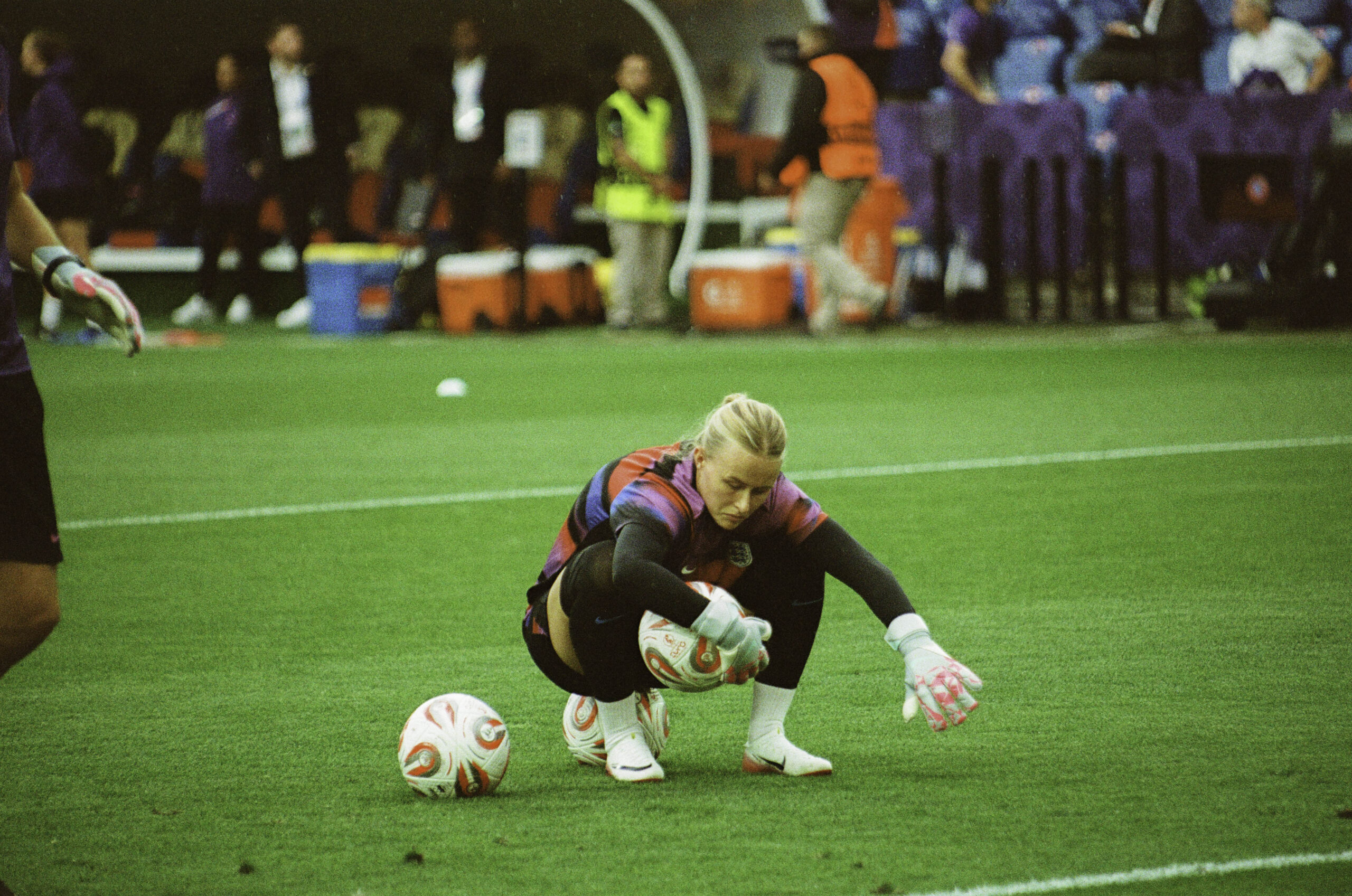
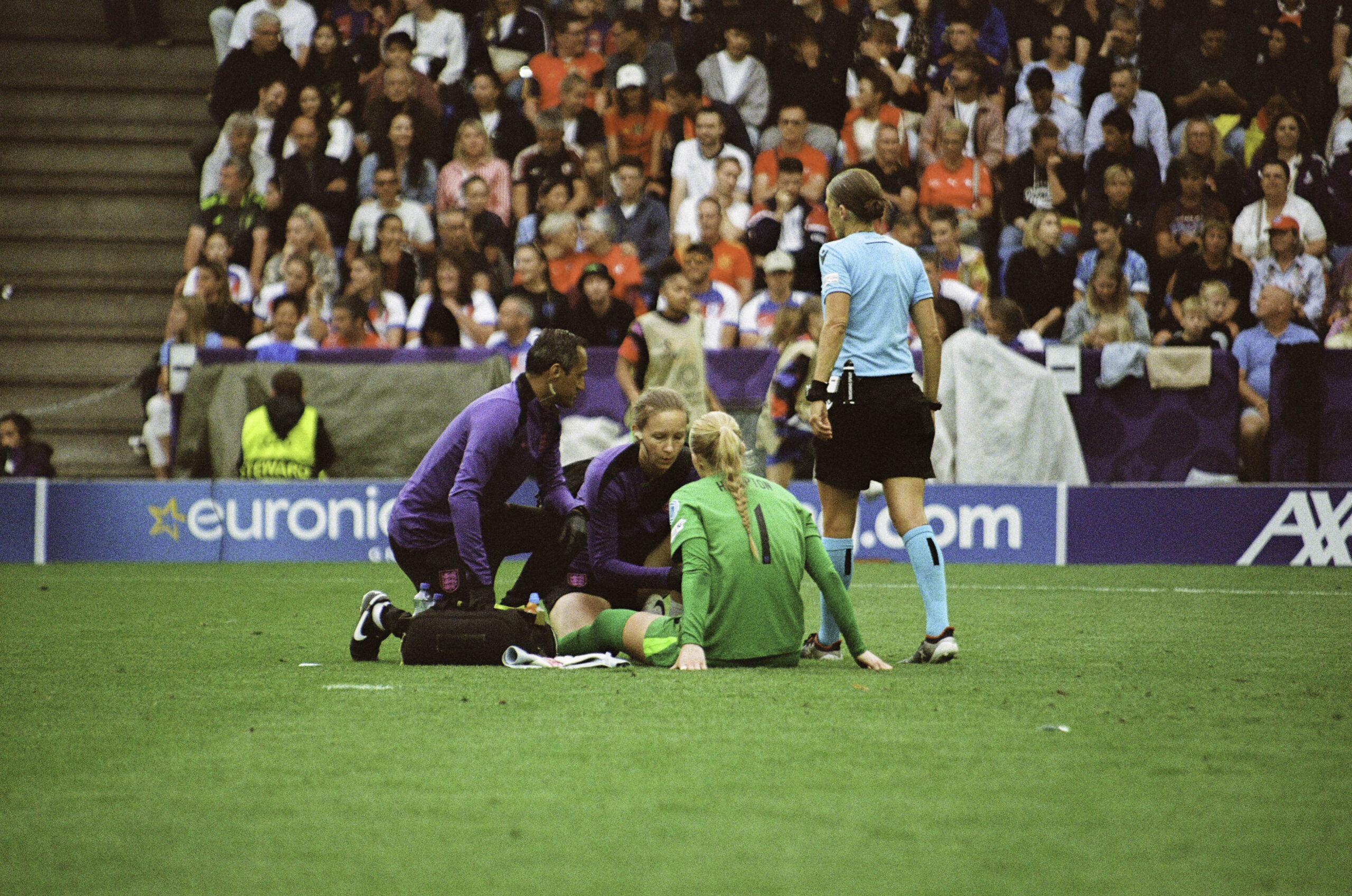
Hannah Hampton squats on a spare match ball, half risen, half regrouping, unaware that in two hours she’ll leave this grass a national hero. I waited for the playful glance she gave a moment earlier; instead the shutter caught her mid-heave, limbs folded, expression clenched – an unflattering freeze of what will become flawless reflex. Warm-up awkwardness is the tax goalkeepers pay for penalty-box grace: tonight, when the shoot-out lights up the scoreboard, she’ll trade this crab-pose for a swan’s stretch, and the stadium will never remember how the story started.

Go

Crowd thickens, heartbeats climb higher
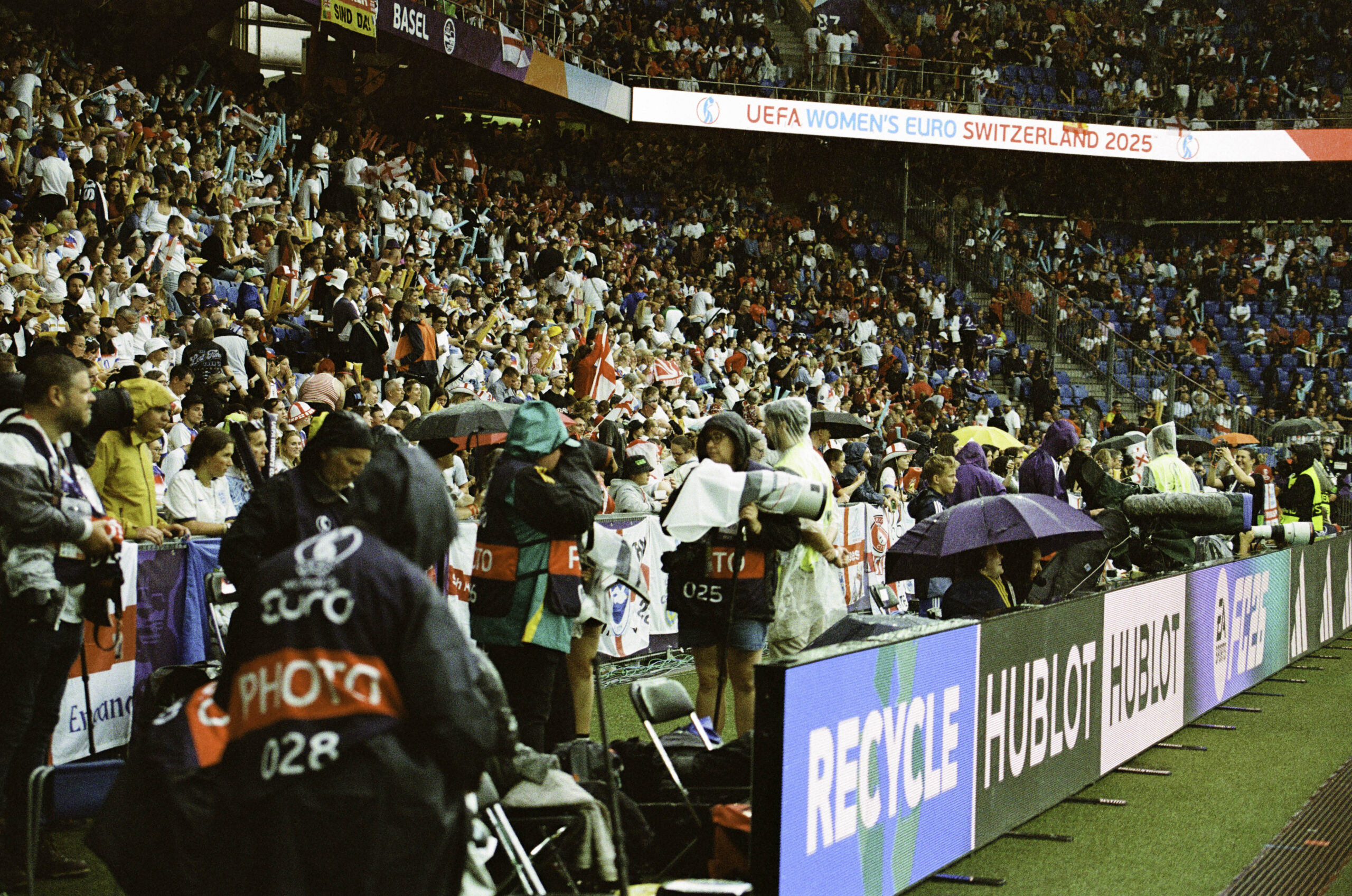
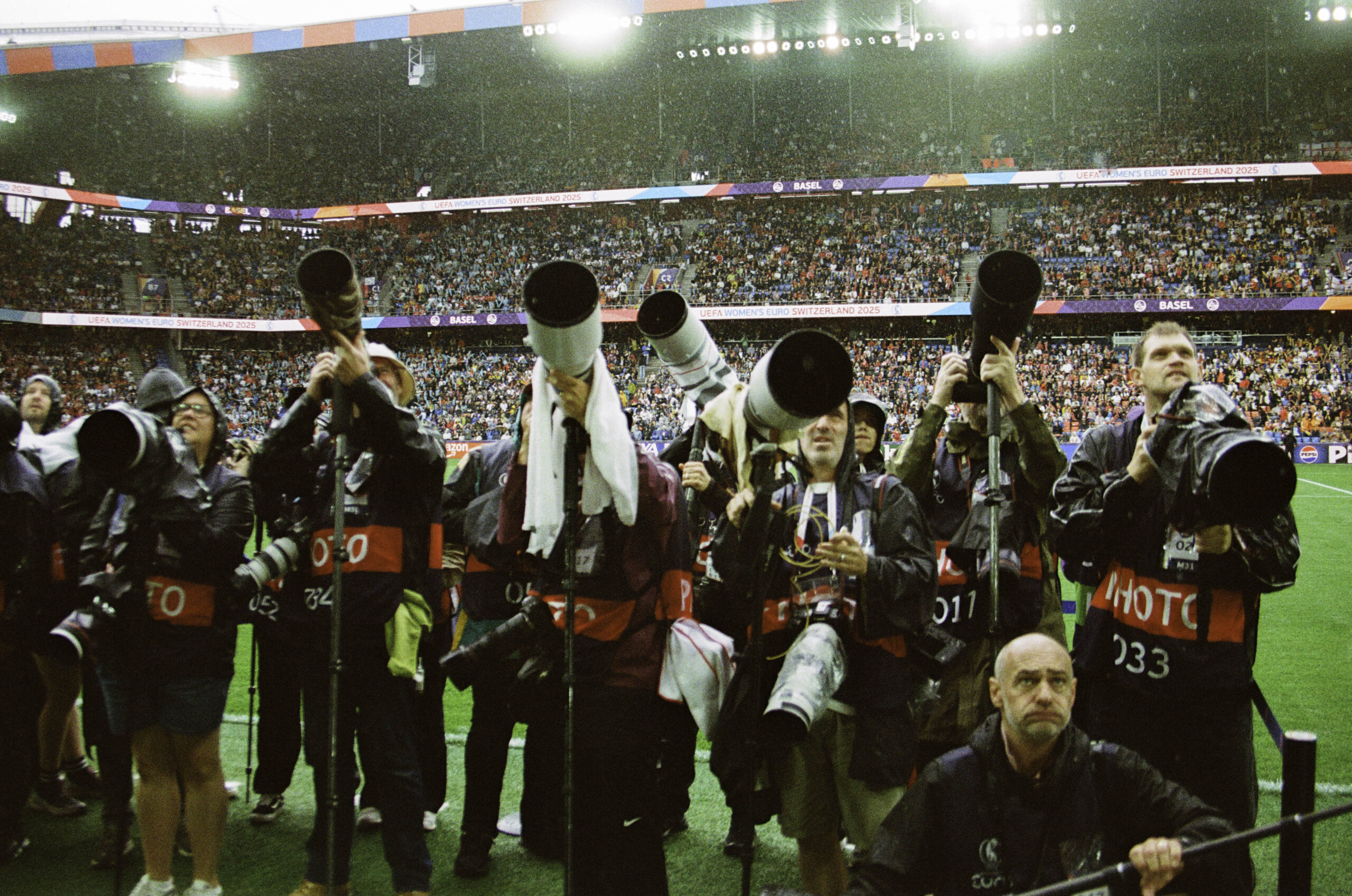
Rain needles the floodlights, turning the sideline into a damp holding pen. The players have ducked back into the tunnel to swap warm up tops for match kits, but every photographer in the corner stay wired – long glass wrapped in plastic sleeves, fingers hovering over the card slots. In a minute a steward will wave us forward and the pack will surge toward the benches, sprinting for the narrow strip that frames the anthem line-up and the team photo.

Etiquette says we shuffle politely, but finals erode manners; elbows sharpen, monopods jab for balance, and the rush becomes a silent scrum. A few veterans anchor themselves next to barrier posts, rain jackets pulled tight, guarding their sight lines with practiced territorial smiles. One clear frame of twenty-two players belting national hymns is worth soaked shoes and bruised ribs. So we wait – crouched, hoods dripping – half still yet already mid-stride in our heads, ready to break the moment the tunnel mouth brightens and the music spills out.

Every telephoto barrel on the sideline has swung a full 180, away from the centre-circle drama they were hired to chase. The target now is the VIP seats: Prince William and his daughter have just taken their seats, and for thirty feverish seconds football drops to a supporting role. Rain beads on lens hoods, towels drape over viewfinders, monopods dig into soggy turf – all anchoring that one high-angle shot of a future king explaining the offside rule to a nine-year-old.

You can feel the collective breath-hold – twenty seasoned pros hoping for a wave, a shared laugh, anything to edge their frame past the wire agencies. On pitch, cones scatter for kick-off, but hardly an eye flinches; priorities recalibrate fast when royalty enters the log. Once the shutters fire and the VIP’s settle, the lenses will whip back toward the anthem line-up. For this heartbeat, though, the monarch’s cameo outranks ninety minutes of final-day football.

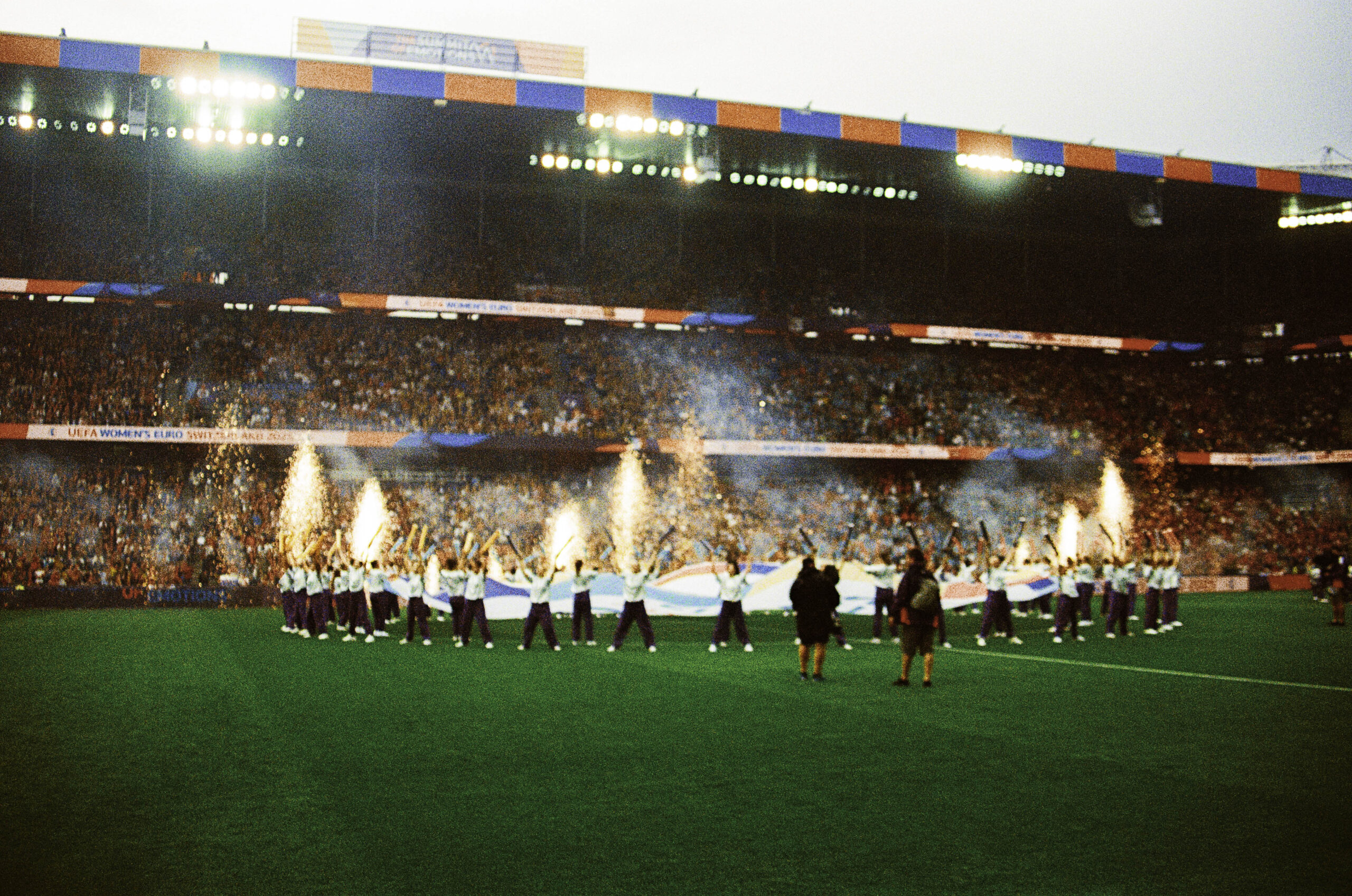
The autofocus hunted and lost – dancers, flames, crowd all melt into one grainy smear – yet the frame still hums with pre-kickoff adrenaline. A ring of volunteers twirls blue-and-white banners while tongues of pyrotechnic fire punch holes in the drizzle behind them, bursting like camera flashes big enough for the gods. The players are still in the tunnel, heartbeat away from marching, but the stadium’s already at full voice; you can almost feel the bass in the blur. Sometimes the lens doesn’t land, and that’s okay: atmosphere outruns sharpness, and the final doesn’t wait for perfect focus.

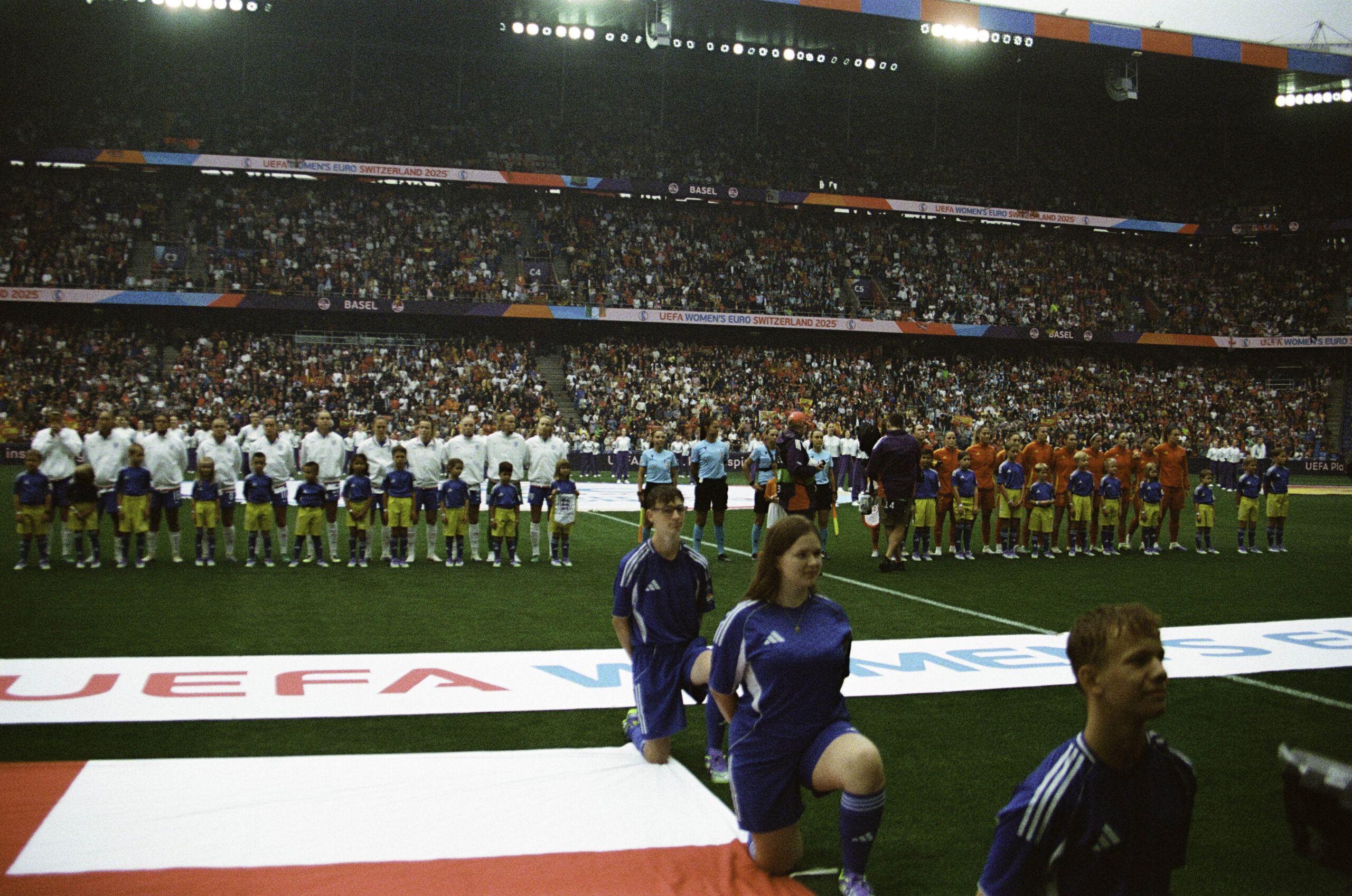
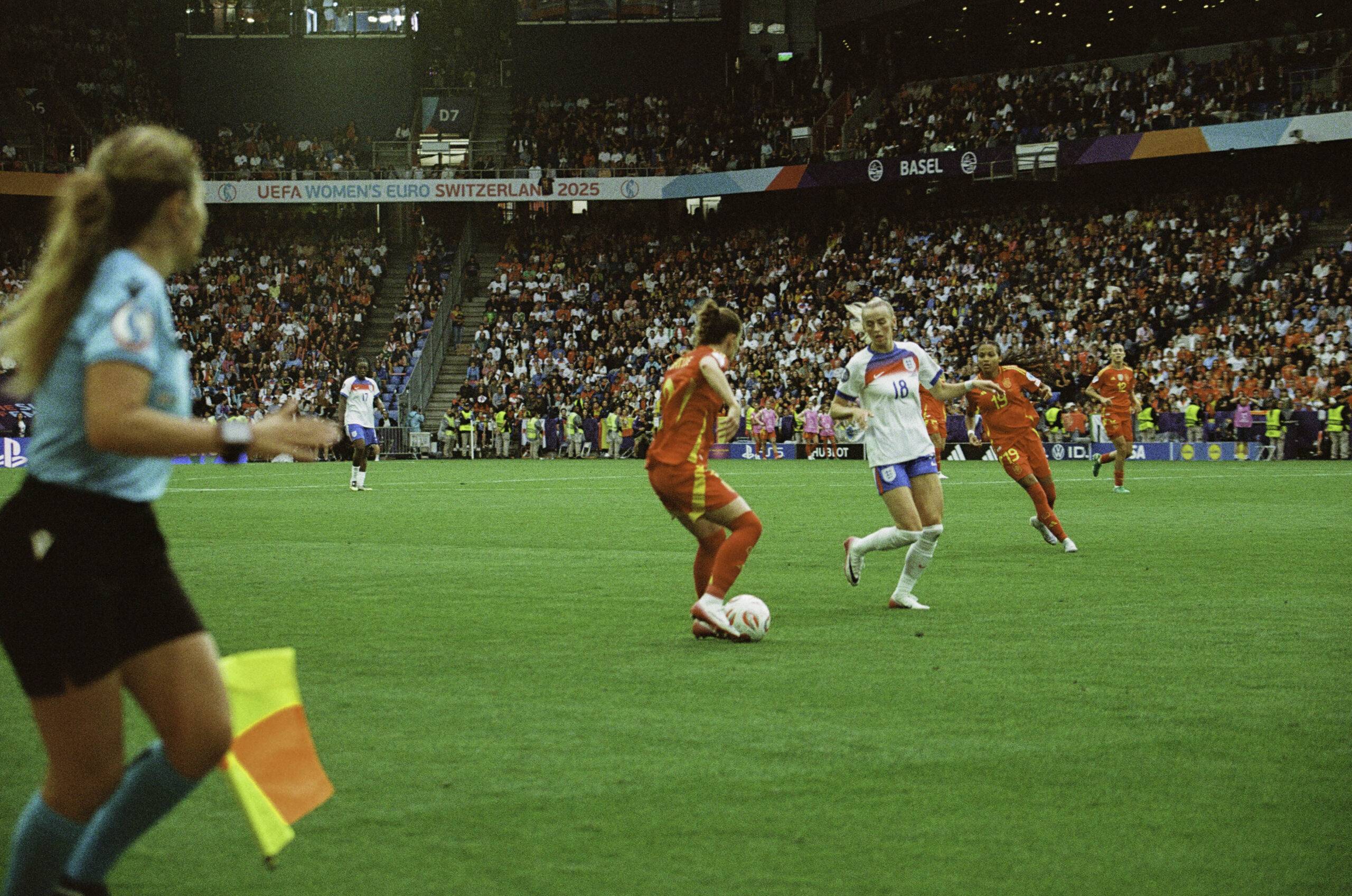
Anthem time, the one choreographed pause before chaos. England in all white on the left, Spain blazing red on the right, a picket fence of kid mascots between them – blue shirts, yellow shorts, eyes darting everywhere except the cameras. Three flag bearers kneel in front of my lens, blocking any hope of symmetry, but the trade-off is context: the giant UEFA banner ripples like surf while the stadium belts verse one.

Floodlights bleach the drizzle to glitter, faces set into game-mask focus; only the keepers allow a quick skyward glance, as if checking whether the rain means anything. Behind me shutters hammer in burst mode – no room for second takes. I squeeze one slow frame instead, let the blur happen, trust that nerves need a little movement to show. Next breath the anthem ends, mascots scatter, and the neat lines shatter into the match we came for.

45′

Breath held, whistle slices the air
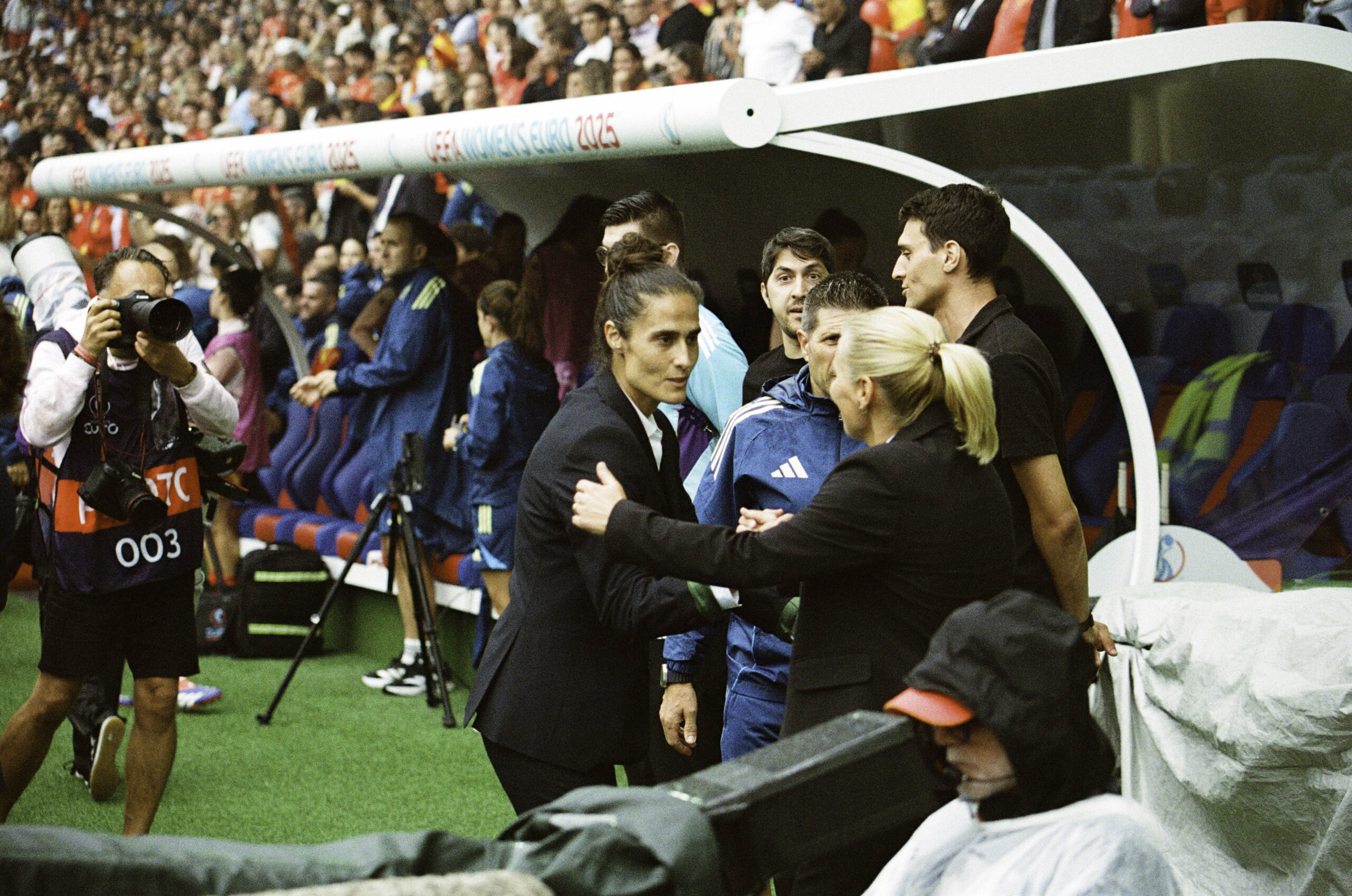
Sideline diplomacy: the two head coaches meet in the thin aisle between substitutes’ benchs and broadcast scrum, a quick clasp that’s half handshake, half shoulder brace. Sarina Wiegman’s ponytail sways as she leans in; her opposite number Montserrat Tome – hair knotted samurai-tight, suit somehow still crease-free after warm-up rain – returns the grip. Their staffs hover, reading lips, timing smiles. A photographer darts across the frame, monopod rattling, desperate for the split-second where strategy gives way to ceremony. In ninety minutes one of these women will lift a trophy and the other will explain margins in a press room, but for this blink they’re equals – two architects acknowledging the blueprint is finished and the building now belongs to the players.

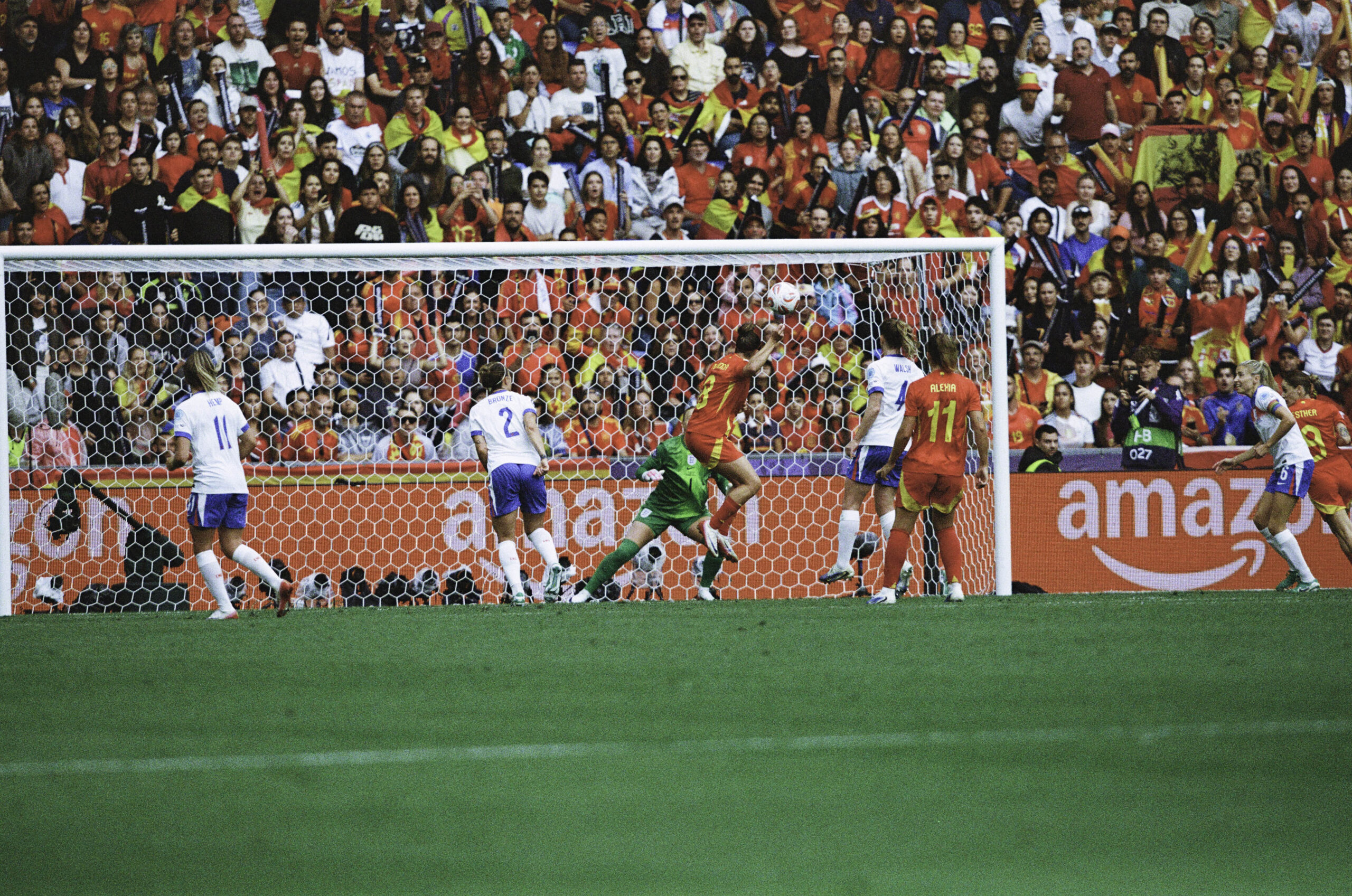
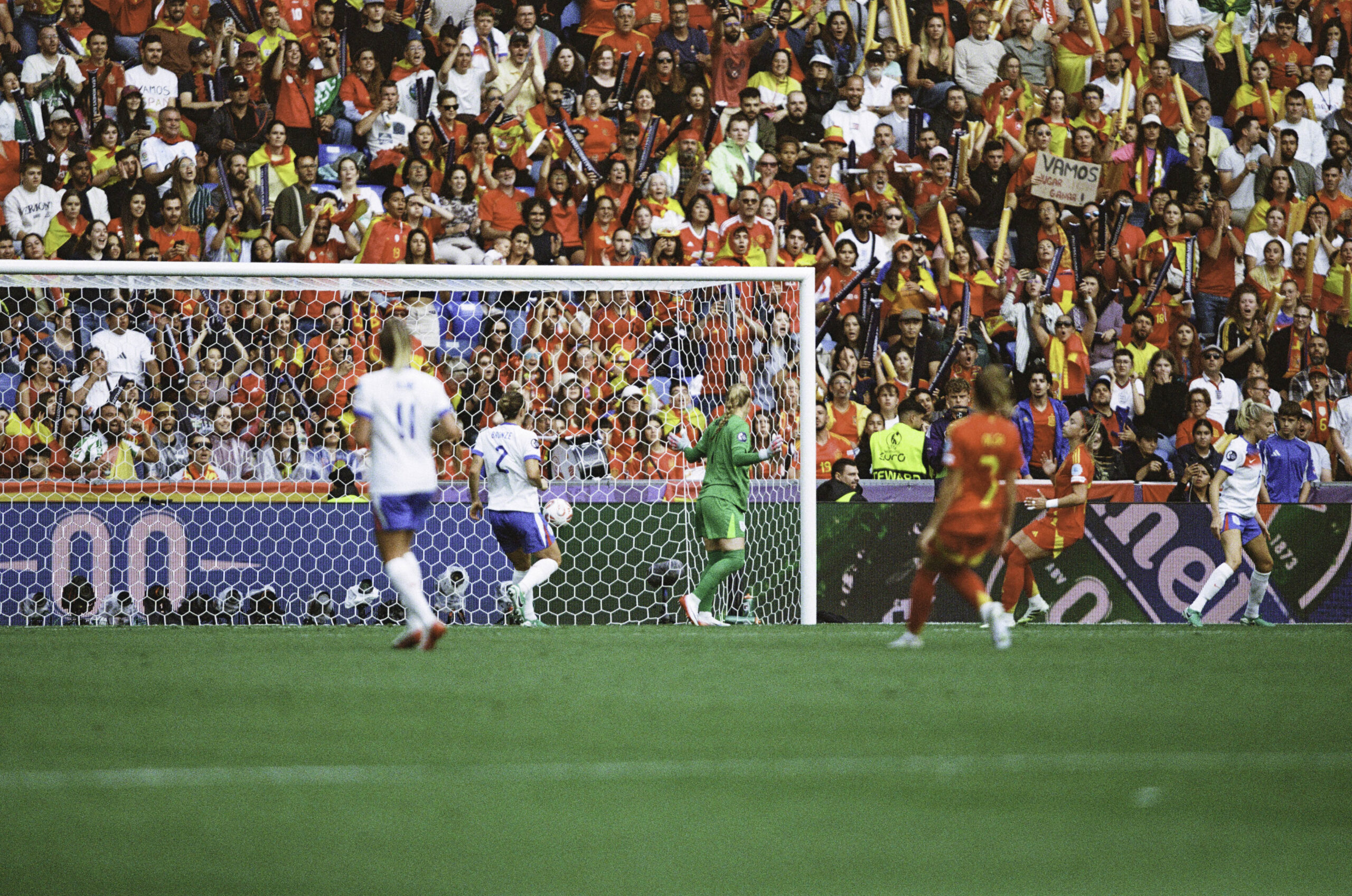
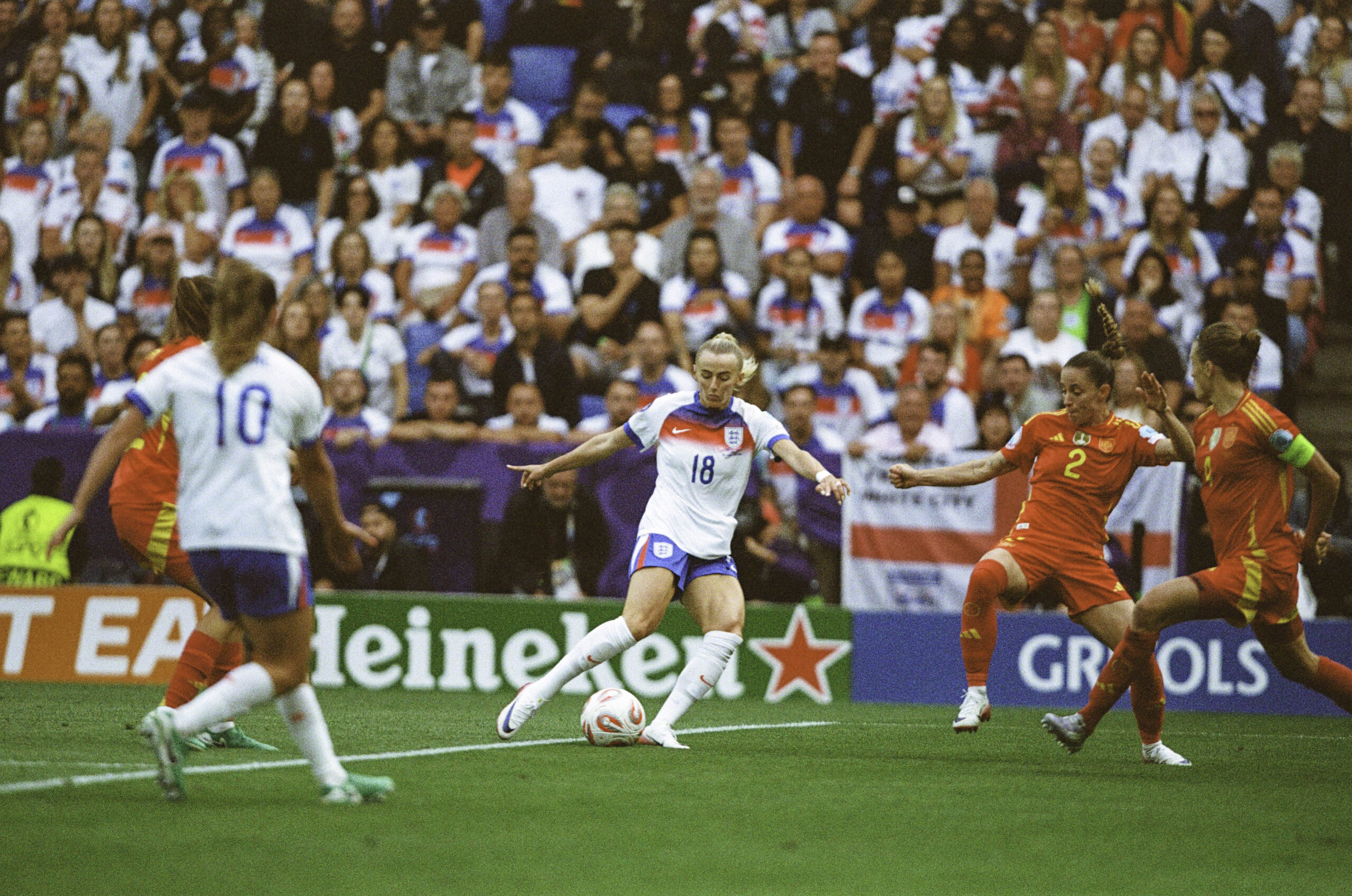
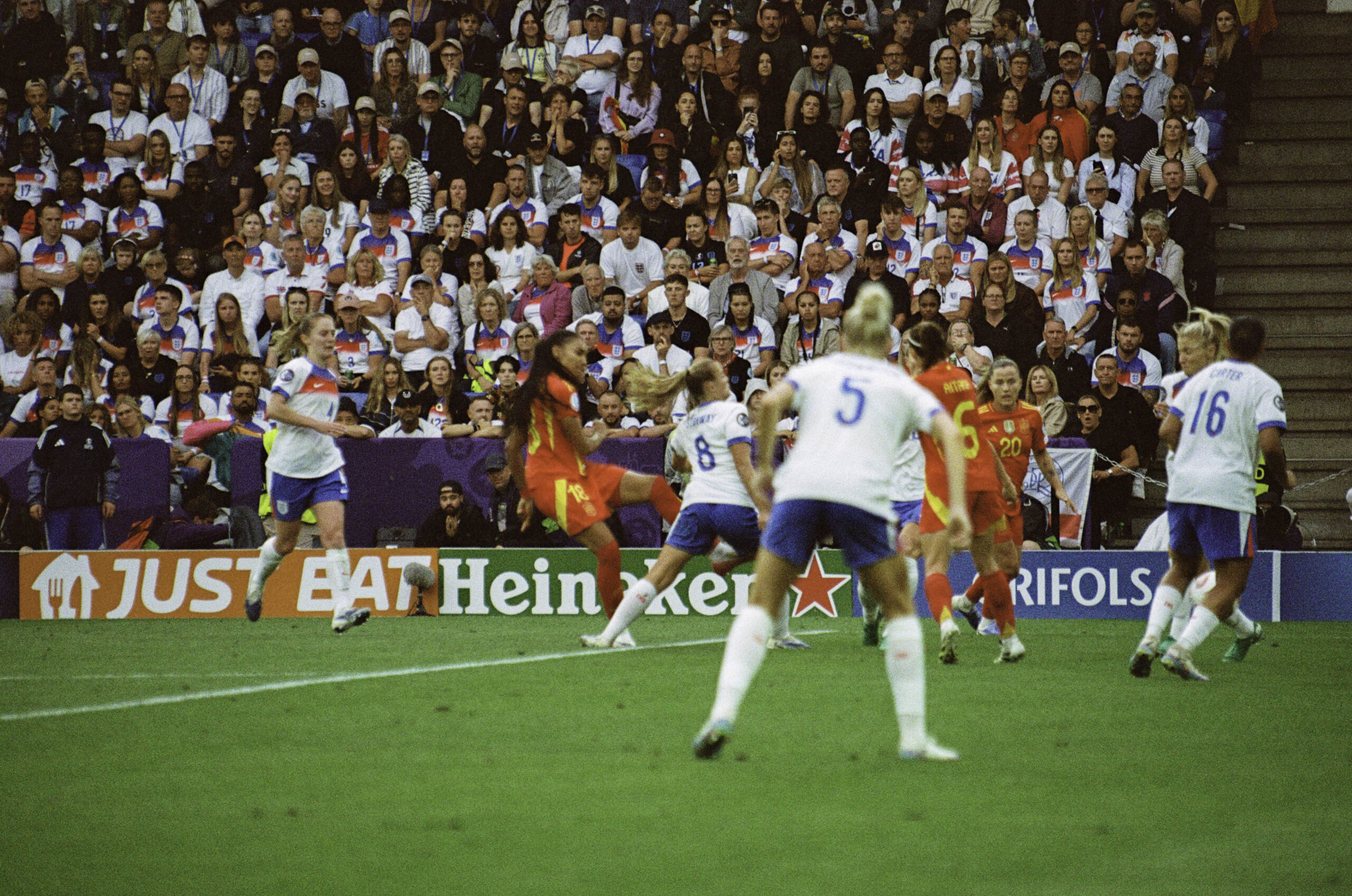
The frame I was chasing all tournament – caught on click 31, almost dead center in the strip. Spain’s #8 Mariona Caldentey hangs in mid air, neck muscles straining, while the ball – just one stop brighter than everything else – kisses the underside of the bar and ricochets home. Hampton is suspended a heartbeat late, studs off the turf, palms still rising. Thousands of red shirts burst behind the net; thousands white faces slump in the foreground. It’s the kind of sequence we usually fake in slide-shows – freeze the apex, then show the blur – but this is one shutter, one slice of 1/1000, one of my precious seventy-two.

Pulling it off on film feels like robbery. The focus of the mighty 400 pre-set a meder inside the penalty area, aperture wide enough to drink the floodlights, left eye on the viewfinder. A fraction early and the ball’s a phantom; a fraction late and it’s already buried in mesh. Somehow everything lined up: lens, luck, and that stolen sliver of time when gravity takes a breath.

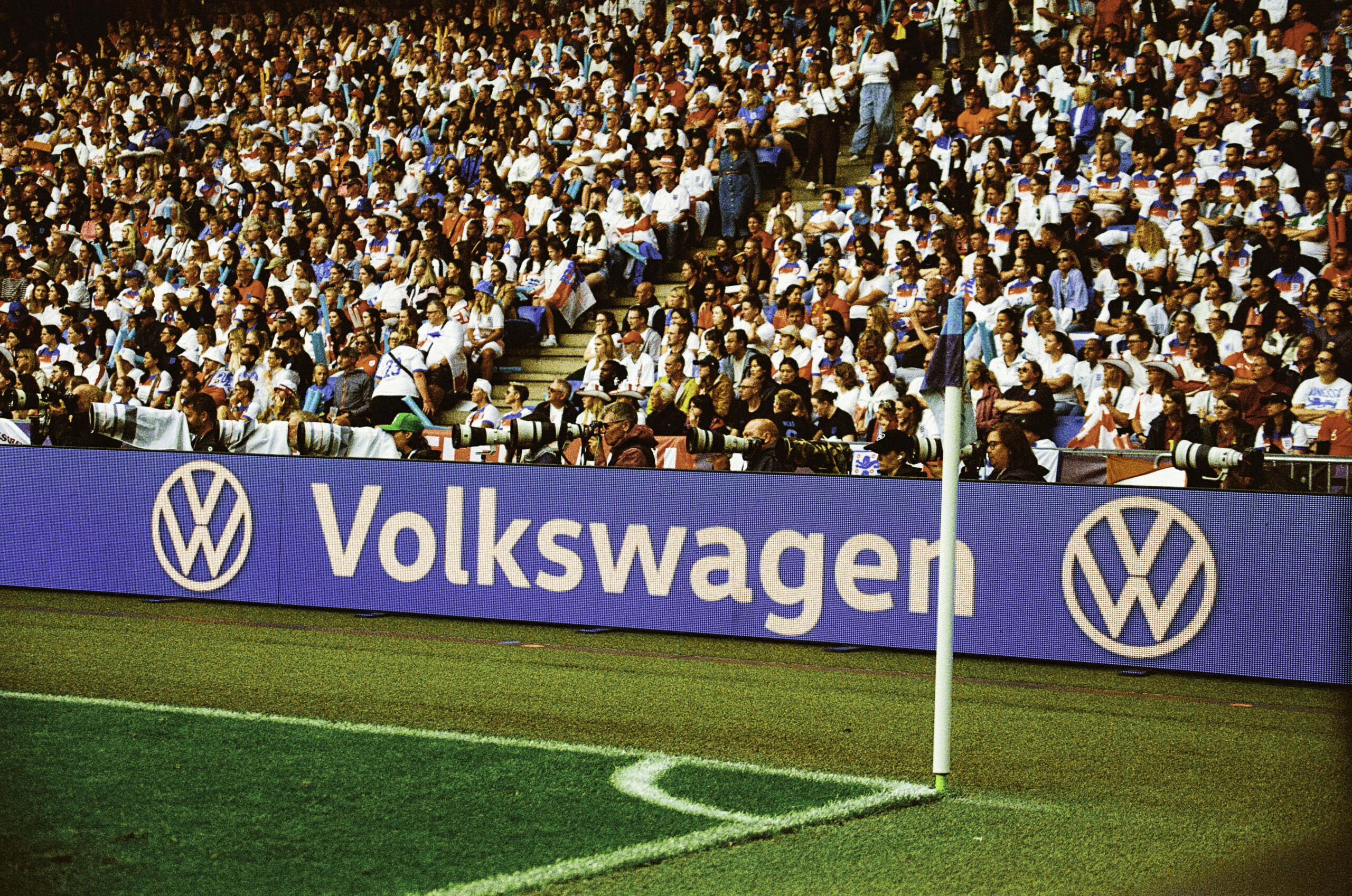
Corner flag, sponsor board, and a firing squad of 400 mm lenses all trained on the penalty area. Behind them, the lower tier ripples in England’s palette – white jerseys flecked with red flags and face paint – one dense block of anticipation staring straight past the Volkswagen blue.

I fire, hear the last crank cycle, then silence: thirty-six exposures used up. Warm-ups, handshake, the Spanish opener, and now this lull before a corner – Roll A’s narrative arc is sealed. The camera rewinds itself, I crack the back, reload in twelve seconds flat. Roll B will have to finish the story Roll A just set in motion.

Halftime

Halftime hush, teams breathe, anticipation
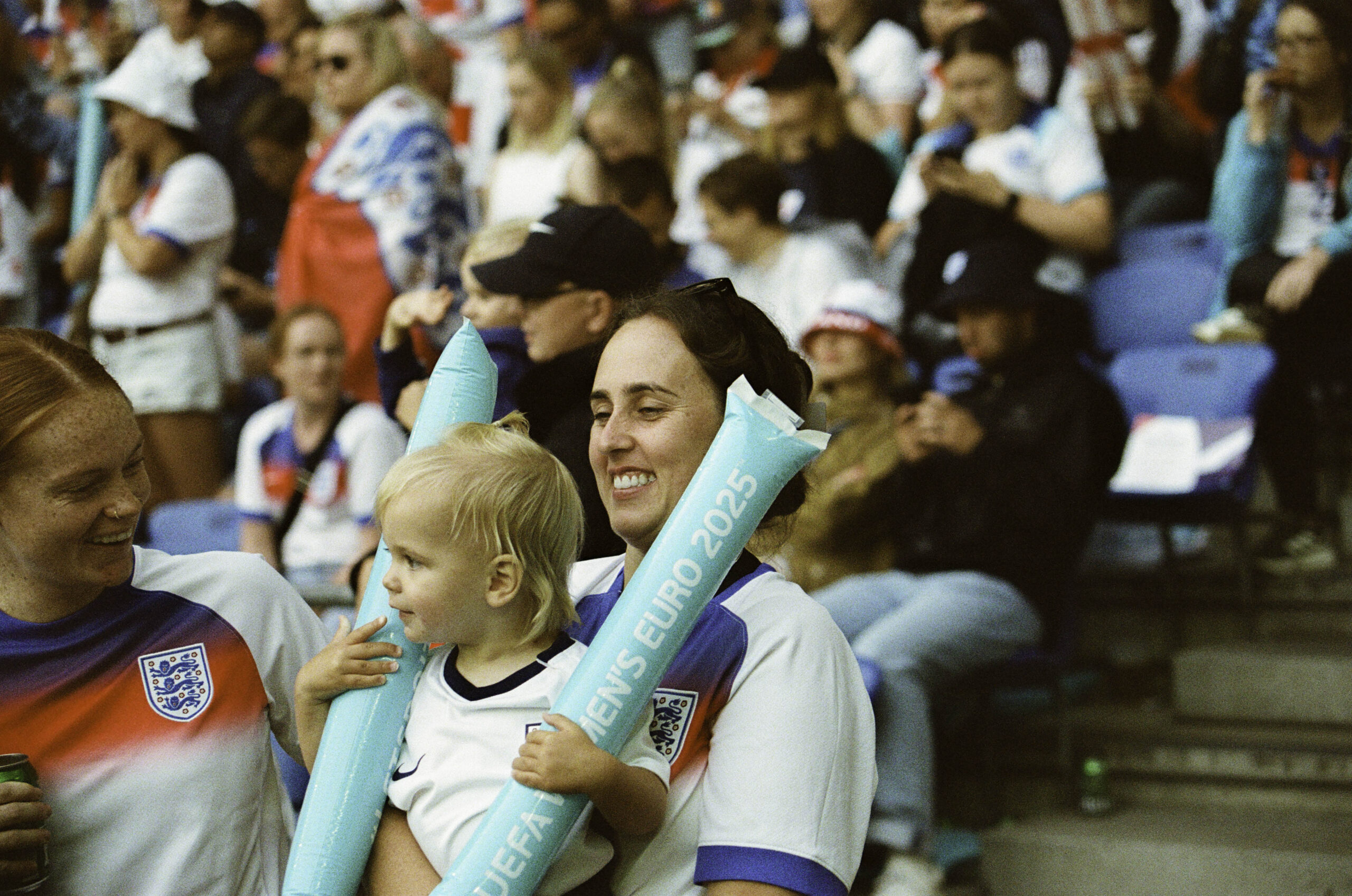
Playtime in miniature: a toddler in a downsized England kit wrestles two aqua‑blue clappers while Mum steadies both child and thunder-sticks against her shoulder. The little one taps a finger on the lion crest, trying to understand why cloth and colour can make a whole stand sing. A friend leans in with a grin and a can of beer, trading grown-up tension for a quick co-oed “peekaboo.” Around them fans scroll phones, sip their own pints, stretch calves – but this corner of the pause feels like a living room.

It’s the only point in the night when heart rates dip long enough for small moments to surface. In fifteen minutes the whistle will haul everyone back into surge mode; for now, a toddler’s giggle fills the gap between tactics boards and second-half nerves.

Most people think halftime is a break; down at ground level it’s a pit stop. With the concourse taps foaming and hundreds of red-and-gold jerseys shuffling toward bratwurst lines, entire blocks of seats sit vacant, their flags drooping like laundry in a lull. The hush lets you hear things you never notice at full roar: studs clacking on concrete, selfie shutters ticking, the compressor hiss of a drinks cart reversing.

On the right side, two pitch-keepers in the penalty area perform miniature surgery on the grass. One prises up a fist-sized divot left by a late first-half lunge, then tamps it flat with the back of a boot. A few metres behind them, goal-line photographers lean over the remote cameras to swap batteries and cards and to do last chance adjustments to gear they won’t be able to touch once the whistle blows again.

Act II is minutes away, and the stage is reset for every fresh sprint, slide, and story the second half will give.

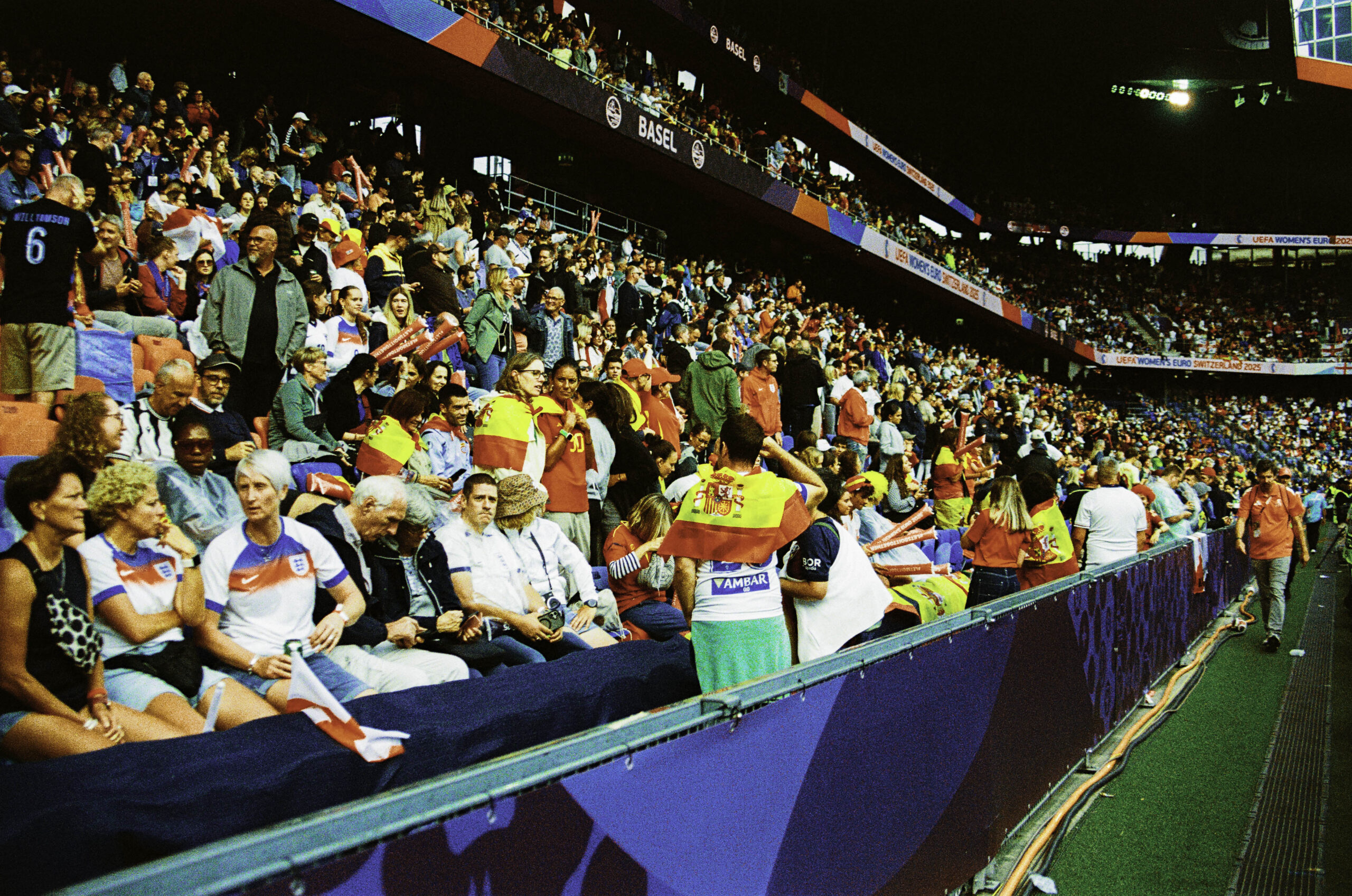
Halftime debate: Spanish flags draped over shoulders mingling with England’s white and red shirts, everyone leaning in to dissect that first-half goal. No police buffer, no snarling chants – just rival ankles tapping the same seat rails while arguments stay playful. A grandfather in a bucket hat passes his binoculars to a Spanish teen; two Lionesses fans hold soft-drink cups for a neighbour who’s tying her Roja scarf tighter. Nobody worries about wearing the “wrong” colours on the tram ride home. For these ninety minutes, the sport remembers what it could always be – shared, spirited, and safe enough for strangers to trade stats without checking the badge on each other’s chest.

Halftime hustle, goal line of England.
That’s my mate Philipp – sometimes we file for the same agency, sometimes we race each other to the upload button. His mini-office is textbook pitch-side: folding chair skewed toward the penalty area, 400 mm bazooka balanced on the monopod, orange Ethernet snaking to the switch. The silver pop-up shelter isn’t a cooler; it’s a laptop cave – keeps glare off the screen and drizzle off the keyboard so captions don’t drown.

Right now he’s not chaining keywords, though. Eye glued to the long glass, he’s panning across the VIP seats, probably hunting the royal pair for that one soft-focus moment wire services will pay double for. Football can wait three beats – celebs don’t linger. One frame, quick chimp, zip the tent, and back to the action before the restart whistle cracks.

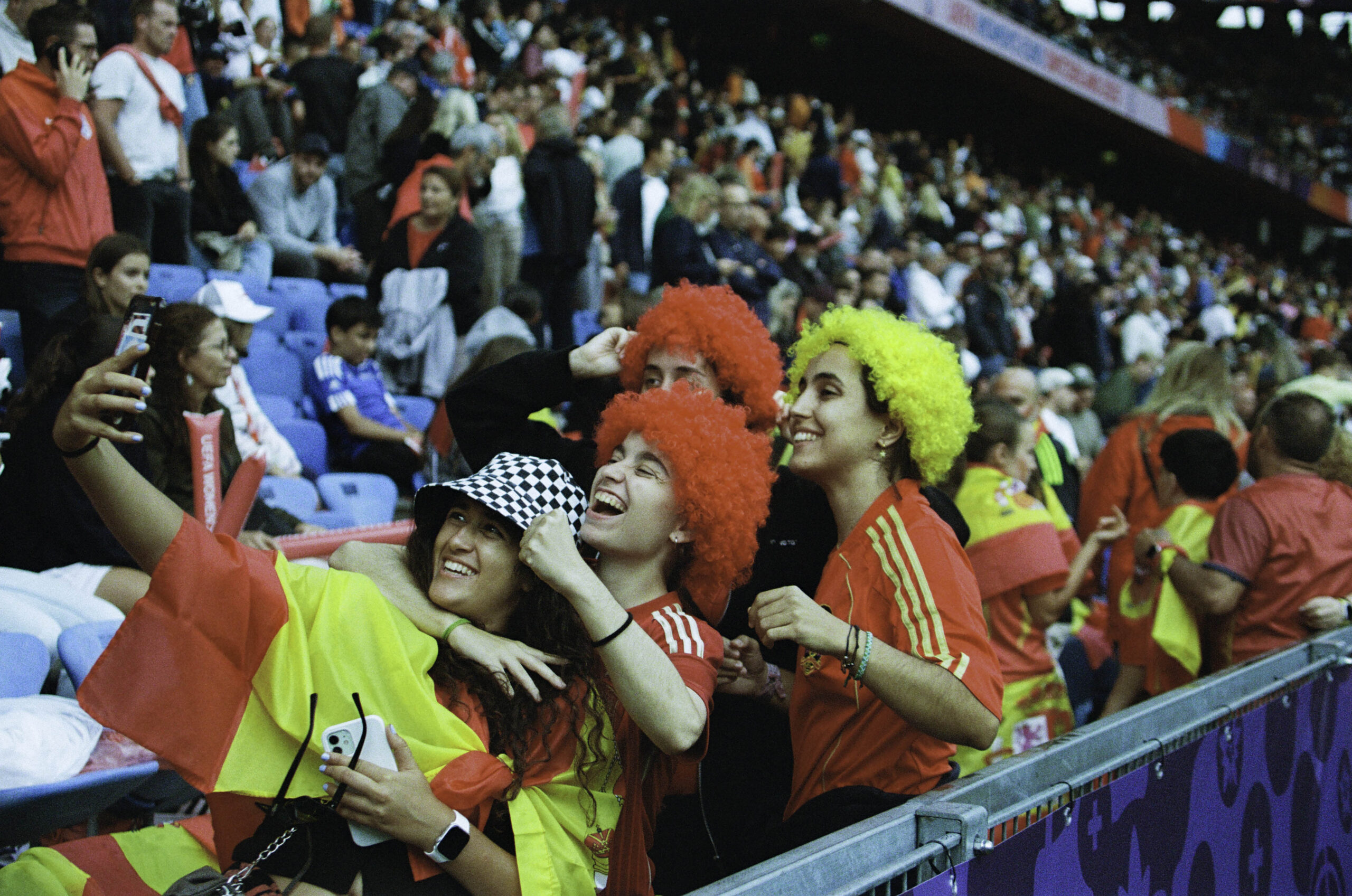
Halftime scoreboards still glow 1-0, and this pod of Spain fans decides the moment is worth a souvenir. Two red wigs, one yellow, a checkered bucket hat, and a flag turned impromptu shawl – leaning together at the rail, they stretch an iPhone just far enough to squeeze everyone’s grin into frame. The flash of the front camera pops; laughter pops louder. For sixty seconds they’re their own victory parade, no matter what the clock finally reads.

90′

Pressure peaks, minutes bleed
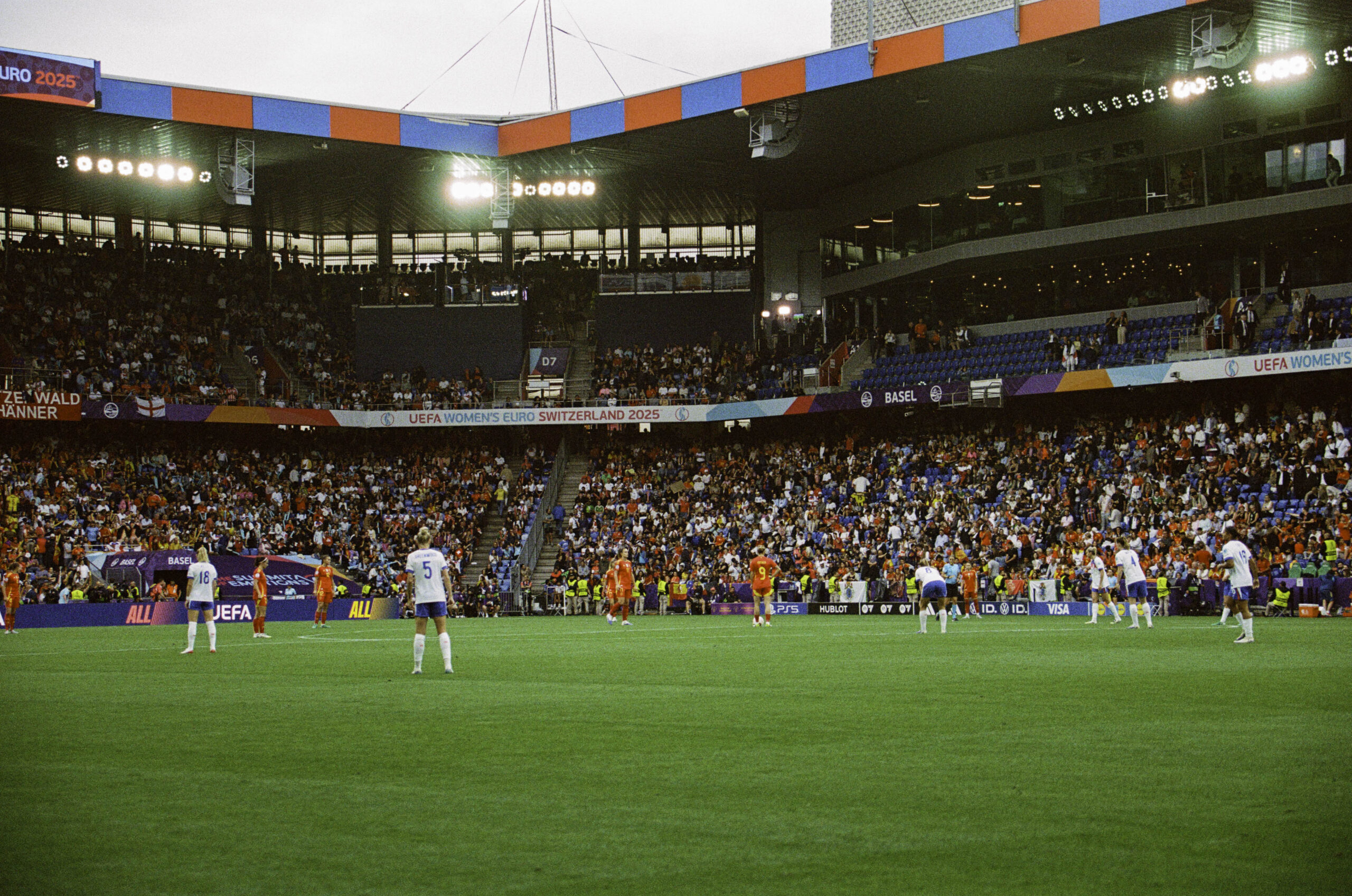
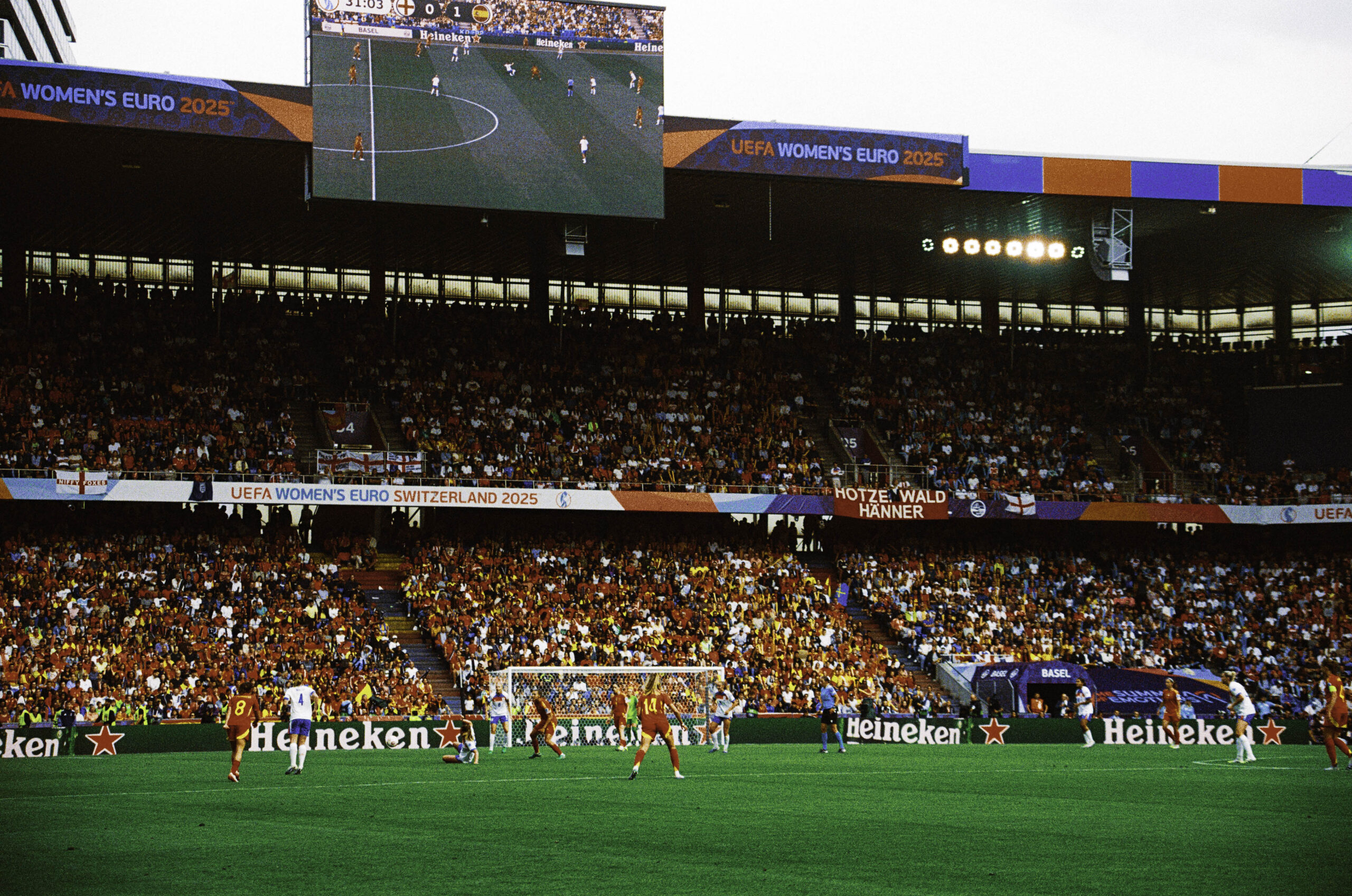
Seconds before the restart: Spain’s No. 9, Esther González, sets one boot on the ball, eyes fixed on the referee’s hand. Is England settling into an aggressive 4-4-2? Hips angled forward, ready to press the back pass and claw the match level. Up in the photo pit we trade quiet guesses: Wiegman’s team has no choice – front-foot, chase, risk the gaps. But what of Spain? Do they guard the single-goal cushion, slow the pulse, smother midfield lanes? Or do they chase the kill-shot, turn the knife with a second and leave England chasing shadows?

The stadium seems to ask the same question. Red sections drum “¡Vamos!” while white shirts answer with whistles, tension zipping between blocs like static. Floodlights tick a notch brighter, the drizzle that whispered through half-time now barely a memory. One sharp tweet of the whistle will decide the script: bunker or breakaway, survival or statement. Forty-five fresh minutes wait inside this still frame, coiled and ready to run.

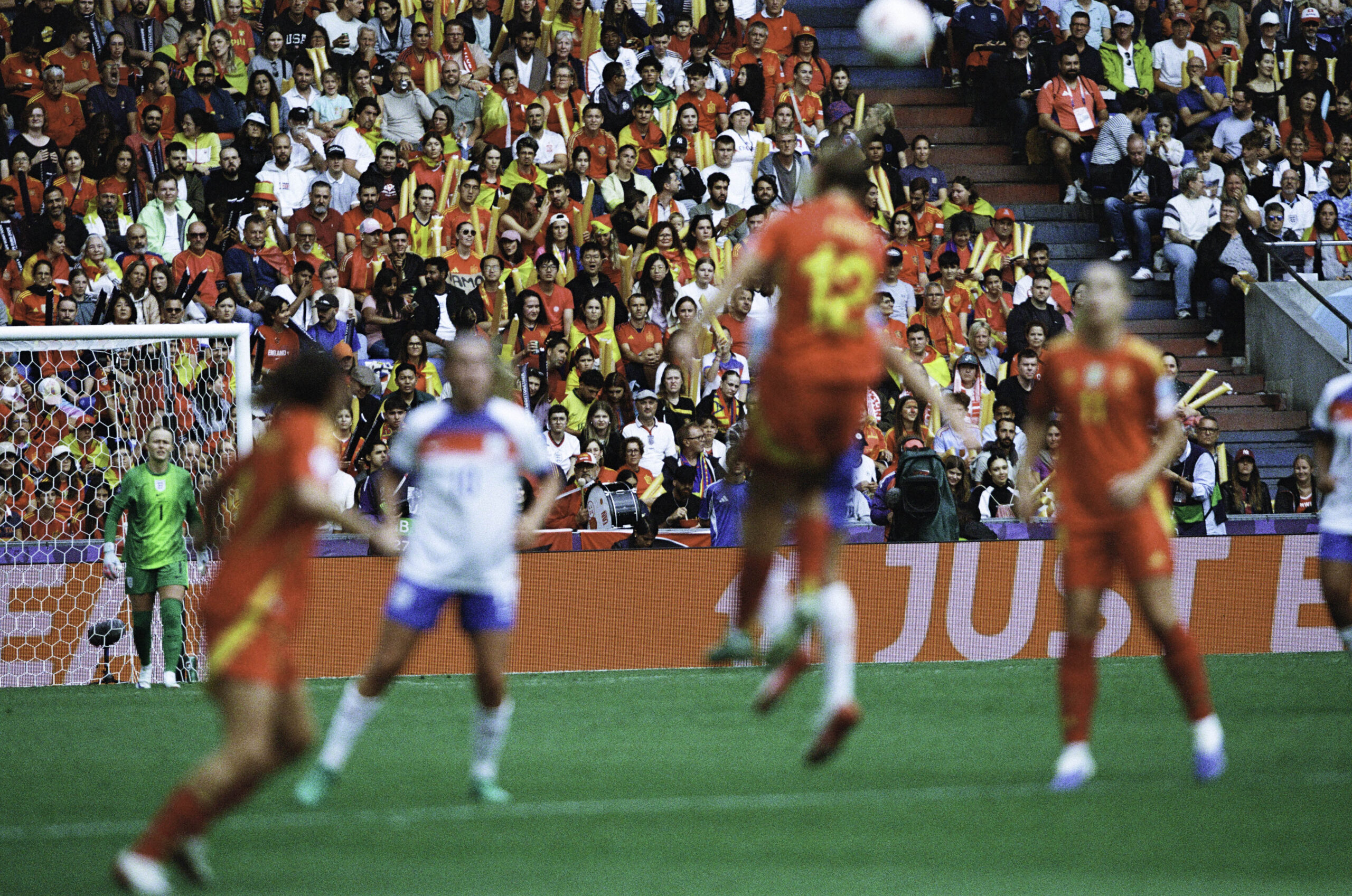
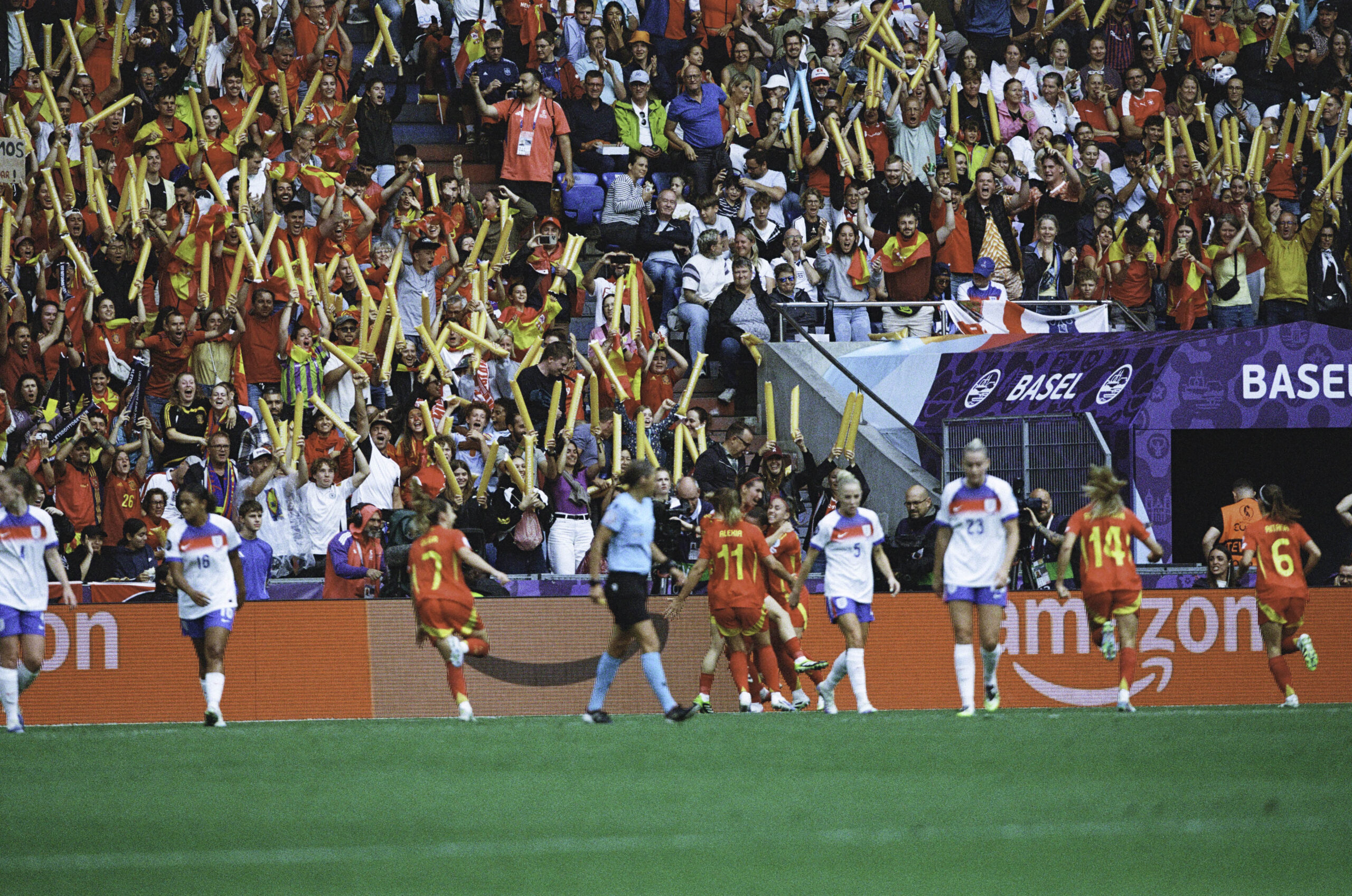
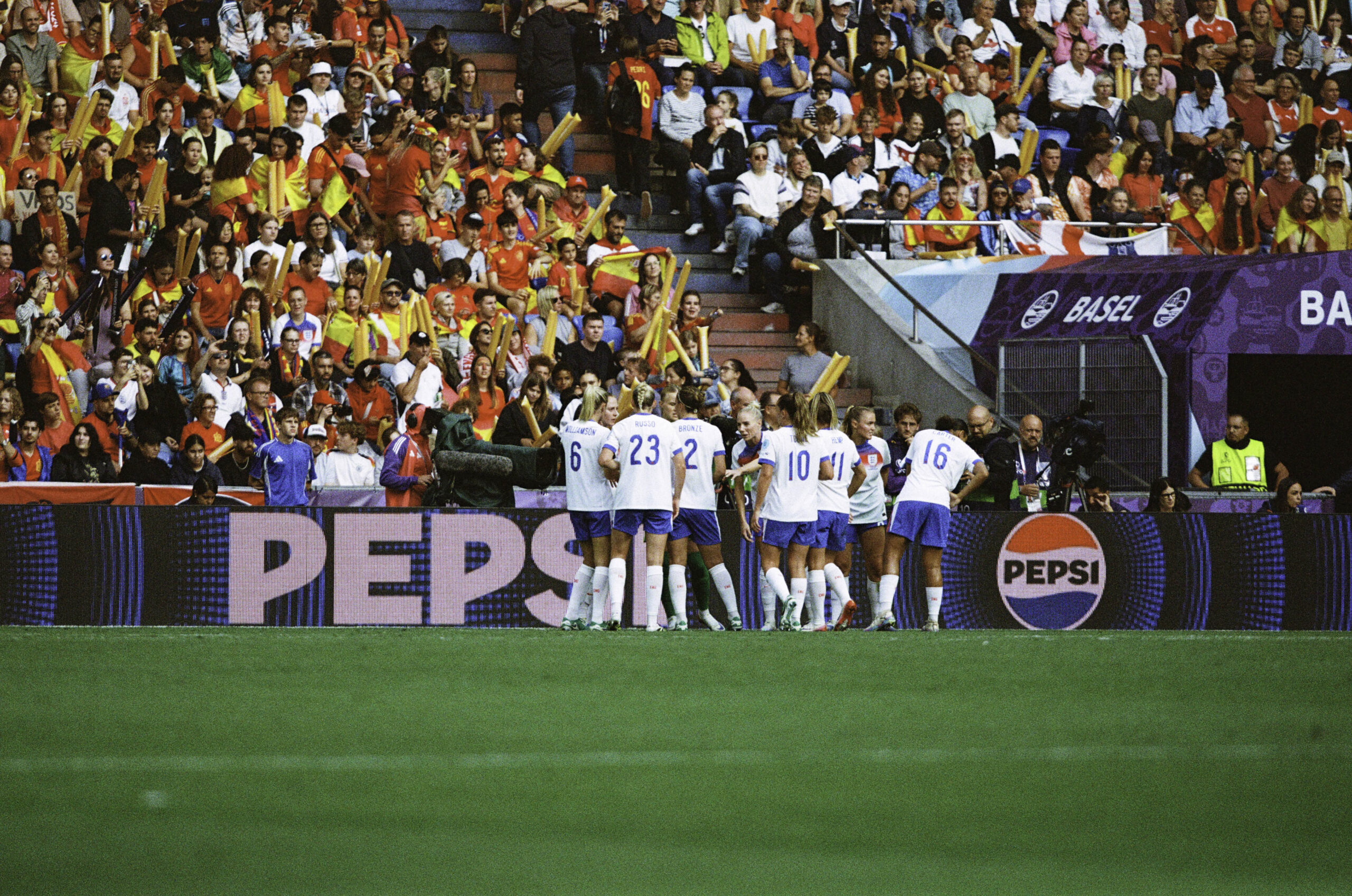
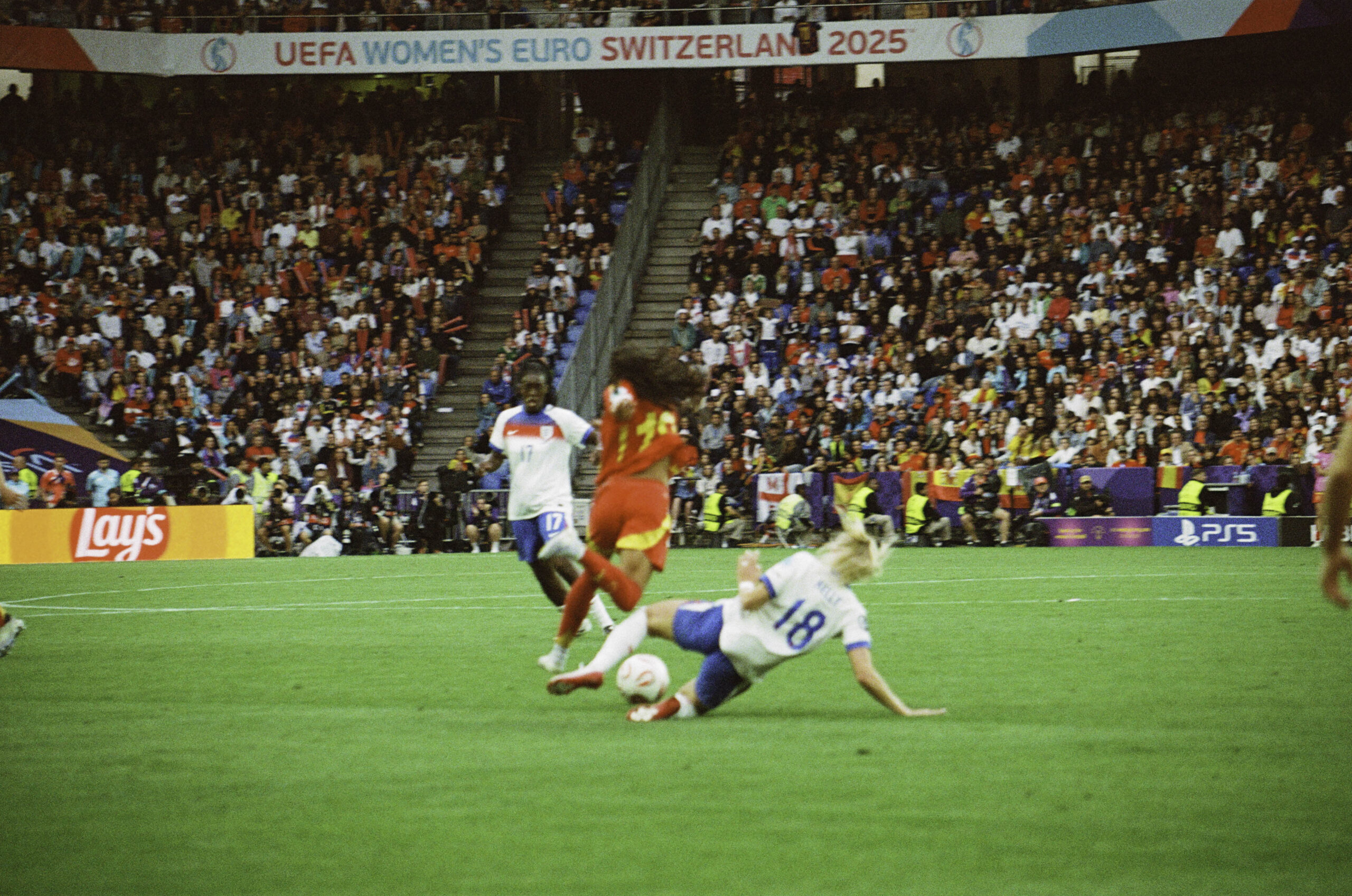
Spain open the half sharper, Mariona first and then Alexia Putellas testing Hampton with skimming drives that make the red end gasp. Possession tilts, England chase shadows – until minute 57 flips the mood. Substitute Chloe Kelly, just on, bends a left-side cross into the corridor of uncertainty; Alessia Russo meets it full forehead, angle true, net billowing before Cata Coll can set her feet. 1-1. A single, clean header resets every balance we’d spent fifty-plus minutes pencilling out.
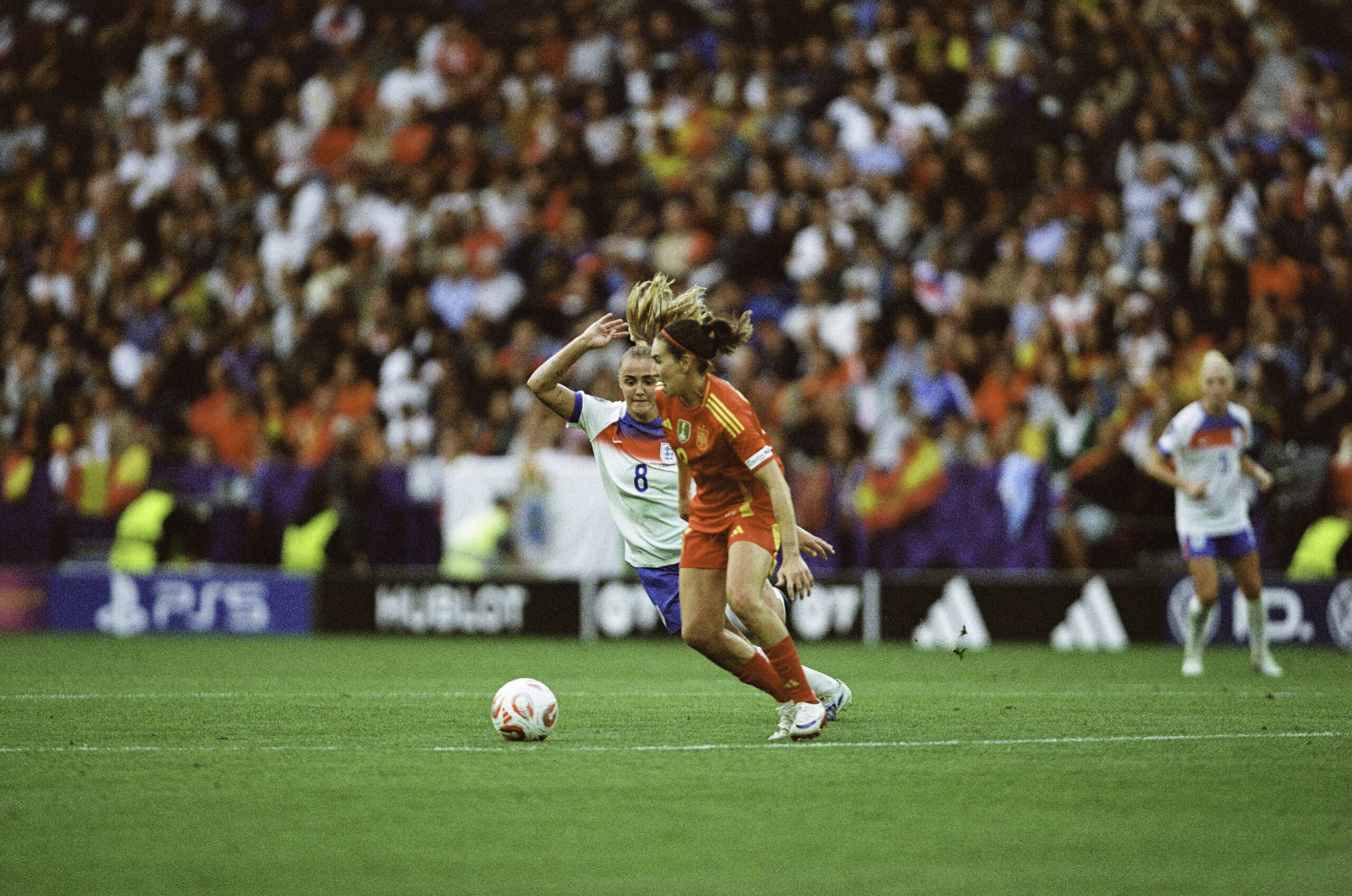
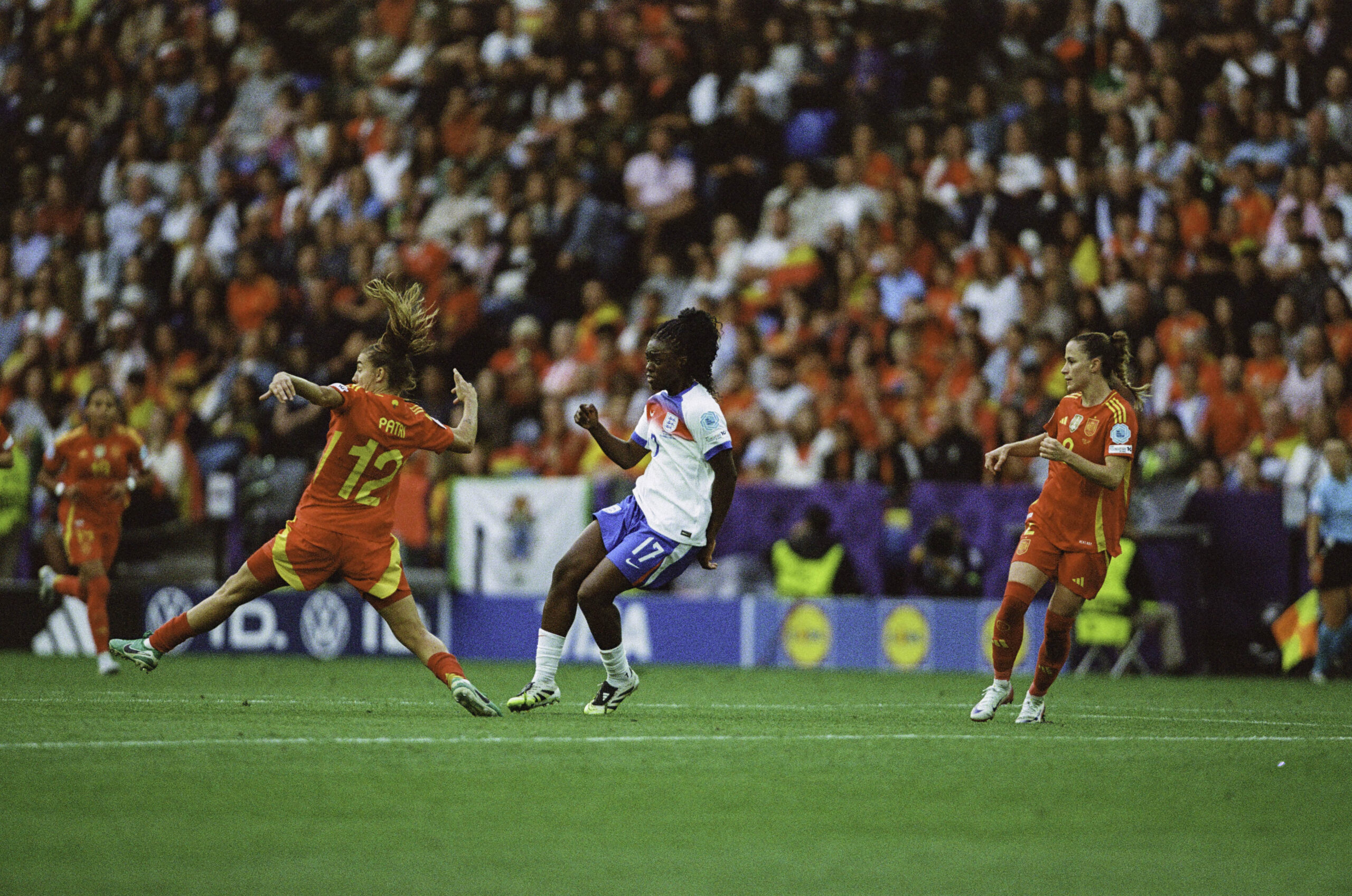
120′

Exhaustion grips, resolve endures
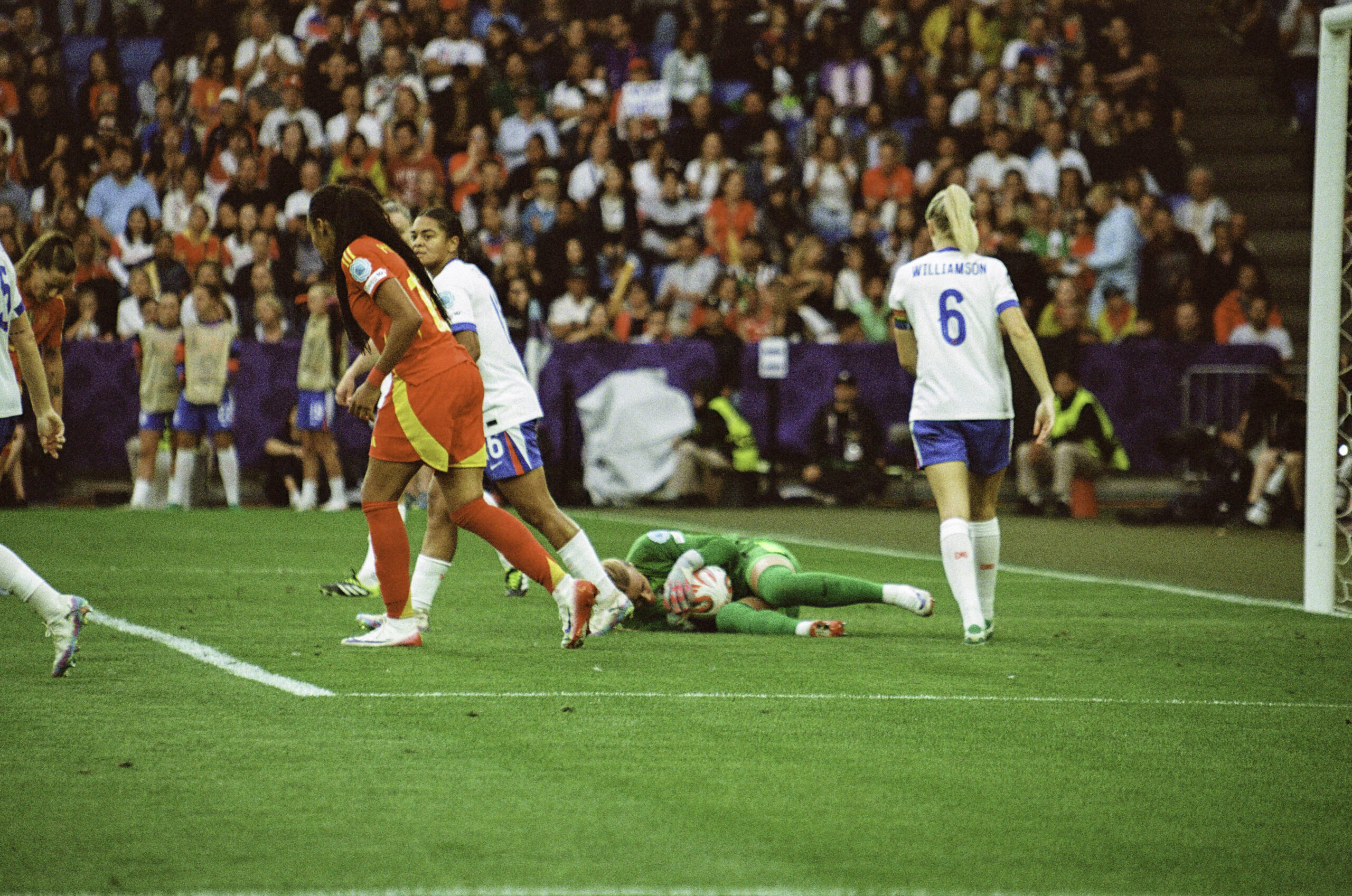
Hannah Hampton smothers the ball at the second grab, body stretched across the penalty area, boots just inside the frame of the near post. Esther González, Spain’s poacher-in-chief, had pounced on the rebound a half-beat earlier – enough to raise 30 000 throats in the stadium – yet the keeper’s left glove corked the gap, dragging the ball back under her chest before studs or hope could prod it loose. Leah Williamson pivots, barking a reset.

It’s the third close-range denial in fifteen minutes, each one a different page from the keeper’s manual: fingertip parry, near-post block, now this full-body clasp. Spain sense that a second goal would tilt the whole night; England live on the wire Hampton keeps tight. You can watch the confidence ripple out – first to the back line, then to midfield – every time she stands and winds the clock down with a slow roll to the edge of the box.

In the stands a pocket of Spain fans resume the drumbeat, louder this time, as if sheer volume might slip the next shot past her gloves. But Hampton’s eyes never leave the ball as she places it for the punt, exhaling once, resetting the story England still believe they can rewrite.
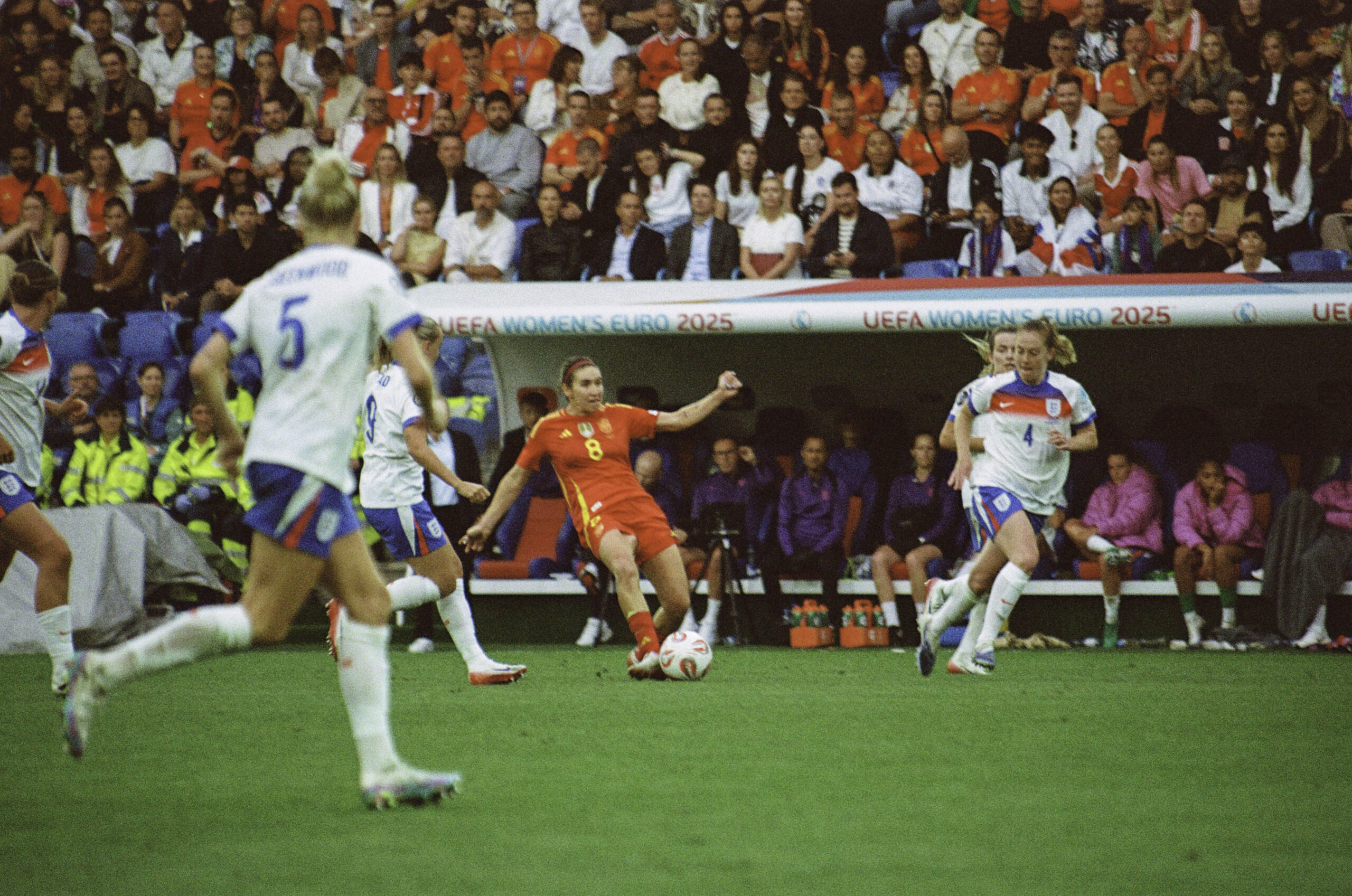
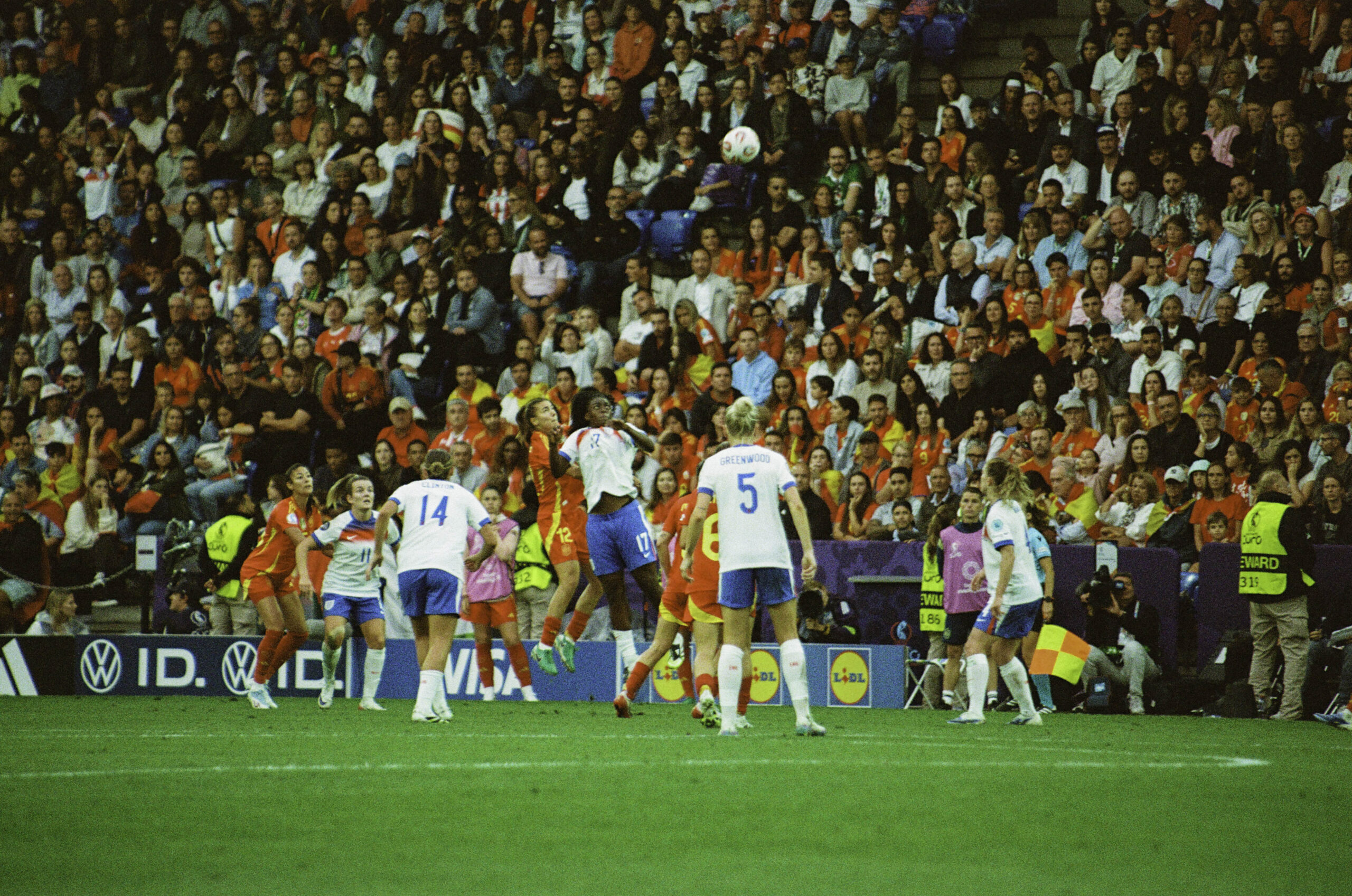
Hundret-plus eighteen on the stadium clock and legs are long since past tidy technique – Patri Guijarro and England’s late sub Michelle Agyemang launch off tired calves, meeting the looping clearance so high the ball seems to stall, undecided. Around them Spain’s midfield files snap shut, Greenwood braces for the second ball, stewards on the sideline lean in. Still 1-1, lungs burning, and every contested header feels like the toss of a coin that could tip the final before penalties call the final bluff.

Penalty

Spotlight glares, destinies flip
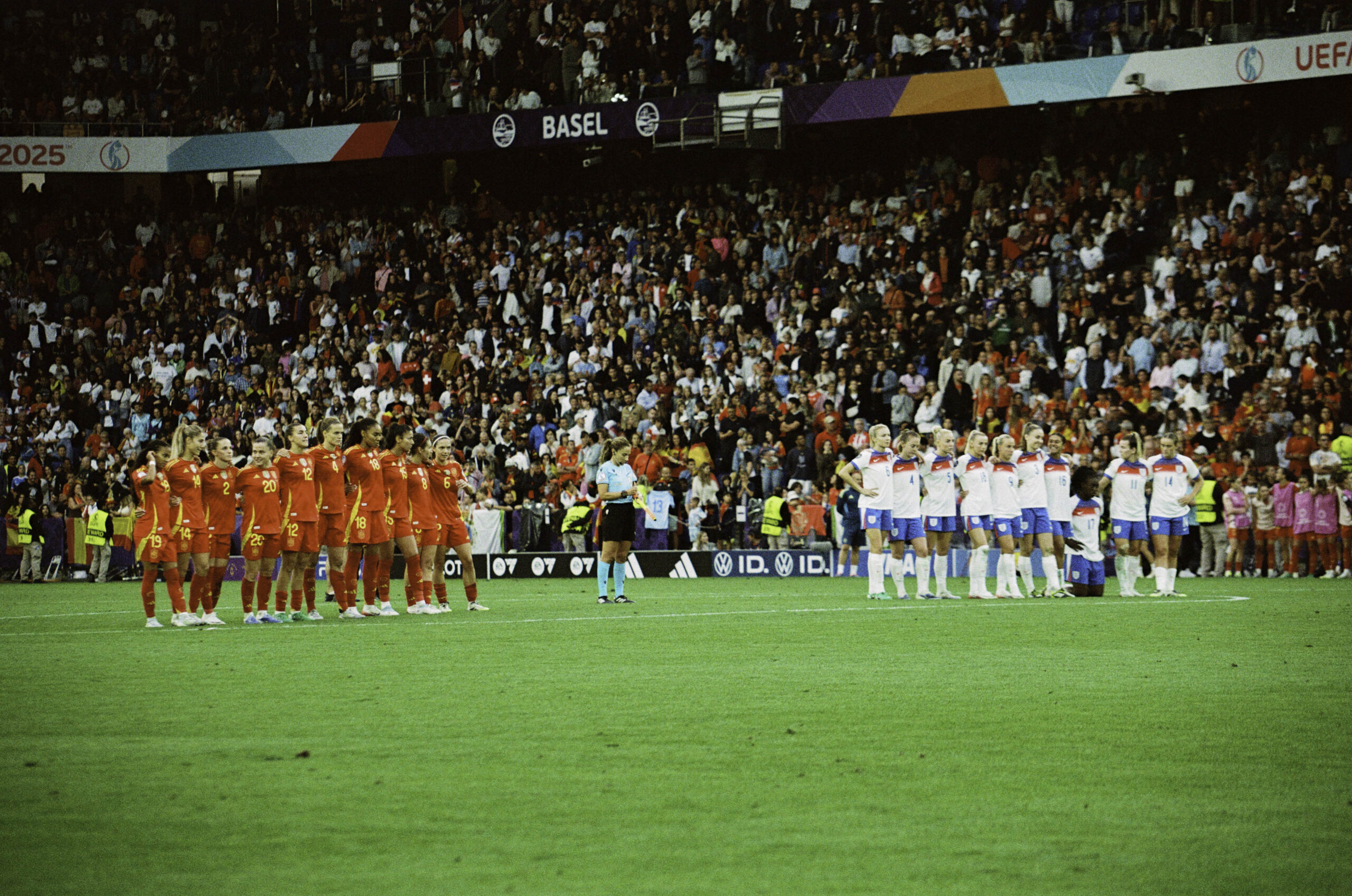
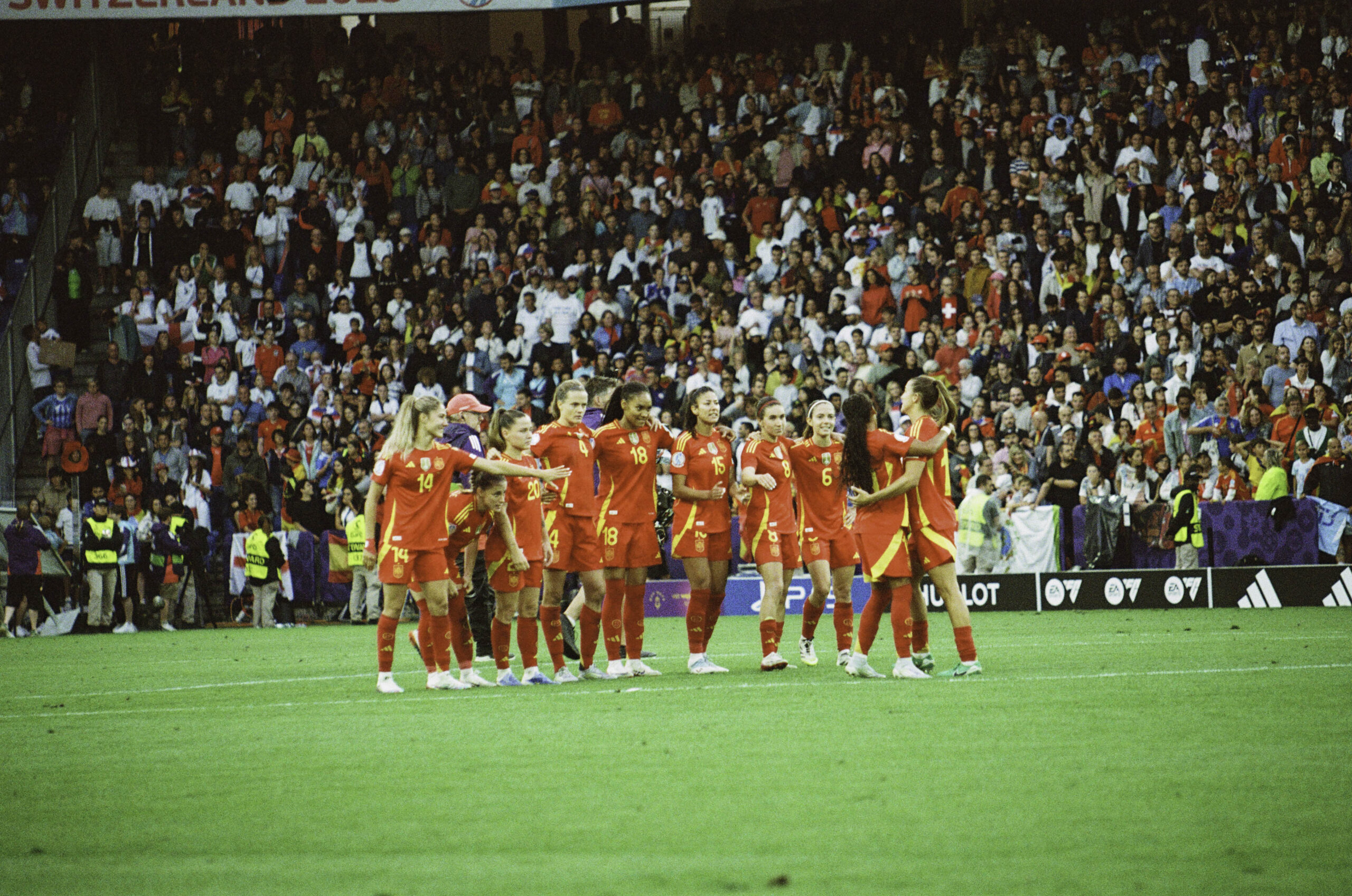
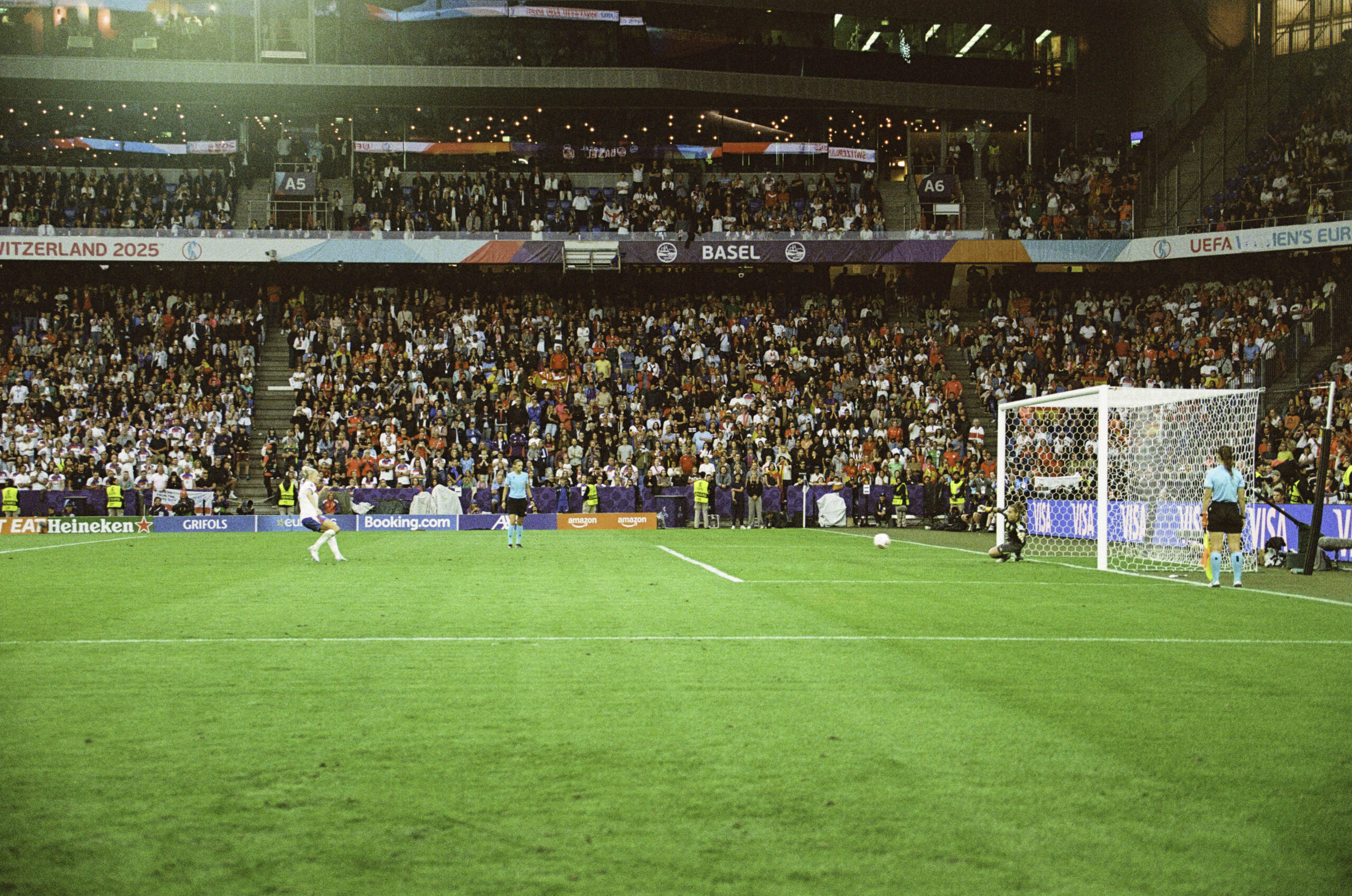
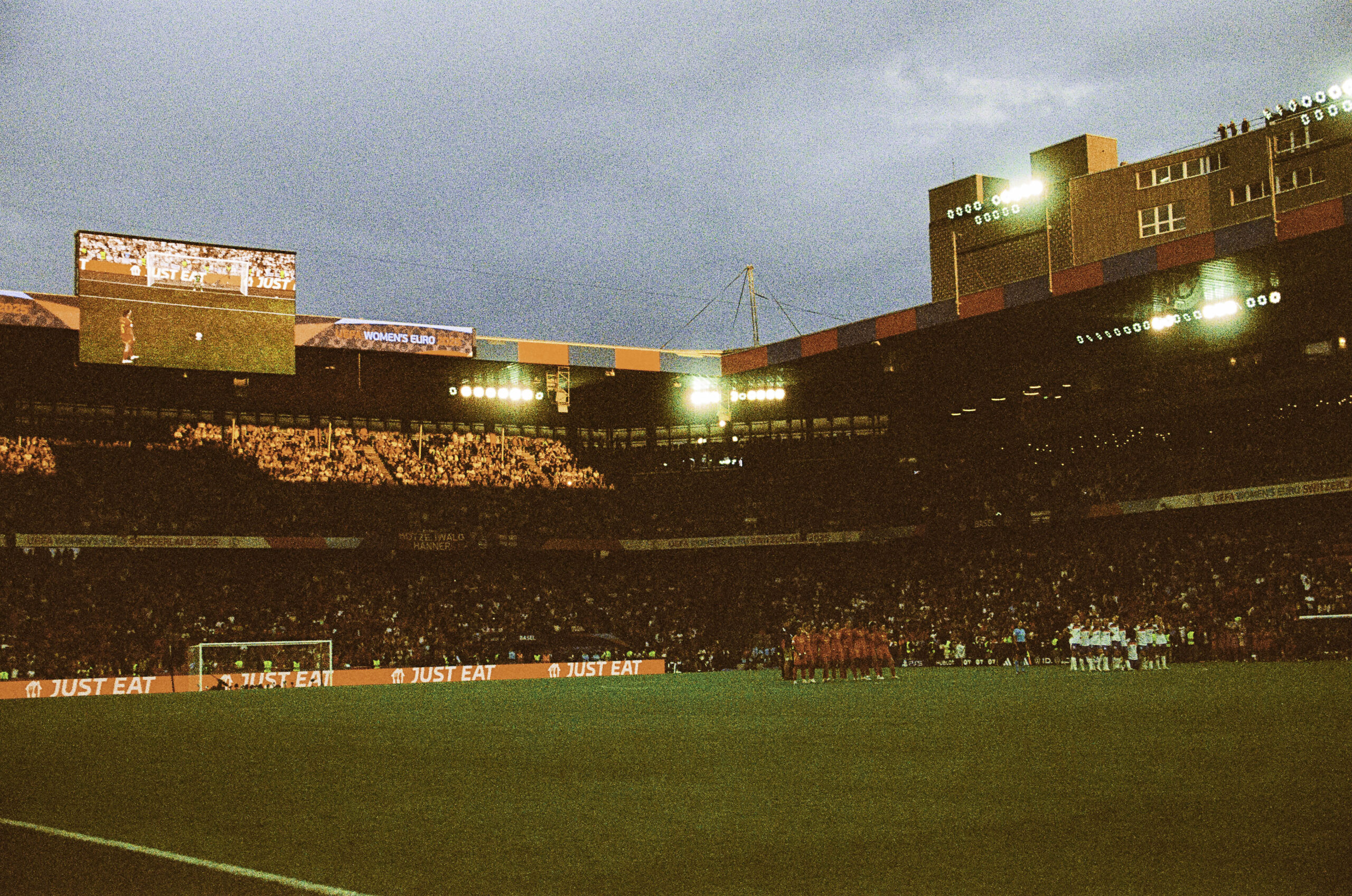
The stadium exhales into the hush that only a penalty shootout can manufacture. Two straight lines – Spain in flame red, England in white and blue – stretch across the centre-circle shadow like rival school choirs. It’s the first Women’s Euro final to reach this point since 1984 where Sweden bet England, and nobody in Basel is pretending to be calm.

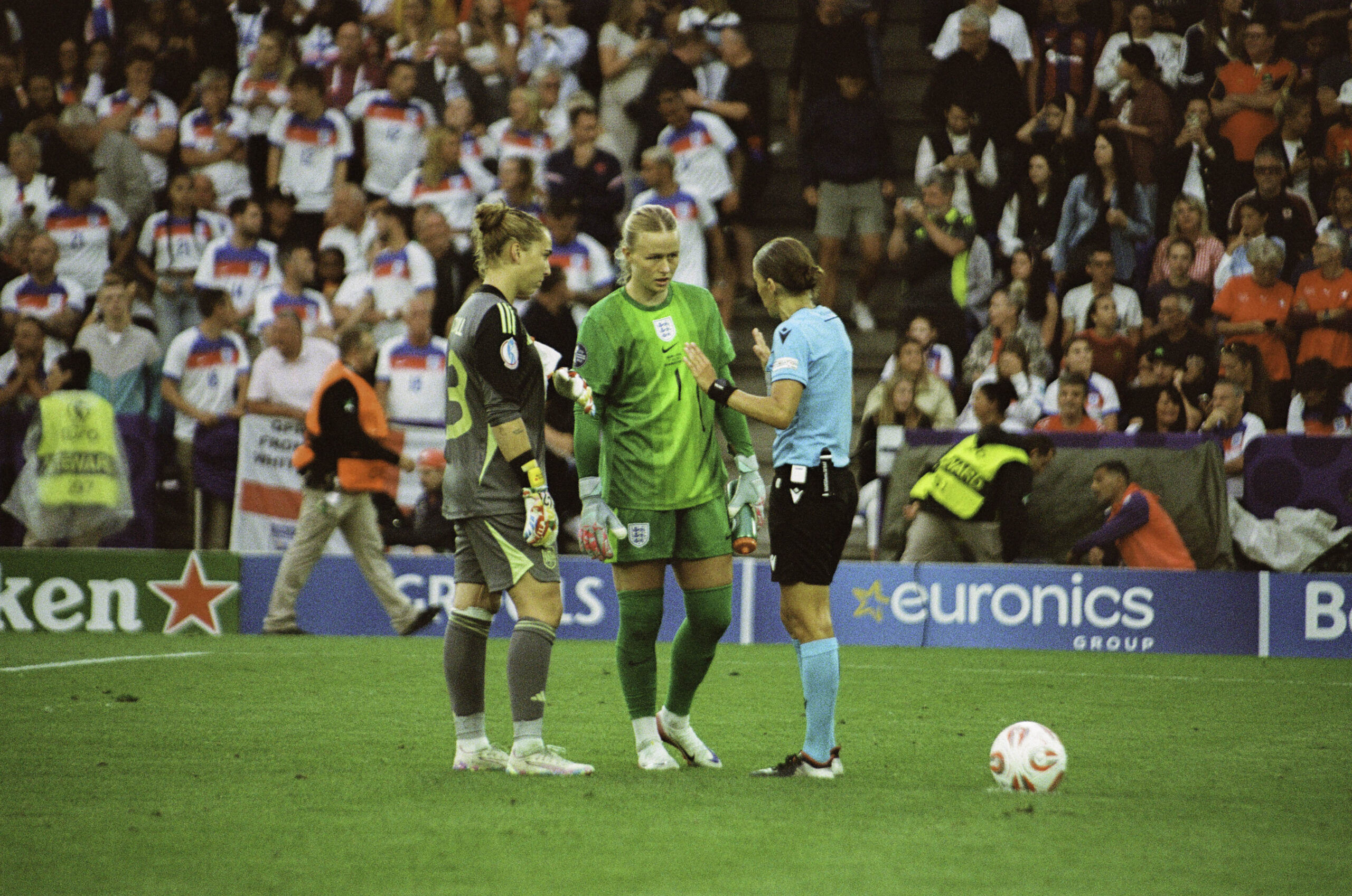
England’s fate rests on Hannah Hampton. She’s already kept her side alive for 120 minutes, but now the assignment narrows to five duels. In the inset frames you can follow her ritual with the referee: gloves tightened, eyes fixed, a nod that says I’ve got this. Moments later she proves it -twice. She goes low to her right to swat Spain’s second kick away, then springs left to glove the fourth. Each stop ricochets through the English huddle, turning nerves into ignition.

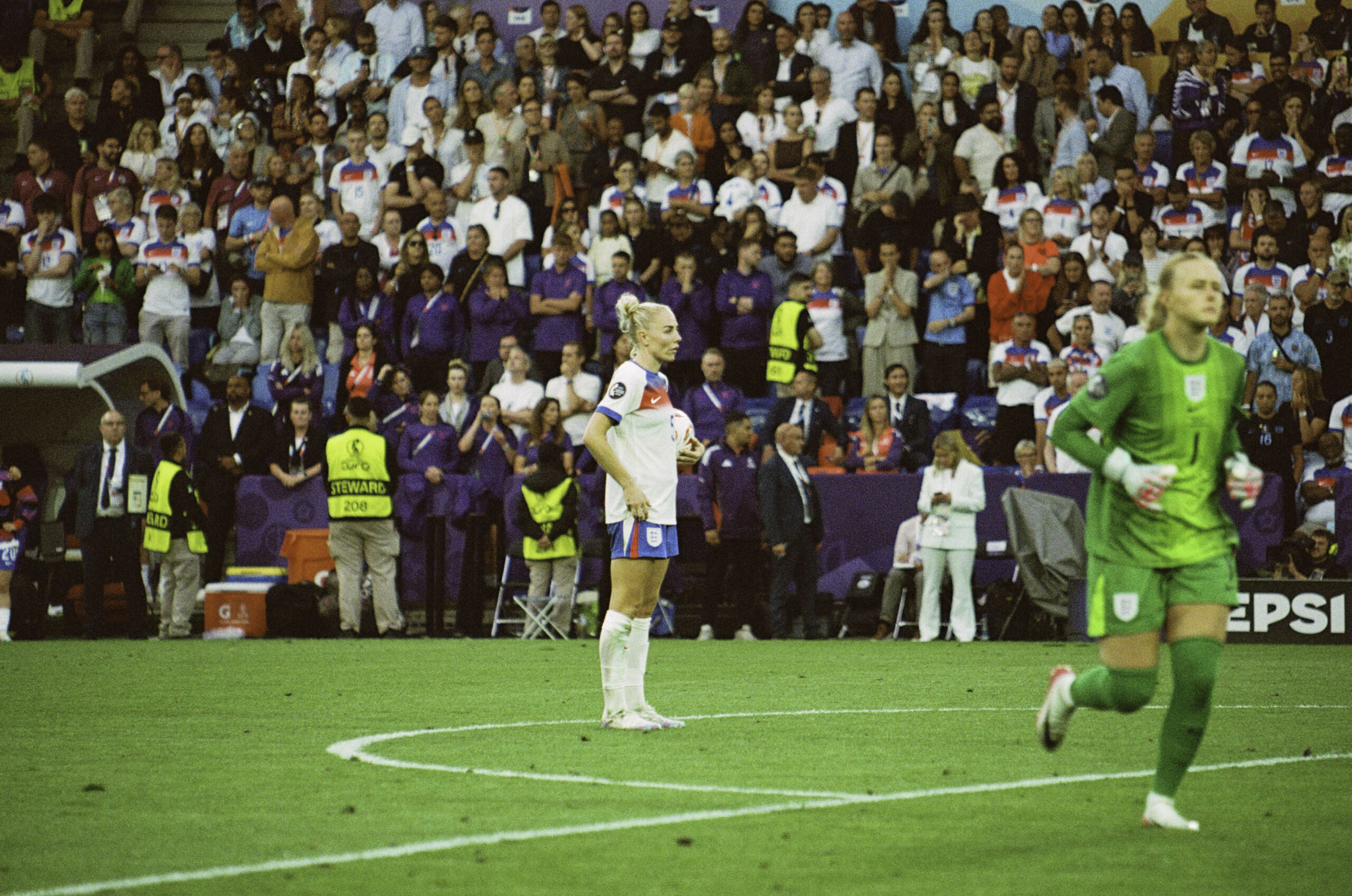
The stage is clear for Chloe Kelly. She walks from halfway, ball tucked under her arm the way kids carry homework, plants it, and hammers high inside the left post. Net ripples, scoreboard flips, and thirty-nine years of shootout heartbreak evaporate in a single swing. England win the title on penalties, 3-1, because Hampton wrote the script in saves and Kelly signed it off with certainty.
Victory

Fans roar, players swarm
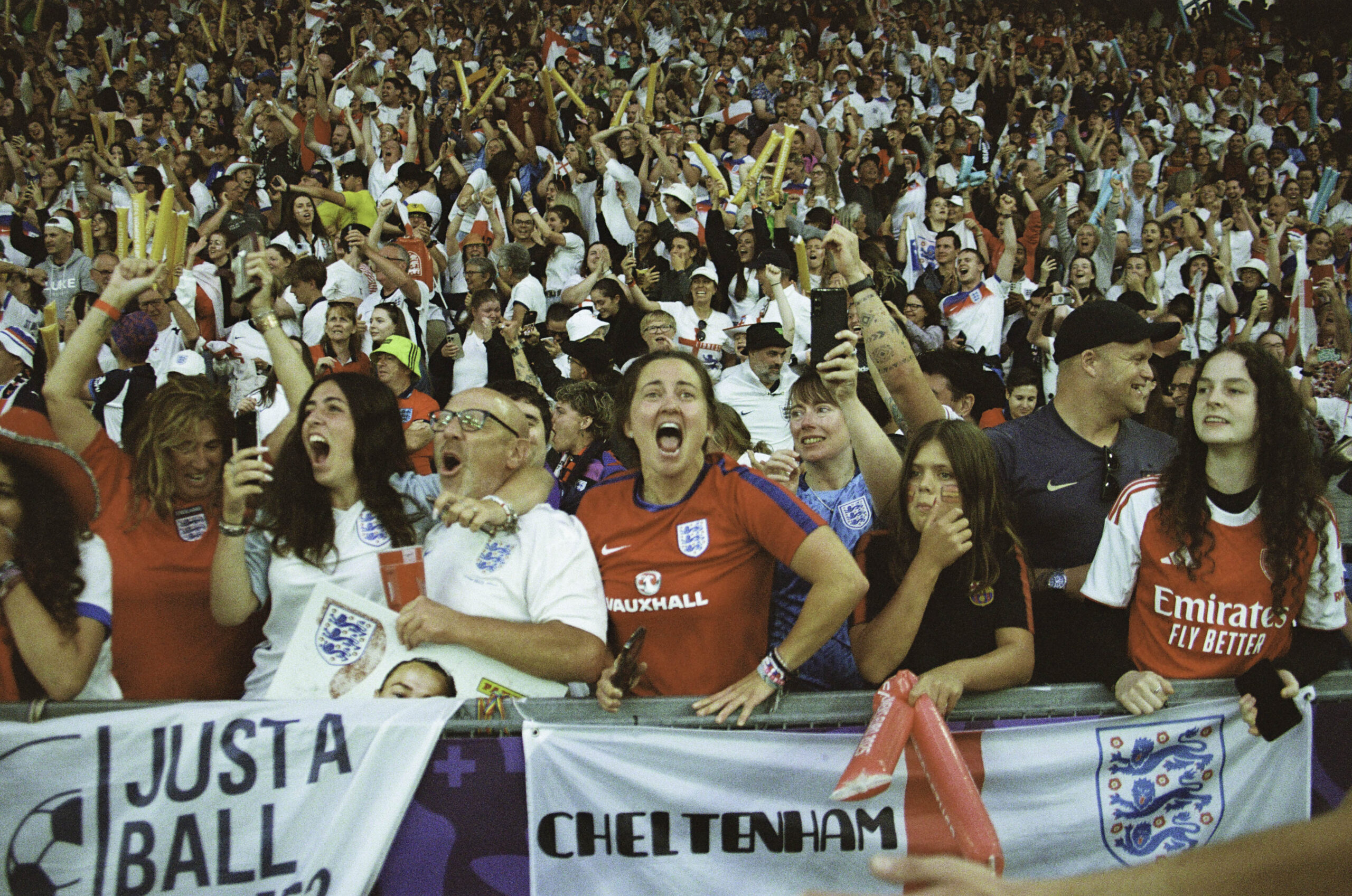
Joy detonates in the England block the instant Chloe Kelly’s winner rips the net. Rows of white and red jerk to their feet as if yanked by the same string – pints launched skyward, phones scrambling for proof, throats giving up every decibel they saved for this moment. In the crush at the barrier a woman in an old Vauxhall-sponsored kit howls at the sky, arm slung around a stranger who’s clutching a folded flag like a life vest. Foam thunder-sticks crash together, selfies blur, someone sobs into a bucket hat, and a girl with Three Lions face paint pauses mid-scream to check that it’s all real. For a few ungoverned beats the Switzerland night belongs to Cheltenham, to Brighton, to every backyard where these colors first mattered – one roaring, shaking hymn to a trophy finally coming home.

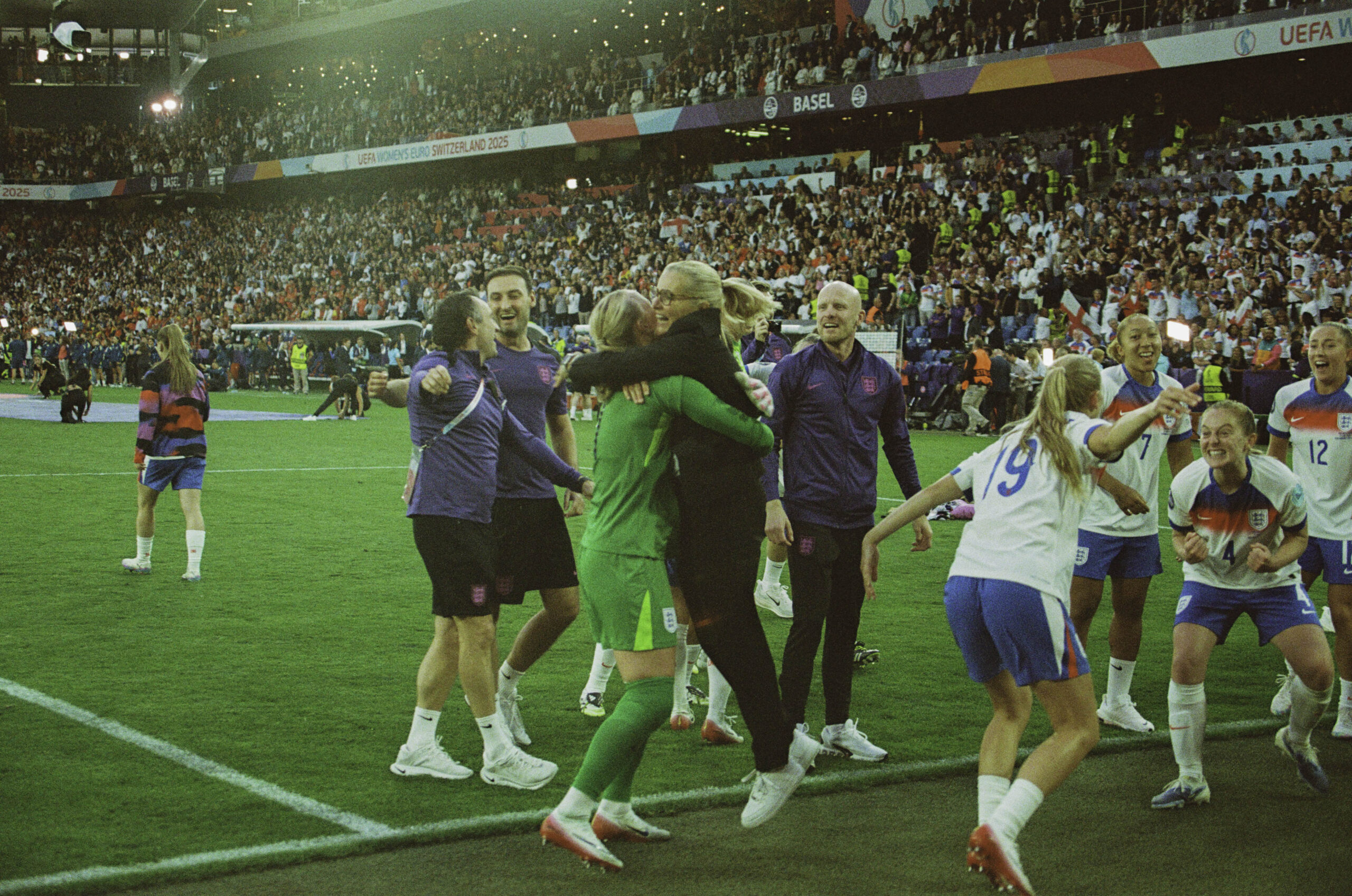
England’s bench empties like a dam breaking. Hannah Hampton, gloves still damp from the last penalty save, sweeps head coach Sarina Wiegman clean off the ground in a hug that’s half relief, half disbelief. Around them, staff and players turn the goal line into a tangle of pointing, shouting, laughing – Lucy Bronze doubled over in triumph, Keira Walsh pumping both fists toward the stands. Behind the huddle, red-shirted Spain players stand scattered, their silence swallowed by a stadium roaring white and blue. For this instant, it’s all joy, all theirs.

Cheer

Silver raised, confetti rains
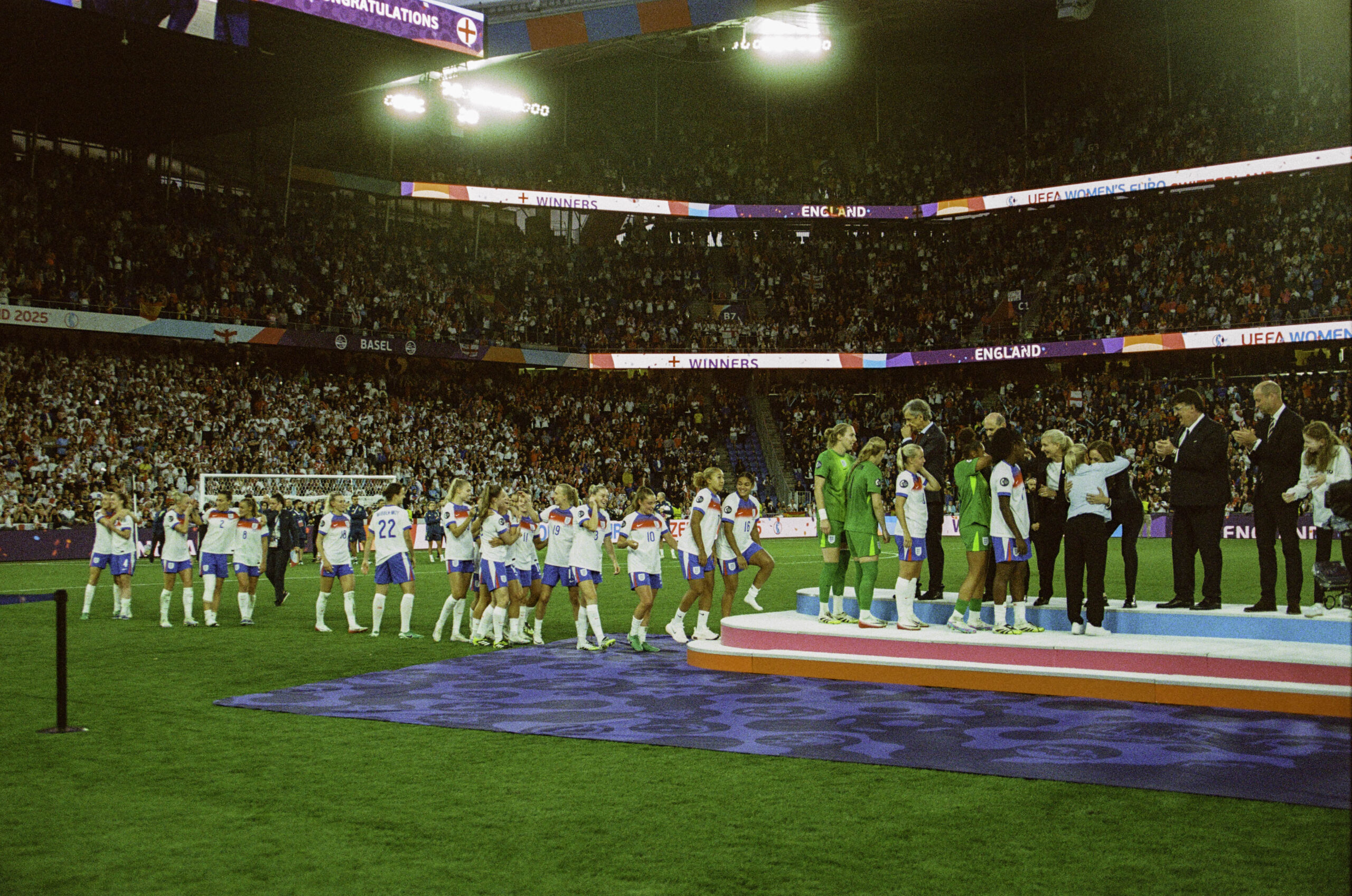
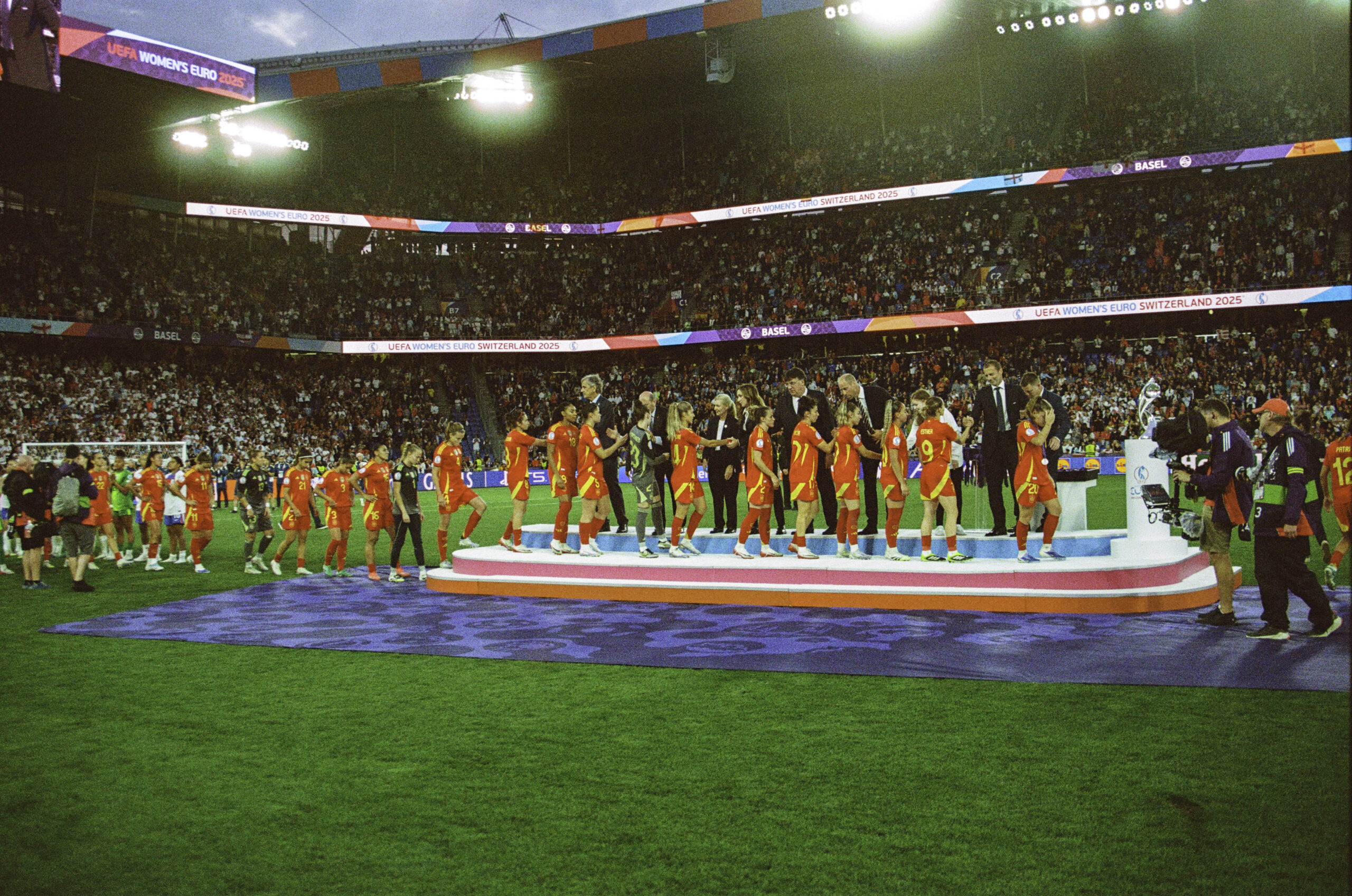
Spain’s line shuffles onto the podium – boots scuffing the temporary steps, heads held just high enough for the cameras. One by one they accept the silver medal that weighs more than its gram count, a quick handshake from UEFA dignitaries, then a glance toward the trophy parked a few metres away like a promise broken at arm’s length. Red shirts gleam under the flood-lights, but their shoulders carry the dusk of what-ifs: Mariona’s early curler, Putellas’ inch-wide volley, a single kick in the shoot-out. Behind them the south stand gives a respectful ovation while England’s huddle waits in the half-light, ready to storm the stage. For La Roja this slow procession is the hardest sprint of the night – thirty seconds to swallow defeat, square the shoulders, and step back into history’s losing column with something like grace.

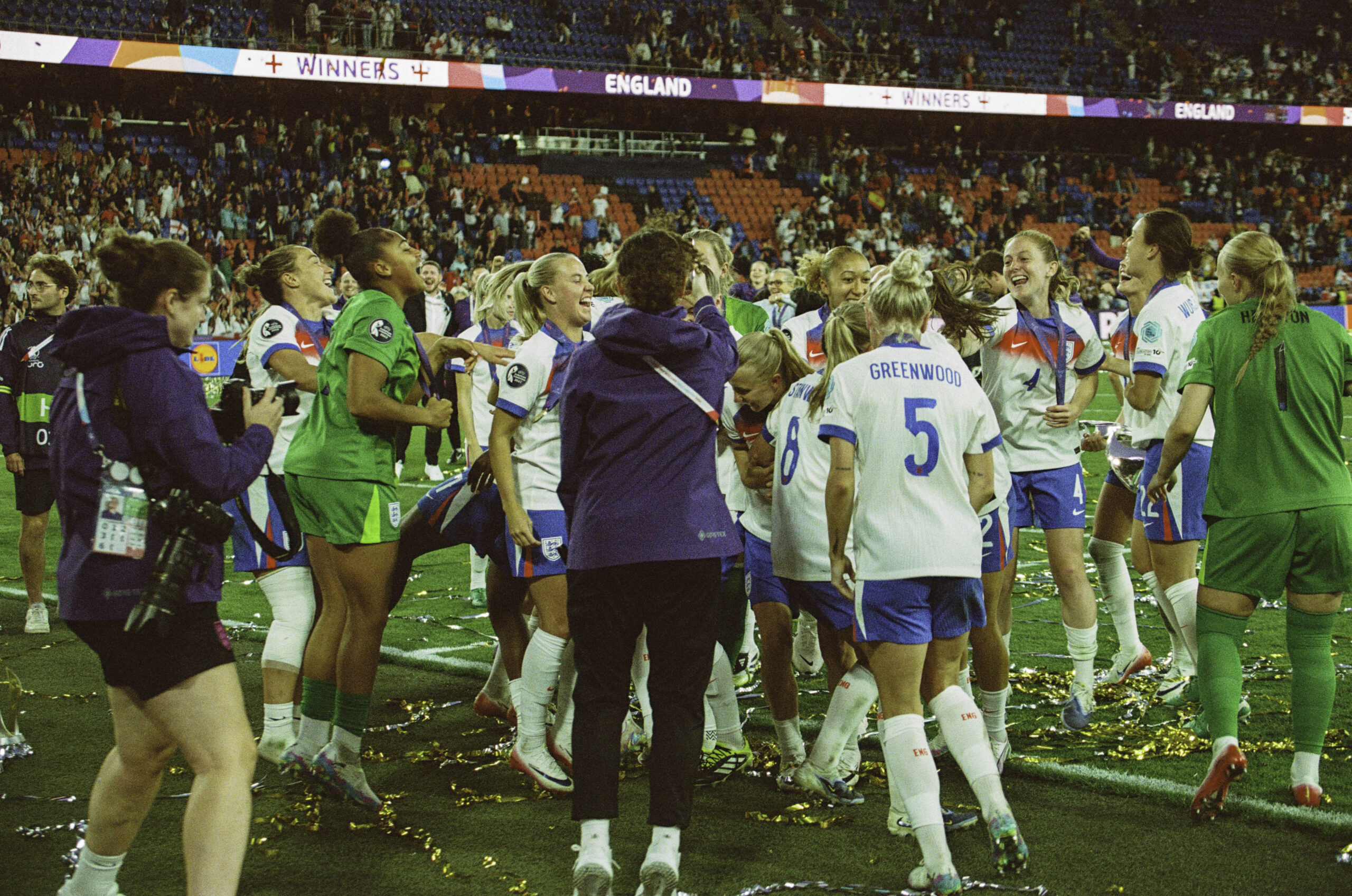
Now it’s England’s turn to thread the blue carpet, only their stride is lighter, shoulders loose, grins leaking before the medals even touch skin. One by one they hop onto the riser – keepers in matching emerald kits first, outfield players jangling boots on plastic steps – collecting gold ribbons from UEFA brass who suddenly seem like part-time roadies at somebody else’s party. Above, the LED ribbon around the bowl spells it out in all caps: WINNERS – ENGLAND. Beyond the podium an ocean of white shirts and St. George crosses boils with noise, while down on the grass everyone’s trying to balance jubilation with protocol long enough to keep the line moving. In sixty seconds the confetti cannons will fire, but this is the sweeter moment: the hush before the boom, when a summer of miles, muscle strains and midnight recovery shakes condenses into the cold weight of a medal pressing against a pulse that’s racing faster than any sprint they logged tonight.

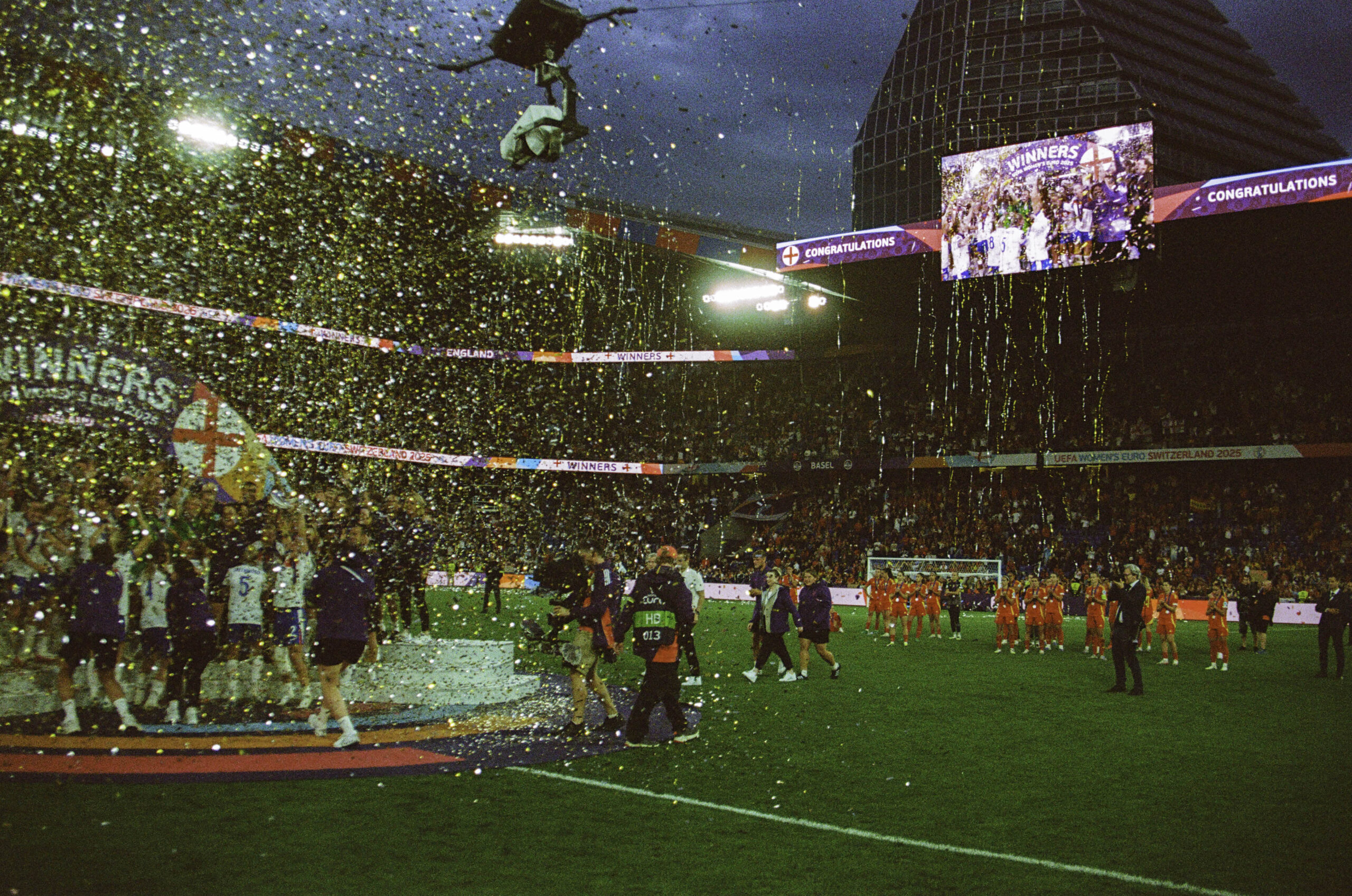
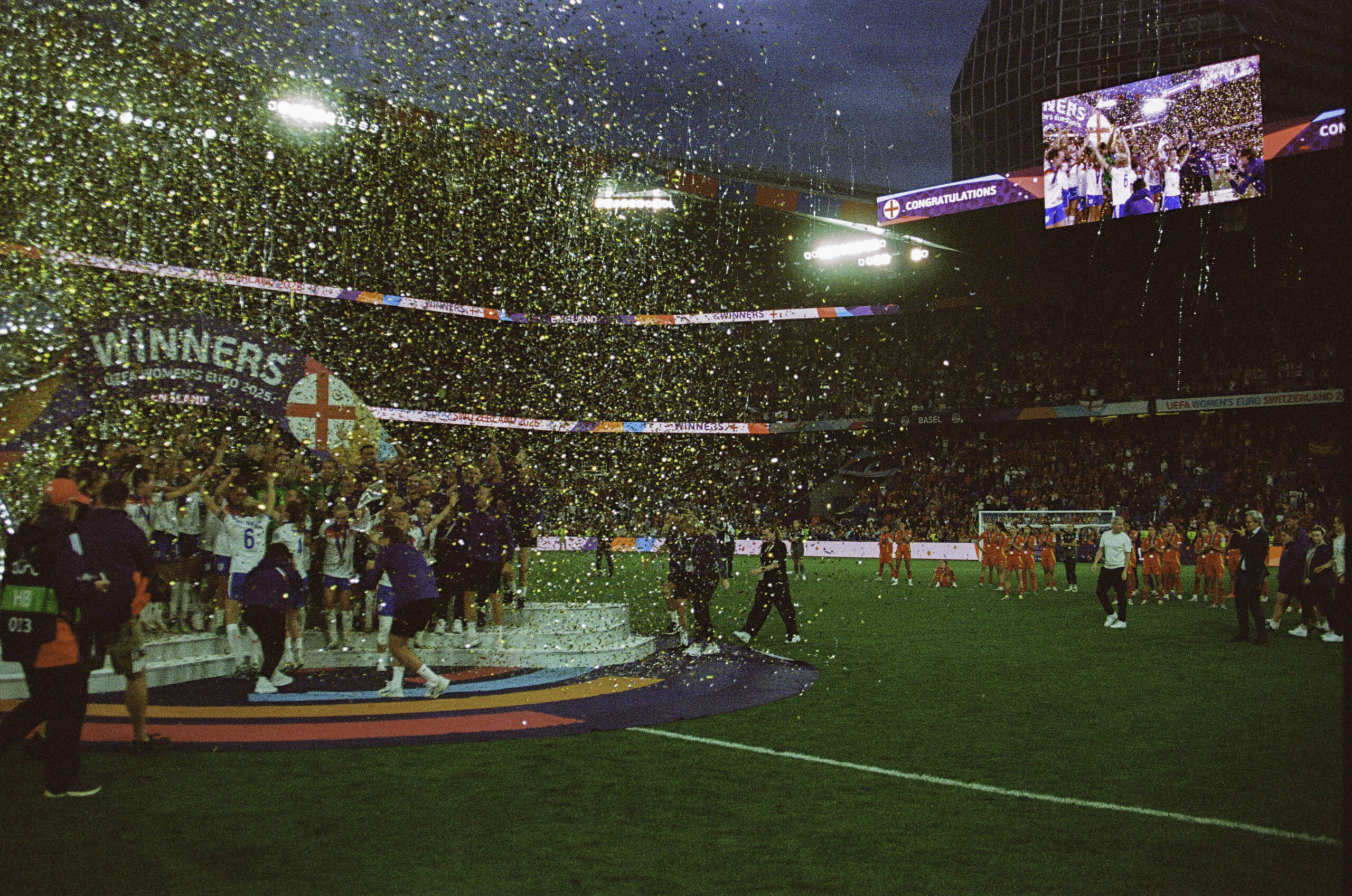
Gold confetti detonates above the podium in a swirling monsoon, the SkyCam whirring through the blizzard like a curious hawk. England’s huddle disappears inside the sparkle, only fists, medals and the white-and-red cross surfacing through the storm. Ten metres away Spain watches in neat rows – some clap, some lean on tired calves, everyone blinking through the same glittering rain that now coats boots, lenses, even the advertising boards. The roar that follows isn’t a single note; it’s layers: players screaming lyrics nobody will recall, fans pitching chants into the night, photographers racking shutters because every frame is suddenly fireworks. For one breath the whole stadium seems suspended – gold dust hanging, floodlights flaring, scoreboards flashing CONGRATULATIONS – and then gravity wins, the flakes settle, and reality clicks back in: Basel’s summer sky, two teams, one trophy, and a pitch that looks like it’s been kissed by stars.

Sorry for an almost identical picture. During the celebration I forgot my task and shot another frame of the same scene.

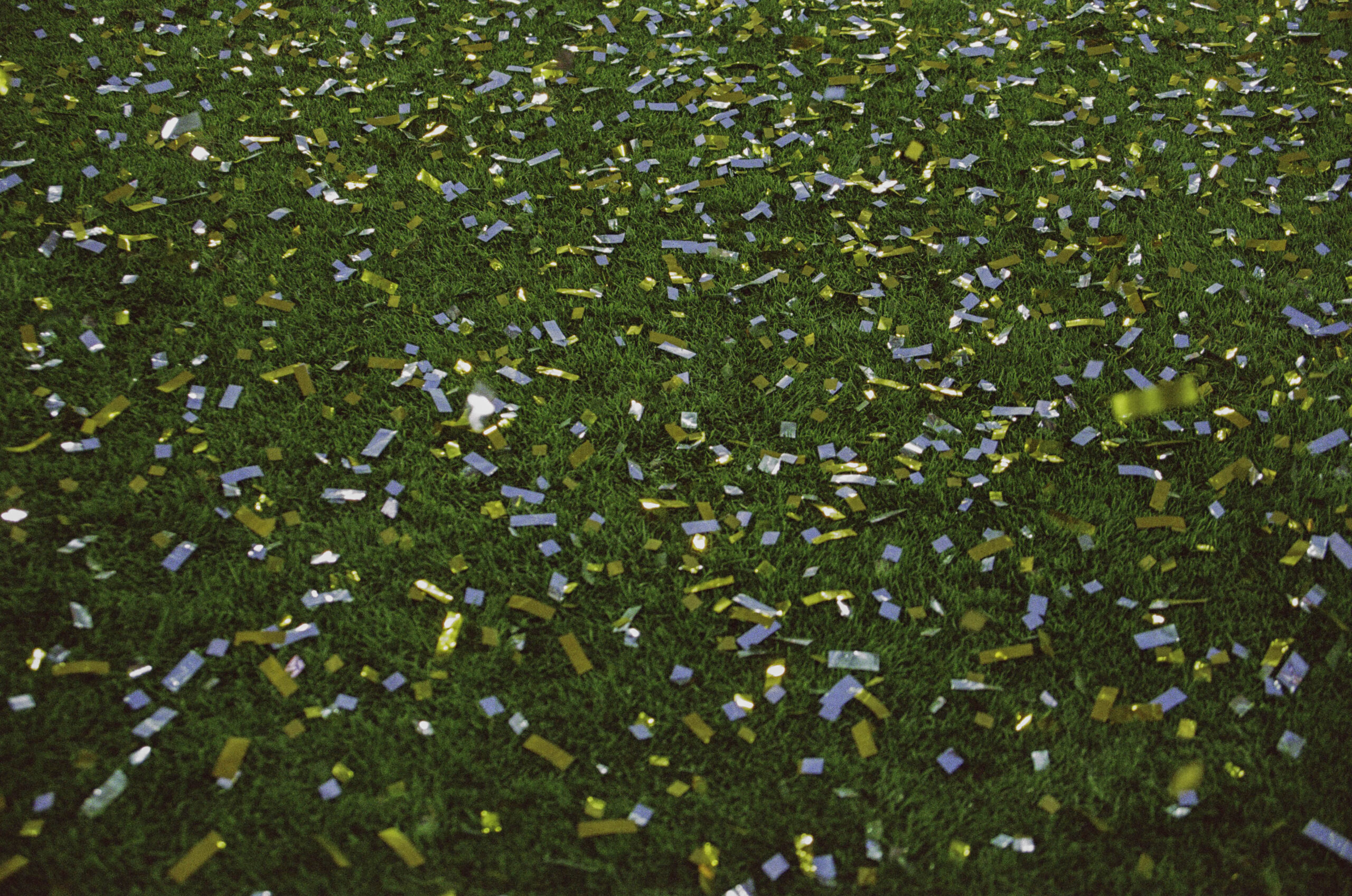
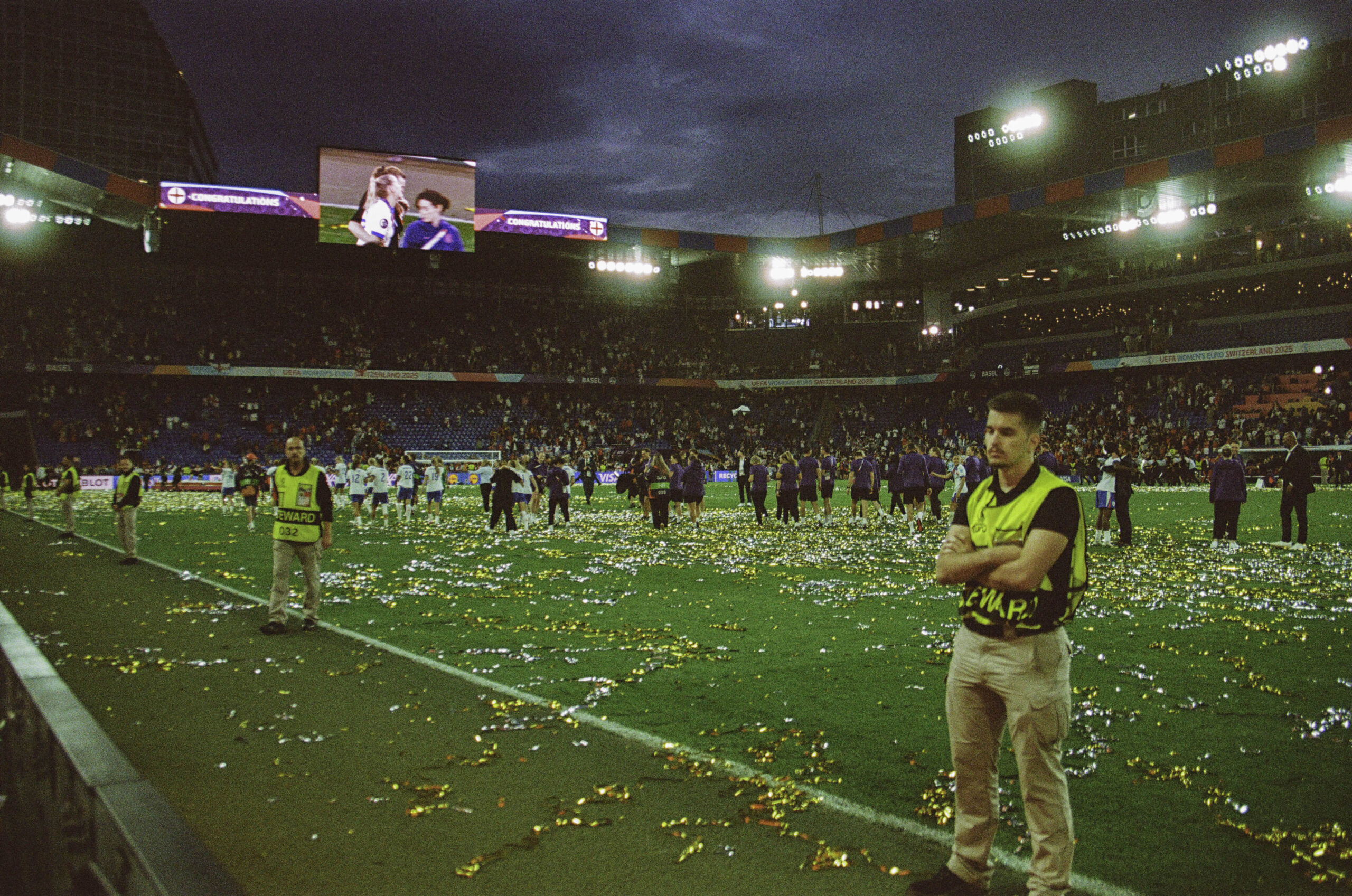
Glitter settles where studs once carved grooves – silver and gold rectangles scattered like lost pixels on a grass screen still damp with sweat, rain, and history. Each shard caught a different moment: Hampton’s leap, Kelly’s sprint, a thousand fists punching skyward. Now they lie quiet, tiny trophies waiting for ball kids to pocket, for groundskeepers to curse gently as they comb the pitch at 2 a.m. Under the floodlights the colours refuse to mute, winking back at the empty tiers as if to say the match is over but the echo isn’t. Tomorrow this lawn will look immaculate again, stripes repainted, divots healed, but somewhere beneath the cut blades a sliver of foil will survive, proof that once – just once – an ordinary rectangle of turf was the centre of the football universe.

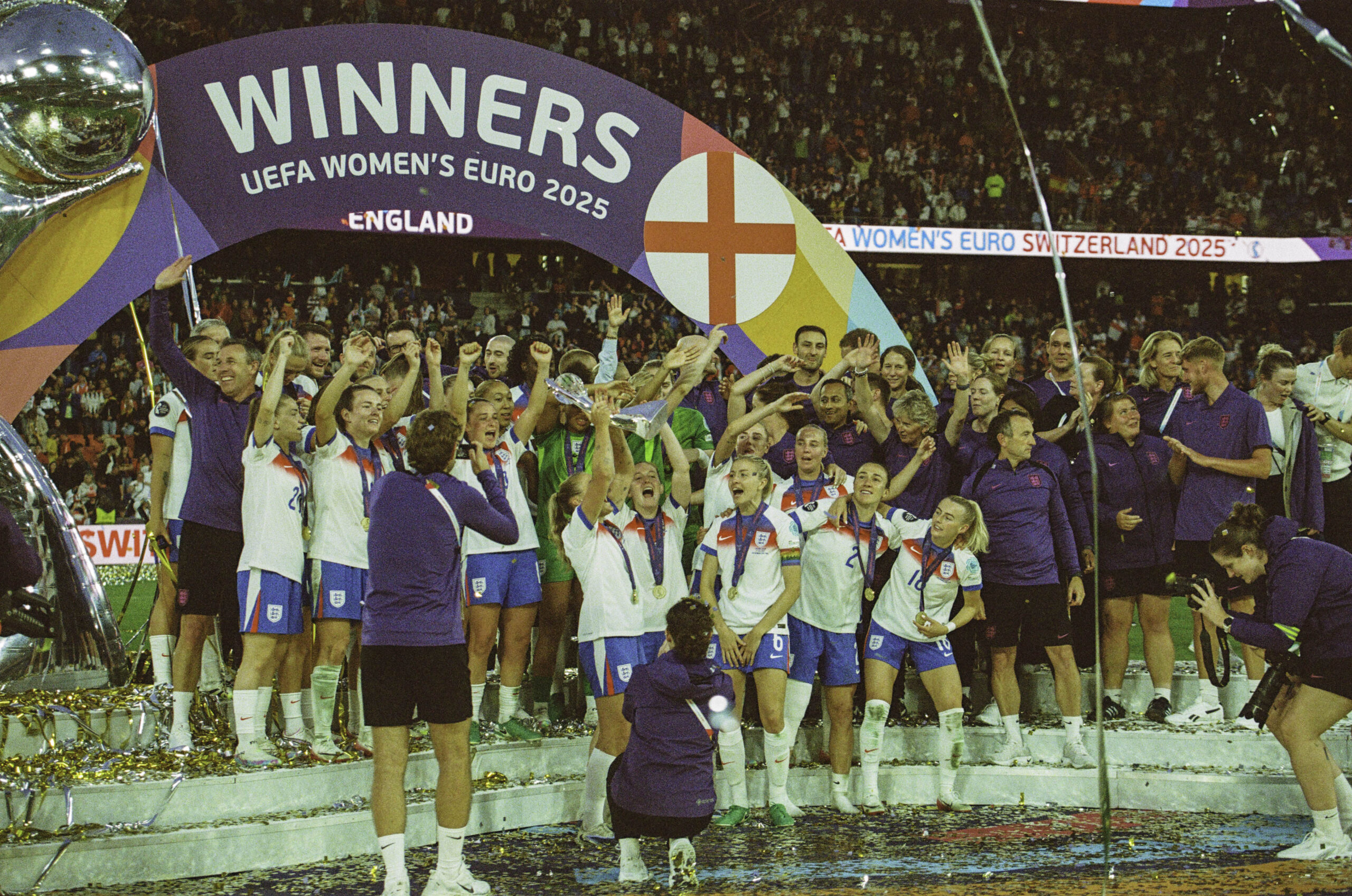
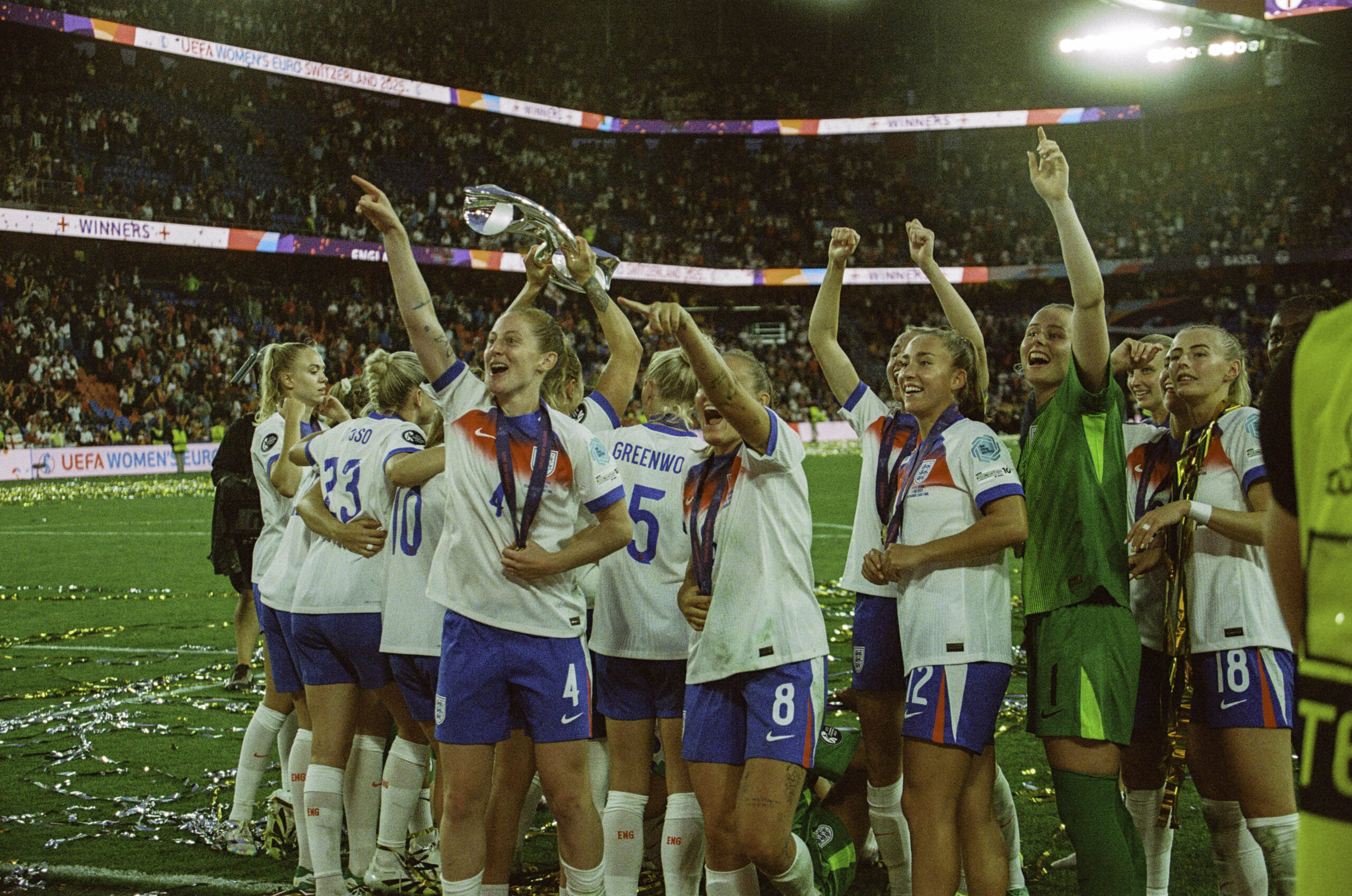
England finally corrals its delirium into one silver-rimmed frame: A player hoists the trophy sky-high, medals flash like tiny floodlights and every arm – players, physios, analysts – rises in unchoreographed sync. Behind the arch that reads WINNERS, a wall of red-and-white flags ripples approval, while on the podium boots slip in the confetti slurry and the team photographers click shutters. After 120 bruising minutes and one nerve-shredding shoot-out, the night distils to this single upward thrust, a country’s long-bottled cheer finally uncorked.

A fresh wave of cheers ripples across the pitch as a knot of Lionesses pivots toward the goal line, index fingers shooting skyward. Someone in the stands – mum, mate, academy coach – has just hollered their name, and for a heartbeat the medal-heavy huddle turns personal. Keira Walsh (4) hugs the sliver of silver to her chest, Georgia Stanway (8) throws a point and a grin into the twilight, while Hannah Hampton, still padded in green, laughs behind them like she’s forgotten the gloves ever mattered. Confetti clings to stud socks, floodlights gleam off the trophy’s spiral, and an ocean of familiar faces answers back, proving that even at the summit you still look for the people who lifted you there.

‘Sweet Caroline’ rolls down from the few thousand voices still inside St-Jakob Park, and the Lionesses answer with a circle shuffle in the confetti. Lucy Bronze punches the air on every “so good!”, Alex Greenwood swings Leah Williamson by the medal ribbon, and Anna Moorhouse taps the crest on Keira Walsh’s back to keep the beat. Phones flash, kit managers dodge stray boots, and a groundsman waiting to sweep can’t help but clap along. It’s not choreography, just instinct – legs that chased for 120 minutes now bouncing on adrenaline alone, echoing the terrace anthem that carried them here..

The party drains toward the exits, but the pitch still glitters like a shaken snow-globe: gold and silver strips stuck to wet blades, clinging to boot studs, whispering under every step. Stewards form a loose cordon – arms folded, radios quiet – watching the stragglers in purple victory tees pose for one last selfie beneath the CONGRATULATIONS ribbon looping the big screen. Out past the penalty spot, a lone England player corrals family for hugs while a groundskeeper wades through tinsel with a leaf-blower he hasn’t switched on yet; no one wants to silence the night just yet. Up in the stands the seats are mostly bare, but a pocket of white shirts still sings, their echo drifting across a stadium that already feels bigger, emptier, the moment shrinking to embers while the confetti keeps pretending it’s still raining gold.

Post

Lights dim, echoes linger
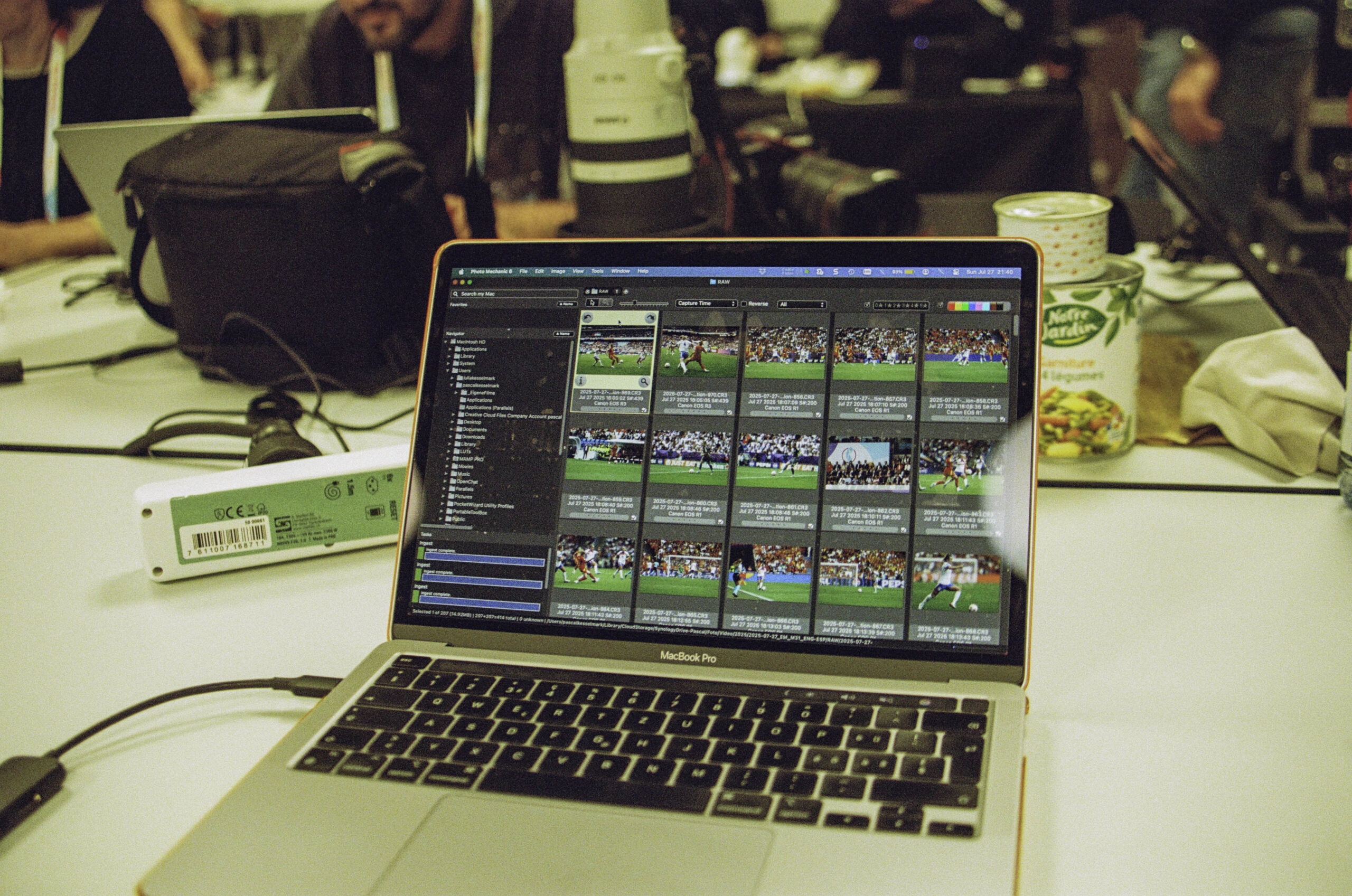
It’s barely 22 o’clock, yet Photo Mechanic is already building thumbnails while progress bars skitter across the MacBook screen – this is the shift when the pictures finally turn back into rent. Around me the once-deserted media hub hums to life again: rain-damp photographers slumping into plastic chairs, reporters dictating ledes between mouthfuls of stadium pretzel, the air thick with the mixed scent of lens cloth, instant coffee and victory champagne someone hurriedly wiped off a memory card. Amid laptops and 400-millimetre barrels sits the evening’s most inexplicable still life: a lonely tin of mixed vegetables, dropped there by a colleague who clearly traded dinner for deadline. No one questions it; deadlines swallow etiquette the way our caption templates swallow keywords. In fifteen minutes the agency server will ping back its first green ticks, and a tiny slice of tonight’s chaos will already be scrolling under a stranger’s thumb.

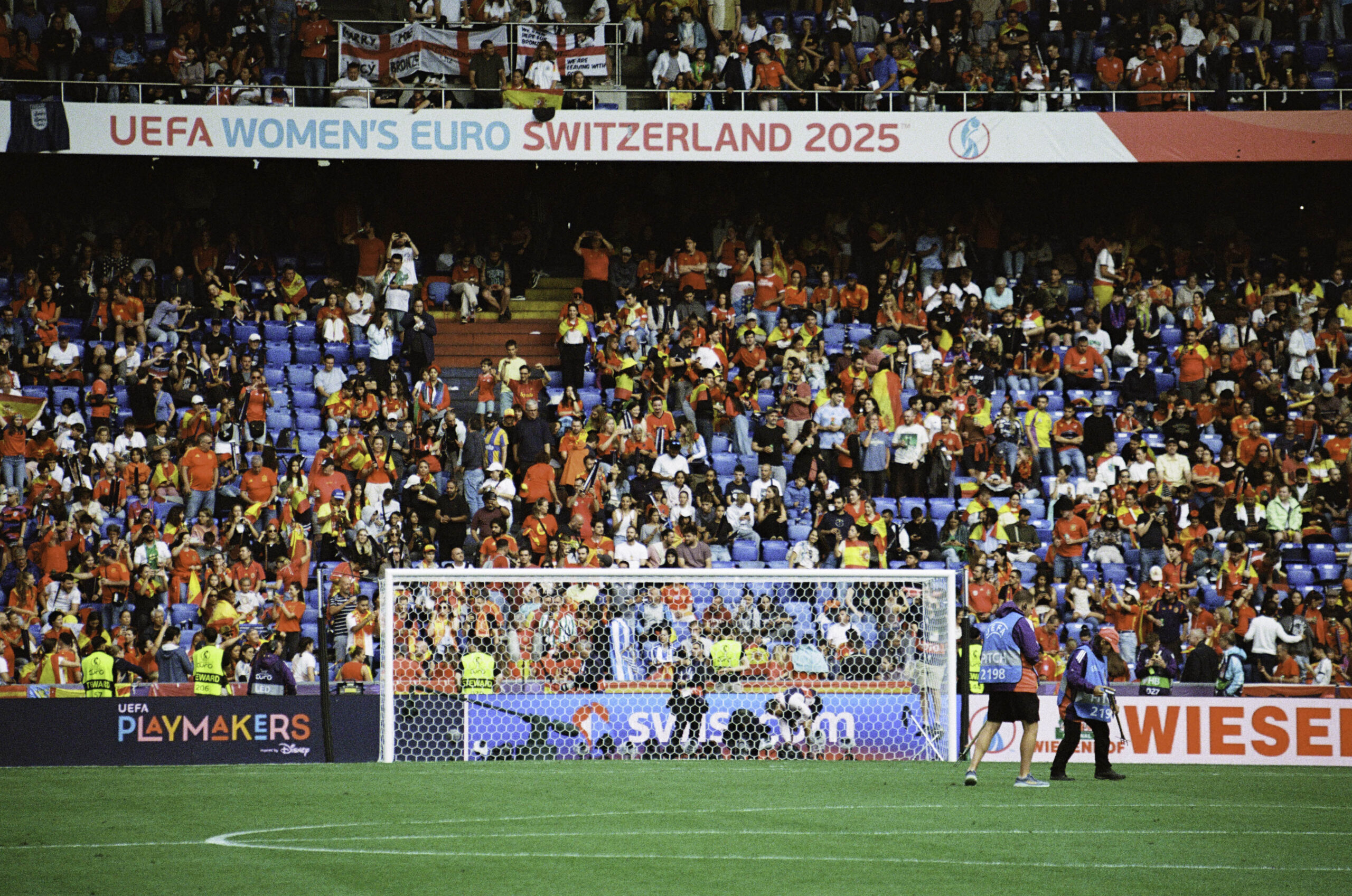
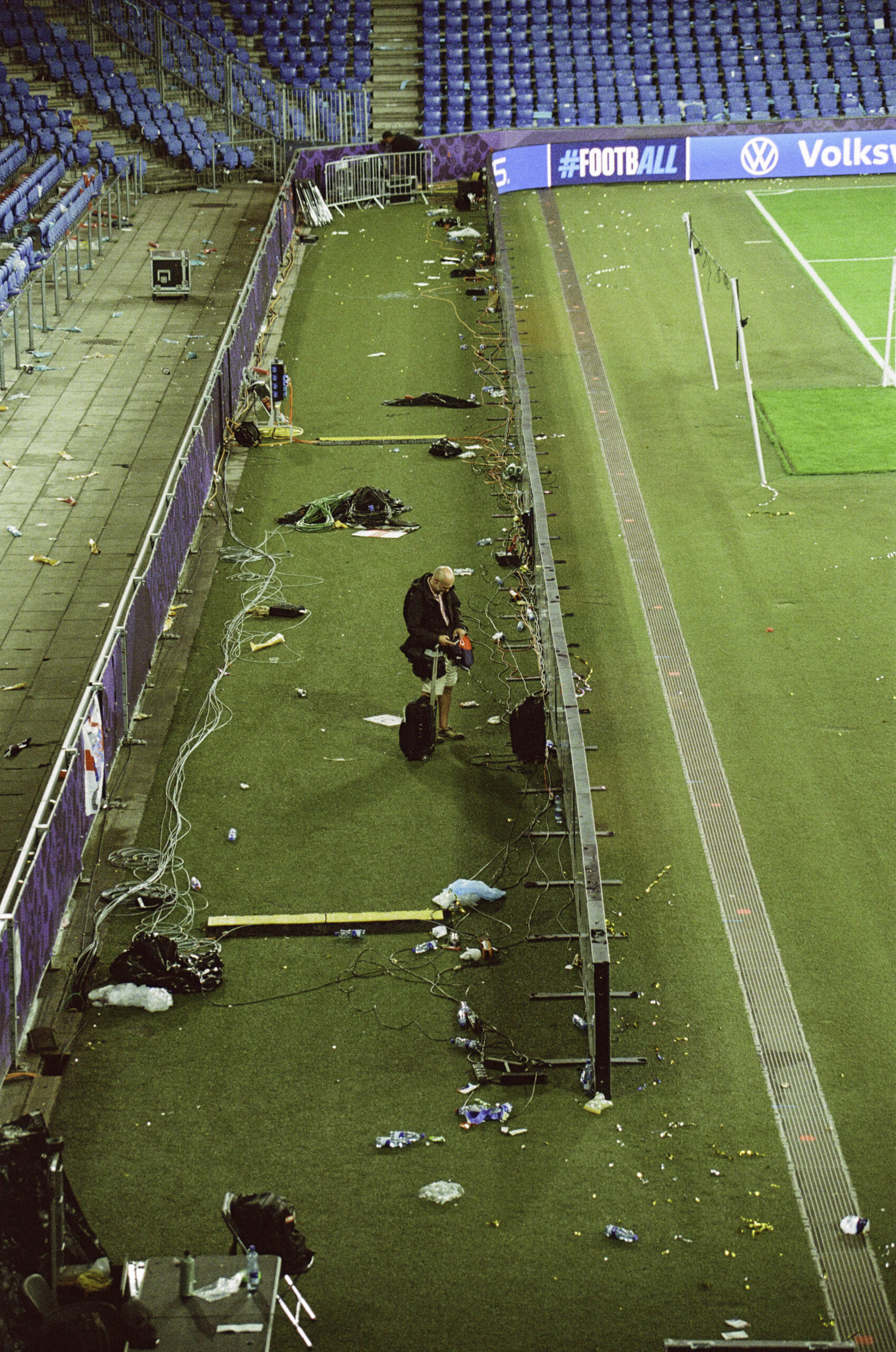
Two hours after the trophy kiss the pitch looks less like a stage than a crime scene: confetti shards glitter like broken glass, empty water bottles roll in the night draft, and the once-neat cable runs snake across the goalline in knotted heaps. High in the bowl a single LED ribbon still blinks “#FOOTBALL” to no one, while down below one lone photographer compresses the day into a roller case, unthreading Ethernet, folding the little camping stool that has been his front-row throne since lunch. Each tug on a cable sends a shiver through the debris, nudging crushed beer cups and soggy ponchos toward the gutter. The echo chamber that swung between “Sweet Caroline” and Spanish drums is now so quiet that his Velcro lens pouch sounds like a rip-cord. He zips the case, glances once at the empty stands – blue seats littered with half-folded flags – and wheels the Europeans last story into the tunnel, leaving the stadium to its janitors and the soft, metallic crunch of confetti under their boots.

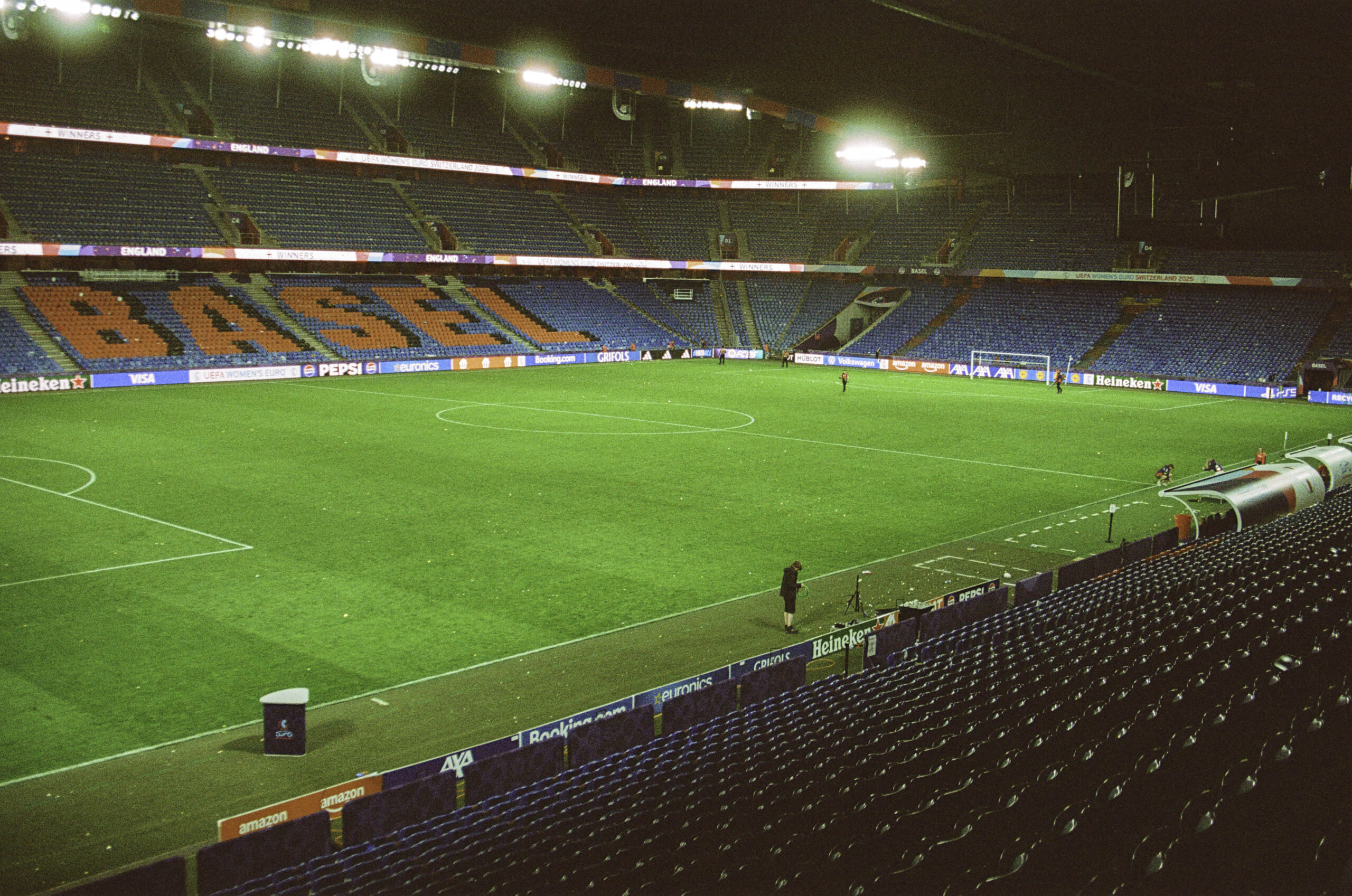
Midnight: the Joggeli is almost empty save for three ground-staff with backpack blowers. They herd the silver-and-gold confetti across the grass in slow, swirling drifts – exactly the way park crews chase leaves along an October path – until every fleck is banked against the far advertising hoardings. The ribbon boards still loop “ENGLAND ● WINNERS” in mute celebration, but the seats spell only B A S E L, rows of vacant blue stepping up into the dark. Some volunteers, staff or crew squeezing at the center line the very last frame out of the night. Above them, the stadium lights hum on full power, illuminating a stage already reset for next stories.

*** the end ***

So maybe that’s the quiet magic of two rolls and seventy-two unknown frames: you press the shutter, walk away with nothing but the afterimage glowing in your skull, and for hours – sometimes days – you live in that charged uncertainty, picturing how the grain might catch the floodlights, how the focus might just miss or miraculously nail, the way a lottery ticket fuels castles of possibility until the draw, whereas digital shows its hand in an instant and the wonder evaporates at exactly the moment the proof arrives.

If you like this project – which was not free and about 30 hours of work – then please share it on your Instagram account. That’s all I want and I can promise you, there will me more seventy2frames in the future.